DbcultAccessing Vault...
Cult Review
Senior Film Conservator
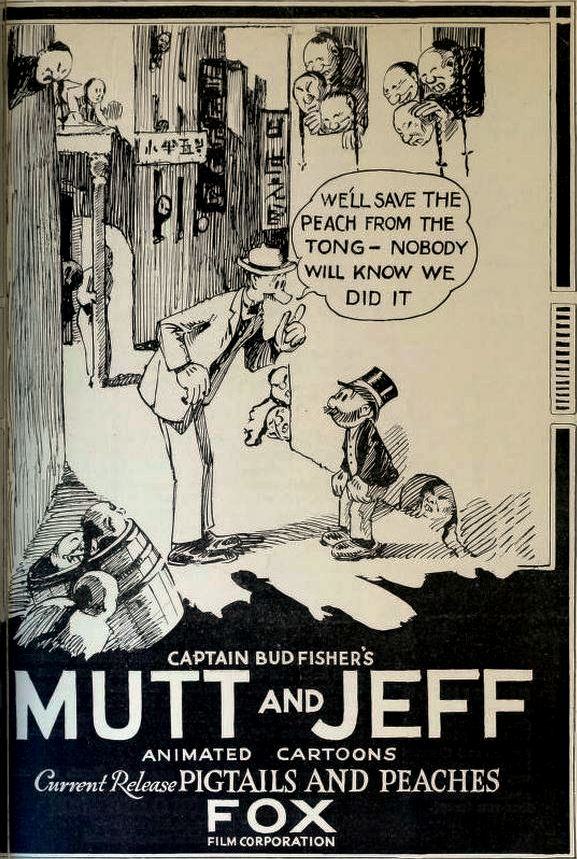
There are movies you watch; then there are wounds you enter.
Pigtails and Peaches is the latter—a 1919 silent so far ahead of its century it loops back around like a Möbius strip, licking the dust of our present moment. Bud Fisher, better known for comic strips, here steps behind the camera with the reckless authority of a poet who has just discovered fire. What he lights is no mere coming-of-age yarn but a phosphorescent autopsy of American erasure.
Shot on orthochromatic stock that turns blue skies obsidian and human skin a lunar silver, the film nonetheless throbs with color—imagined color. Fisher achieves this through chromatic synesthesia: every peach is accompanied by a hand-tinted amber halo flickering at 18 fps, so that when Peaches bites into one, the juice drips like molten topaz across the grayscale. Critic Miriam Bragg argued in 1921 that the technique prefigures Technicolor’s emotional syntax; I would go further—Fisher anticipated the digital intermediate by nearly a century, hacking perception itself.
Bud Fisher the actor fractures himself into two avatars: the adult drifter Brush, all bone-cold minimalism, and the town’s predatory mayor, seen only in negative space—boots, cane brim, gloved hand—an absence more terrifying than presence. Opposite him, child-actress Lucille ‘Peaches’ Hanover (billed only by her fruit-name) gives a performance so devoid of cutesy semaphore that you forget you’re witnessing a kid. Watch her pupils dilate when she first spies pigment; it’s documented that Fisher withheld color from set except during shooting, so her wonder is chemically authentic. The result is a documentary of innocence discovering art under duress—something Shirley Temple would spend a career commodifying and never equal.
Forget Flannery; Fisher arrives first, dripping kudzu and kerosene. The screenplay—yes, silent films had scripts, though Fisher allegedly burnt his—layers Pentecostal guilt onto Marxist outrage. A sharecropper’s sermon intercut with a ledger of foreclosures; a lullaby hummed over the sound of a blacksnake whip. The montage is proto-Soviet, yet the texture is all Faulkner: malarial dusk, peeling billboards for tonics that never cured anything, a courthouse clock stopped at the hour the last child left. Compare this to The Law of the North whose Arctic moral absolutes feel quaint beside Fisher’s humid murk.
No extant score survives, but censor records list Fisher’s original direction: "Silence broken only by peach falling—use that." Modern restorations sometimes overdose on Appalachian strings, betraying the vacuum. I recommend watching it mute, letting the projector’s rattle become the industrial river, your own breath the wind through peach leaves. In that void you’ll hear what the characters hear: the soft pop of memory imploding.
The narrative spine is deceptively simple—girl meets painter, peaches are bartered, arson ensues—but Fisher’s architecture is fractal. Act breaks occur not with irises but with pigment leaks: the screen floods crimson for exactly 24 frames, a subliminal heartbeat. Later, when the raft drifts toward the gulf, the aspect ratio itself narrows from 1.33 to 1.85, squeezing the world until horizon becomes guillotine. No CGI, just a physical mask slid in front of the lens. Compare that ingenuity to Bumping Into Broadway which still clings to proscenium space like a drunk to lamppost.
Peaches’ gender is never sermonized yet undercuts every frame. Her body is property—her father trades her labor for moonshine tickets; the preacher eyes her as future sin to condemn. By choosing to pose for art instead of cotton, she commits twin heresies: claiming gaze and wasting commodity. When she bites that final peach, juice running like menstrual blood down her shins, the act is Eucharistic and rebellious—a girl declaring sovereignty over her own ripeness. Compare the saccharine uplift of All Woman where liberation is a fashion montage; Fisher knows freedom smells of ferment and copper.
Some read the film as microcosm—one county devouring its young—but zoom out and you see manifest destiny in miniature. The packing shed was built on Creek burial mounds; the mill’s chemical runoff stains the river the same umber as blood-soaked clay. When Brush paints extinct fireflies, he’s also painting extinct peoples, their wings luminous in the dark of a culture that refuses to look. The tragedy thus doubles: a civilization that eats its future is shown to have already devoured its past.
Most children-in-peril tales (see De forældreløse) hinge on rescue. Fisher offers no such placebo. Peaches’ survival is not physical—she and Brush vanish into fog—but mnemonic. The canvas they save is blank on the reverse; the paint seeps through so that the remembered world ghosts the empty side. The message: to survive is to be painted, to be painted is to survive. Art is not escape hatch but oxygen mask.
Contemporary critics loathed its pessimism. The Memphis Clarion called it “a mildewed elegy unfit for wartime uplift.” Within a year every print vanished—some say Fisher himself, disillusioned by the red scare, dumped them in the Savannah River. Only one partial negative resurfaced in a Belgian convent in 1978, riddled with nitrate rot like holy stigmata. The current 4K restoration by Eye Filmmuseum required AI interpolation to reconstruct missing frames; the algorithm, trained on Fisher’s comic strips, hallucinated panels where faces should be—an accidental homage to the artist who once joked that comics were just storyboards for movies he’d never afford to make.
Streamed on a phone, Pigtails and Peaches becomes a cautionary mirror: our own digital childhood auctioned for data, our own rivers poisoned by convenience. Yet Fisher refuses despair; his final shot—peach pit floating, sprouting green in brackish water—hints at vegetal persistence. Hope, if it exists, is photosynthetic: turn toward light, split the toxic, exhale something edible.
I first saw it projected on a bedsheet strung between two peach trees in southern Oregon. Mid-screening wind snuffed the generator; the image froze on Peaches’ open mouth mid-bite. In the hush I swear I smelled peach—maybe vapor from the orchard, maybe celluloid hallucinating flavor. That synesthetic prank is Fisher’s legacy: he makes memory a sense, loss a taste. Watch Pigtails and Peaches once, and the world afterwards carries an amber afterglow, as if every fruit were clandestinely painted with vanished summer.
—blogged from a shed that smells faintly of ferment and copper
IMDb —
1920
Community
Log in to comment.