DbcultAccessing Vault...
Cult Review
Senior Film Conservator
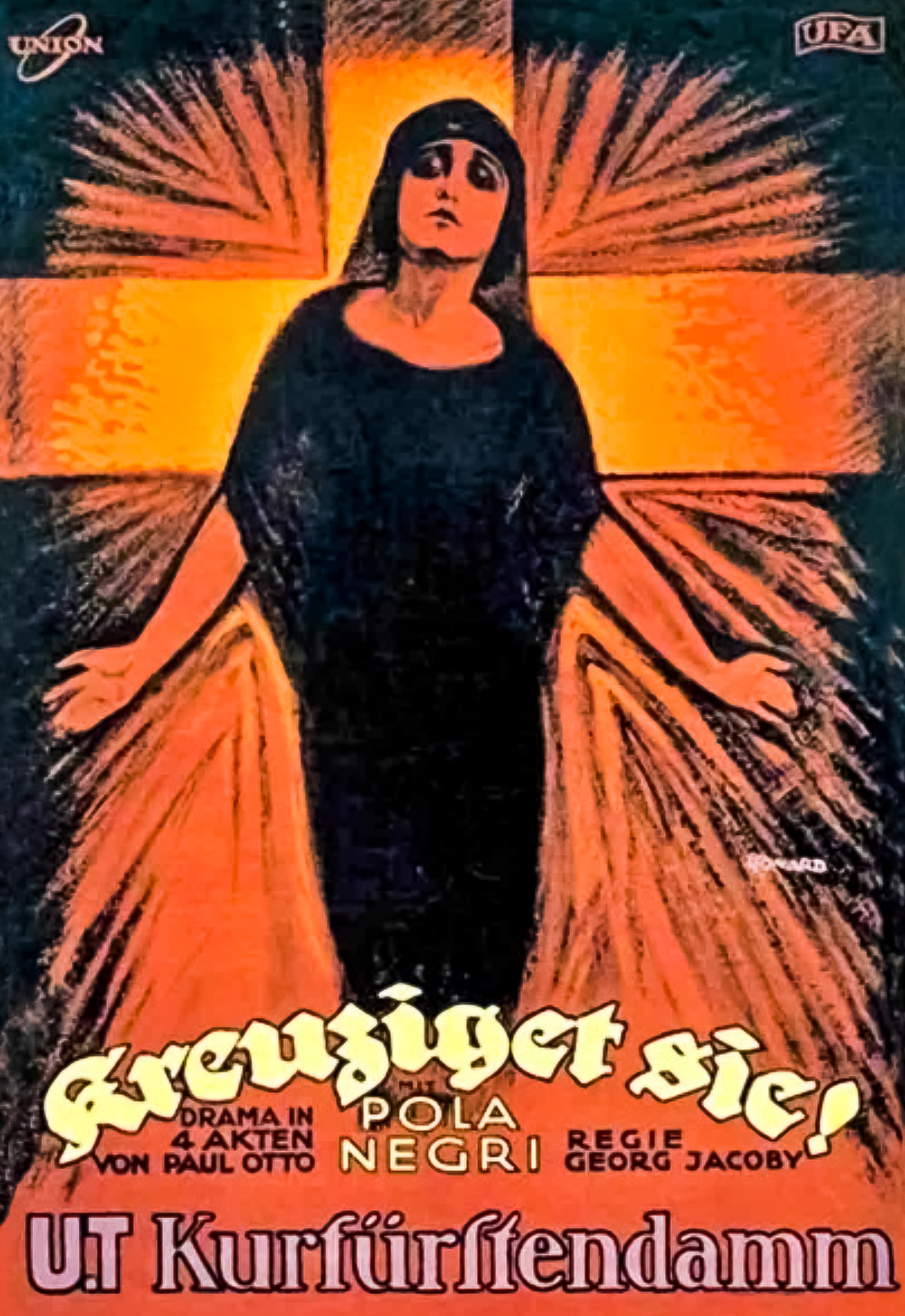
In the tumultuous landscape of post-Great War German cinema, where the embers of expressionism were just beginning to glow, a film emerged with a title that cut like a knife: Kreuzigt sie! (Crucify Her!). This 1919 silent drama, penned by the masterful Paul Otto, stands as a stark, unflinching mirror to the darker impulses of humanity, specifically the ease with which a society can be whipped into a frenzy of condemnation. It's a narrative that, even a century later, retains its chilling resonance, exploring the devastating power of public opinion when fueled by malice and misinformation. Far from a mere historical curiosity, this picture is a profound psychological study cloaked in the dramatic flourishes characteristic of its era, demanding attention for its potent social commentary and the sheer force of its lead performance.
At the very epicenter of this maelstrom of injustice is the magnetic Pola Negri, embodying the role of Eva, a celebrated opera singer whose artistic brilliance is tragically overshadowed by a meticulously orchestrated downfall. Negri, a titan of the silent screen, delivers a performance of such raw vulnerability and fierce defiance that it elevates the entire production. Her portrayal of Eva is not merely that of a victim; she is a woman of immense spirit, whose initial shock and despair gradually harden into a steely resolve, even as the world conspires to crush her. The nuances of her expressions, the subtle shifts in her posture, and the profound sorrow etched onto her features communicate volumes without a single spoken word. It’s a masterclass in silent acting, showcasing her unparalleled ability to convey complex emotional states, from the heights of artistic triumph to the depths of public humiliation. Her Eva is a figure of tragic grandeur, reminiscent in her suffering and public scrutiny to the titular character in Camille, though Eva's plight stems from external malice rather than internal moral conflict. Negri’s ability to elicit profound empathy for her character is truly remarkable, drawing the audience into Eva's nightmare with an almost unbearable intensity, making her struggle feel deeply personal and universally resonant.
The film’s narrative engine is largely driven by the machinations of its antagonists, particularly Wilhelm Diegelmann as the formidable Herr von Hagen. Diegelmann imbues von Hagen with a chilling blend of aristocratic arrogance and vindictive malice. His portrayal is a study in quiet, calculated cruelty, making his character a truly loathsome figure whose wounded pride fuels a destructive campaign against Eva. He is not a mustache-twirling villain, but rather a man of immense power who wields societal influence as a weapon, a stark reminder of how easily authority can be corrupted. His cold, unyielding demeanor creates a palpable sense of dread, making his presence on screen a constant source of tension. The insidious nature of his plot, a blend of personal vendetta and social manipulation, feels disturbingly real.
Lotte George, as the jealous stage manager Greta, provides a crucial foil to Negri’s Eva. Her performance is a nuanced depiction of envy and betrayal, her subtle sneers and furtive glances speaking volumes about her character's insidious nature. Greta's complicity in von Hagen's scheme highlights the devastating impact of petty jealousies, transforming a professional rivalry into a catalyst for an innocent woman's destruction. The dynamic between George and Negri is fraught with unspoken tension, a testament to their acting prowess and the script's ability to craft complex female relationships, even when one is driven by pure malevolence.
Providing a much-needed beacon of hope and justice is Harry Liedtke as Paul, the idealistic young journalist. Liedtke brings a refreshing earnestness to his role, portraying Paul's gradual awakening to the truth with conviction. Initially swayed by the sensationalism, Paul’s journey from a passive observer to an active investigator is compelling. His burgeoning belief in Eva's innocence and his courageous efforts to expose the conspiracy offer a powerful counterpoint to the pervasive cynicism and mob mentality. Liedtke's portrayal grounds the melodrama with a sense of genuine moral urgency, making his character's quest for truth both believable and inspiring. One might draw parallels to the determined investigator in The Rogues of London, though Paul's fight is more against systemic injustice than organized crime, requiring a different kind of bravery.
The ensemble cast further solidifies the film's dramatic integrity and its portrayal of a society in flux. Paul Hansen, perhaps as a cynical newspaper editor or a high-ranking, easily swayed official, embodies another facet of the societal forces arrayed against Eva, reflecting the ease with which influential figures can be misled or corrupted. Magnus Stifter, with his imposing presence, likely portrays a stern, unyielding judge or prosecutor, whose rigid adherence to flawed evidence personifies the institutional blindness to truth. Albert Patry, perhaps as the socialite whose jewels are supposedly stolen, adds another layer of superficiality and misguided certainty to the public outcry. Victor Janson’s role, whether as a police inspector or another official, contributes to the oppressive atmosphere of the legal system bearing down on Eva. And Hermann Picha, often known for comedic roles, here likely adds a touch of the everyday citizen, embodying the easily swayed public, their faces contorted by rumor and groupthink. Each actor, in their silent pantomime, contributes to the rich tapestry of a society grappling with its own capacity for both cruelty and compassion, making the world of Kreuzigt sie! feel remarkably complete and unsettlingly familiar.
Paul Otto's screenplay for Kreuzigt sie! is a masterclass in dramatic construction. The narrative unfolds with a relentless, almost suffocating pace, ratcheting up the tension as Eva's situation becomes increasingly dire. Otto meticulously builds the case against Eva, making the fabricated evidence seem chillingly plausible, thus immersing the audience in the terrifying reality of her predicament. The dialogue, conveyed through intertitles, is sharp and impactful, driving the plot forward without unnecessary exposition. Otto doesn't shy away from depicting the ugliness of human nature, yet he also skillfully weaves in moments of hope and resilience, preventing the film from descending into utter bleakness. This careful balance ensures that while the film is a powerful indictment of societal flaws, it also celebrates the enduring human spirit and the possibility of truth prevailing, however arduous the journey.
The thematic richness of Otto's writing is particularly noteworthy. He deftly explores the perils of unchecked power, the destructive force of public hysteria, and the fragility of reputation. The film serves as a potent critique of a society quick to condemn based on superficial evidence and rumor, echoing the social commentary found in films like The Morals of Marcus, which similarly scrutinizes societal judgment and the arbitrary nature of moral codes. The title itself, a direct command, encapsulates the film's central theme: the collective desire to punish, often without due process or genuine understanding. It’s a chilling reminder of the historical instances where public fervor has led to profound injustice, making the film's message timeless. The urgency of Paul's quest for justice also brings to mind the directness and resolve seen in films like One Shot Ross, where a singular focus on righting a wrong drives the entire narrative.
While specific directorial credits are sometimes obscured by the passage of time for films of this vintage, the visual language of Kreuzigt sie! speaks volumes about a production team acutely aware of the power of cinematic expression. The cinematography, though rudimentary by modern standards, effectively utilizes light and shadow to enhance the dramatic tension. Close-ups on Negri’s face amplify her emotional torment, drawing the audience intimately into her suffering. The bustling cityscapes and grand opera house sets provide a stark contrast to the claustrophobic feeling of Eva’s impending doom, effectively establishing the societal context against which her personal tragedy unfolds. The film doesn't rely on flashy camera work but rather on meticulously composed shots that convey mood and narrative information with remarkable clarity. The use of deep focus in certain scenes allows for multiple layers of action, subtly revealing character reactions or impending threats.
The production design and costuming further immerse the viewer in the opulent yet morally ambiguous world of early 20th-century German society. Eva's elegant gowns in the early scenes underscore her status and grace, making her later degradation all the more poignant. In contrast, von Hagen's somber, authoritative attire reinforces his power and unyielding nature, a visual shorthand for his unassailable position. The visual aesthetics, while perhaps not as overtly expressionistic as later German films, nonetheless contribute significantly to the film's emotional impact. The careful attention to detail in creating a believable world, even when the narrative itself delves into heightened melodrama, is a testament to the craftsmanship of the era. The high stakes and dramatic turns, visually conveyed, also bring to mind the tension present in a film like The Ship of Doom, where every frame is charged with impending crisis and the characters are often at the mercy of overwhelming forces. The film's pacing, achieved through judicious editing and the rhythm of intertitles, masterfully controls the audience's emotional journey, building suspense and releasing it with impactful dramatic beats.
More than a century after its release, Kreuzigt sie! remains a compelling and, at times, discomforting watch. Its exploration of mob mentality, the abuse of power, and the devastating consequences of false accusations is as relevant today as it was in 1919. In an age dominated by social media and instant judgments, the film serves as a powerful cautionary tale about the dangers of quick condemnation and the importance of seeking truth over sensationalism. The journey of Paul, the journalist, reminds us of the crucial role of investigative integrity in challenging prevailing narratives, a theme that resonates even in contemporary storytelling, where the line between truth and propaganda is often blurred. One might even see echoes of its spirit in the ambition and moral quandaries depicted in La fièvre de l'or, though the contexts differ greatly, both speak to the corrupting influence of power and desire.
The film's impact is indelibly linked to Pola Negri’s unforgettable performance. Her star power, even in a role that plunges her character into profound suffering, shines brightly, solidifying her status as one of silent cinema’s most enduring icons. The film's ability to evoke such strong emotions through purely visual means is a testament to the artistry of silent film, often underestimated in modern discourse. It's a powerful reminder that compelling storytelling transcends spoken dialogue, relying instead on the universal language of human emotion and dramatic spectacle. This narrative of a wronged individual fighting against a powerful system also finds a spiritual kinship with the themes of justice and redemption found in films like Bogdan Stimoff, showcasing a timeless human struggle against overwhelming odds.
In its harrowing depiction of an innocent woman caught in the crosshairs of societal prejudice and personal vengeance, Kreuzigt sie! leaves an indelible mark. It’s a film that challenges its audience to look beyond the surface, to question authority, and to champion justice even in the face of overwhelming opposition. For aficionados of silent cinema, or anyone interested in the foundational narratives that shaped cinematic storytelling, this is an essential viewing experience. It’s a powerful, often unsettling, but ultimately profoundly rewarding journey into the heart of human fallibility and resilience. The enduring power of its narrative, coupled with the incandescent performances, secures its place as a significant work within early German cinema. While other films like With Neatness and Dispatch might offer a lighter take on justice, Kreuzigt sie! dives into its darkest, most tragic implications with an unwavering gaze. It is a cinematic experience that resonates long after the final frame fades to black, a testament to the potent storytelling of a bygone era, and a chilling reminder of the fragility of truth in the face of collective fury.
IMDb —
1914
Community
Log in to comment.