DbcultAccessing Vault...
Cult Review
Senior Film Conservator
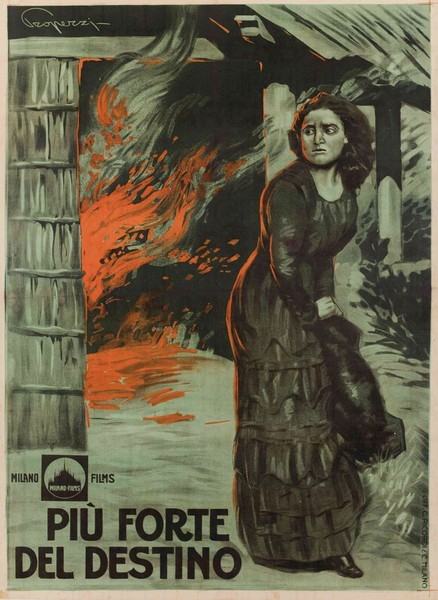
In the annals of early 20th-century cinema, where narrative often wrestled with the nascent technical limitations of the medium, certain films emerge as incandescent beacons, transcending their era to speak to universal truths. "Più forte del destino," an Italian silent drama from a period brimming with artistic fervor, is precisely such a work. Its very title, "Stronger Than Fate," is a clarion call, an audacious declaration of human resilience against the capricious whims of destiny. This cinematic offering, while perhaps less frequently discussed than some of its more internationally distributed contemporaries, possesses an emotional gravitas and narrative sophistication that demands reappraisal.
The film plunges us into a world where societal strictures and personal ambition conspire to thwart genuine affection. At its heart lies the poignant romance between Elena, portrayed with exquisite fragility and inner strength by Tina Martini, and Giovanni, brought to life with earnest intensity by Amedeo Chiantoni. Their love, a tender bloom in a harsh landscape, is immediately imperiled not merely by the conventional obstacles of class or fortune, but by the insidious machinations of Baron Von Richter. Ugo Gracci, in a performance that bristles with understated menace, crafts a villain whose malevolence is less overt theatricality and more a chilling, calculating desire. The Baron's obsession with Elena forms the central pivot of the narrative's tragic trajectory, setting in motion a series of events that test the very fabric of human endurance and fidelity.
The plot, while steeped in the melodramatic conventions prevalent in silent cinema, is executed with a nuanced understanding of human psychology. Giovanni's wrongful imprisonment, a consequence of the Baron's meticulously planned subterfuge, serves as the initial cataclysm, tearing apart the nascent happiness of the lovers. This act of injustice is not merely a plot device; it is a profound exploration of societal vulnerability and the corrupting influence of power. Elena's subsequent dilemma – her mother, Maria (Teresa Boetti Valvassura, delivering a performance of quiet pathos), on the verge of death, requiring costly medical aid – forces her into an agonizing choice. Her decision to marry the Baron, a sacrifice born of desperation and filial devotion, resonates with a profound, almost biblical, sense of tragedy. This is not a choice made lightly or out of weakness, but a testament to a love so expansive it encompasses both romantic devotion and familial duty, a theme also explored with varying degrees of success in films like The Unwelcome Mother, albeit with a focus more squarely on maternal bonds.
The return of Giovanni, a man hardened by suffering and injustice, forms the crucible of the film's middle act. His perception of Elena in the Baron's opulent world, a vision of what appears to be betrayal and willing capitulation, shatters his spirit anew. This misunderstanding, a classic dramatic trope, is handled here with a delicate touch, allowing the audience to feel the full weight of Giovanni's despair without reducing him to a caricature of blind rage. His subsequent retreat from society, his transformation into a solitary, embittered figure, speaks volumes about the corrosive nature of perceived perfidy. It’s a narrative arc that finds echoes in the grand tragic operas, where miscommunication and circumstance often lead to devastating outcomes, much like the intense emotional landscape depicted in Carmen (1915), though "Più forte del destino" maintains a more grounded, less operatic, sense of personal tragedy.
The performances in "Più forte del destino" are a masterclass in silent film acting. Tina Martini, as Elena, conveys a breathtaking range of emotions through subtle gestures, expressive eyes, and a posture that shifts from hopeful buoyancy to crushed resignation. Her internal torment is palpable, a silent scream that reverberates through the screen. Amedeo Chiantoni’s Giovanni, initially radiating youthful exuberance, transforms convincingly into a man burdened by fate, his movements becoming heavier, his gaze more haunted. Ugo Gracci's Baron is a study in restrained villainy; his power lies not in bombastic declarations but in the chillingly calm execution of his schemes. The supporting cast, including Pina Fabbri and Attilio Fabbri, contribute to the rich texture of this cinematic world, each playing their part in the intricate dance of fate and free will.
The direction, while uncredited to a specific individual in the provided information, demonstrates a keen understanding of visual storytelling. The use of dramatic chiaroscuro, the careful framing of emotionally charged close-ups, and the kinetic energy of certain sequences all contribute to the film's immersive quality. The mise-en-scène is meticulously crafted, with lavish sets and period-appropriate costumes that transport the viewer to early 20th-century Italy. The film’s pacing, a critical element in silent cinema, builds slowly but inexorably towards its dramatic climax, allowing the audience to fully invest in the characters' plights. There's a particular skill in how the film manages to convey complex emotional states without dialogue, relying instead on the universal language of human expression and carefully constructed visual metaphors. This attention to visual detail and emotional depth elevates the film beyond mere melodrama, placing it firmly in the realm of art. One could draw parallels to the atmospheric tension and intricate plotting found in films like Mysteries of London, though "Più forte del destino" focuses its lens more intensely on the personal, psychological drama rather than the broader social tapestry.
At its core, "Più forte del destino" is a profound meditation on the themes of resilience, redemption, and the ineluctable force of love. The titular assertion is not merely a poetic flourish but the very essence of the film's philosophical underpinning. Elena's unwavering, albeit hidden, love for Giovanni, even as she endures a life of silent suffering, is a testament to the enduring nature of true affection. Giovanni's eventual discovery of the truth, spurred by the loyalty of Pietro, is not just a narrative turning point but a moment of profound spiritual awakening. It's a journey from bitterness and despair back to faith and hope, a redemption arc that feels earned and deeply moving. This resilience in the face of overwhelming odds is a motif that resonates across cinematic history, seen in narratives of personal triumph like The Spirit of the Conqueror, though "Più forte del destino" grounds its triumph in the intimate victory of two souls against a malevolent world.
The film culminates in a powerful denouement where the Baron's elaborate charade unravels, his villainy exposed in a public reckoning. This climax is both cathartic and emotionally resonant, allowing for the long-awaited reconciliation of Elena and Giovanni. Their final embrace is not just the end of a long ordeal but a profound affirmation of their bond, a love that has been tested in the crucible of suffering and emerged stronger, purer. It speaks to the idea that while fate may weave intricate and often cruel patterns, the human heart, fortified by genuine affection and unwavering loyalty, possesses a strength that can defy even the most predetermined of destinies. The film, in its quiet power, suggests that true strength lies not in avoiding pain, but in enduring it, in allowing it to temper and refine the spirit rather than break it.
To fully appreciate "Più forte del destino," one must situate it within the vibrant, yet often overlooked, landscape of early Italian cinema. This era was characterized by a distinct aesthetic, often dubbed 'diva films' due to the prominence of glamorous female stars, and a penchant for grand, operatic narratives. While Elena's character certainly embodies some of the 'diva' archetypes of strength and beauty, the film transcends mere spectacle, delving into deeper emotional complexities. It stands as a testament to the sophisticated storytelling capabilities of the silent medium, demonstrating how adept filmmakers were at conveying intricate plots and profound human emotions without the aid of spoken dialogue. This film, like many from its period, utilized intertitles not as a crutch, but as an elegant enhancement, guiding the audience through the narrative while allowing the visual performances to carry the emotional weight.
Comparing it to other works of its time, "Più forte del destino" shares certain thematic similarities with films that explore societal pressures and personal desires, such as The Market of Vain Desire, which similarly critiques the corrupting influence of wealth and ambition. However, "Più forte del destino" distinguishes itself through its relentless focus on the individual's struggle against an almost mythological force of fate, rather than a purely social critique. It's a more intimate epic, if you will, where the battles are fought within the confines of the human heart and the immediate social circle, rather than on a grand, sweeping canvas. Even compared to films that deal with moral quandaries and difficult choices, like The Devil, "Più forte del destino" maintains a distinctive tone, leaning into the redemptive power of love rather than succumbing to nihilism or cynicism.
The film's exploration of loyalty, both personal and familial, is also a compelling aspect. Pietro's steadfast devotion, leading to the crucial discovery of the Baron's treachery, underscores the importance of human connection and trust in overcoming adversity. This element of a loyal ally proving instrumental in the hero's redemption is a recurring motif in storytelling, but here it feels organic and earned, not merely a convenient plot device. It’s a subtle reminder that even in the darkest hours, a glimmer of hope can be found in the unwavering support of those who truly care. The emotional journey of Elena and Giovanni is a powerful reminder that true love is not merely a fleeting passion, but a profound commitment, a willingness to endure hardship and sacrifice for the beloved. This resonates with the stoicism and resilience often portrayed in historical dramas like The Commanding Officer, where characters face intense personal and professional trials.
In conclusion, "Più forte del destino" stands as a compelling example of silent cinema's capacity for profound emotional storytelling. It is a film that, despite its age and the inherent limitations of its medium, manages to convey a narrative of love, sacrifice, and ultimate triumph with remarkable clarity and emotional depth. Its themes – the struggle against injustice, the power of enduring love, the resilience of the human spirit – are as relevant today as they were over a century ago. For those willing to immerse themselves in the rich, expressive world of silent film, this Italian masterpiece offers a deeply rewarding experience. It serves as a poignant reminder that while the stylistic conventions of cinema may evolve, the fundamental human stories of love, loss, and the indomitable will to overcome remain timeless, echoing across generations and cultural divides. It’s a work that challenges the notion of predetermined outcomes, asserting instead the profound agency of the human heart. Its narrative, though tinged with melodrama, is ultimately an uplifting testament to the belief that love, in its purest form, is indeed stronger than any fate that might seek to thwart it. It is a cinematic experience that should not be relegated to the dusty archives but rediscovered and celebrated for its enduring artistry and poignant message. Much like the universal appeal of narratives found in films as diverse as Peer Gynt or Neptune's Daughter, "Più forte del destino" speaks to the core human experience, proving that great storytelling transcends temporal and technological boundaries.
IMDb 6.2
1931
Community
Log in to comment.