DbcultAccessing Vault...
Cult Review
Senior Film Conservator
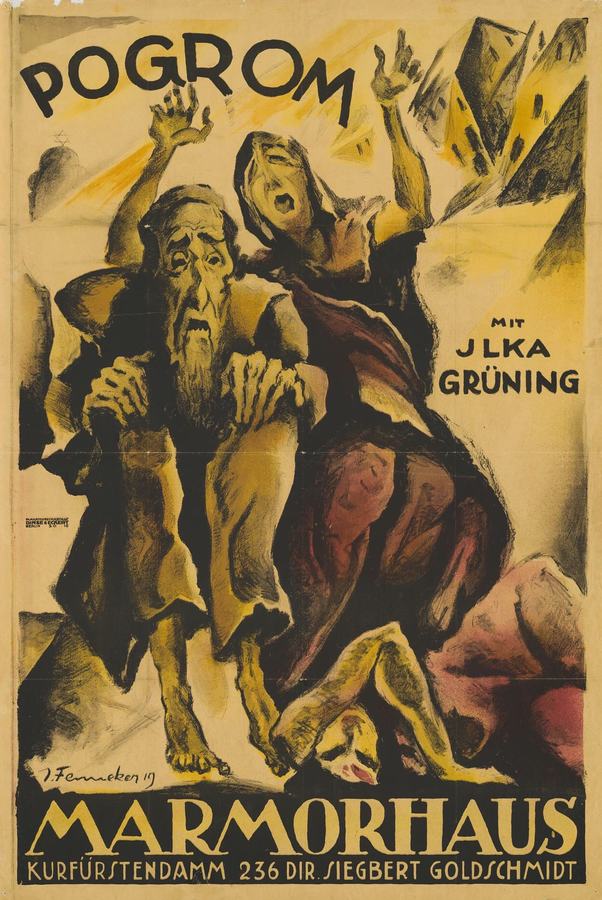
Alfred Halm's 1920 cinematic endeavor, simply titled 'Pogrom,' stands as a stark and unflinching mirror reflecting humanity's capacity for both profound cruelty and unwavering resilience. This silent era masterpiece, though perhaps less widely known than some of its contemporaries, delivers a narrative punch that resonates with a chilling prescience, particularly when viewed through the lens of history's subsequent tragedies. It is a film that demands attention, not merely for its historical context but for its masterful characterizations and its audacious willingness to tackle such a sensitive and brutal subject matter head-on.
The film transports us to the idyllic, yet increasingly imperiled, Eastern European shtetl of Kreslav, a community characterized by its vibrant culture, deep-rooted traditions, and the everyday rhythms of life. Halm, with a delicate directorial hand, initially paints a picture of communal harmony, only to systematically dismantle it as external forces begin to exert their pernicious influence. The rising tide of nationalist fervor, depicted as a creeping menace rather than an immediate onslaught, serves as the insidious antagonist, slowly eroding the foundations of peace and trust. The tension is palpable from the outset, a low thrum beneath the surface of daily life, hinting at the storm to come.
At the heart of this community stands Rabbi Mendel, brought to life with an arresting blend of quiet dignity and inner turmoil by the incomparable Ernst Benzinger. Benzinger's portrayal is a masterclass in understated acting, conveying volumes with a mere glance or a subtle shift in posture. His Rabbi Mendel is not a figure of unshakeable dogma, but a man burdened by the immense responsibility of his flock, grappling with the moral quandary of passive resistance versus active defense. His internal conflict becomes a microcosm of the wider community's struggle, a philosophical battle fought within the confines of a single, powerful performance. The weight of tradition and the desperate need for pragmatic action pull at him, creating a deeply human and relatable spiritual leader.
In stark contrast to Rabbi Mendel's measured approach is his son, David, embodied by Hermann Bauer with youthful vigor and impassioned conviction. Bauer's David is the embodiment of a new generation, unwilling to passively accept the injustices inflicted upon his people. His advocacy for proactive self-defense creates a compelling generational chasm within the narrative, a conflict that is both intensely personal and deeply symbolic. The scenes depicting the intellectual and emotional sparring between father and son are among the film's most potent, highlighting the complex dynamics of leadership and survival in the face of existential threat. This tension is not merely dramatic; it reflects a genuine historical debate within persecuted communities, a question of how best to preserve identity and life itself.
The political machinations that fuel the impending disaster are expertly woven into the fabric of the story. Hans Josberg delivers a nuanced performance as Mayor Schmidt, a character caught in the unenviable position between his own conscience and the mounting pressure from extremist factions. Josberg masterfully conveys the mayor's internal struggle, a man trapped in a moral quagmire, his attempts at appeasement ultimately proving futile against the tide of hatred. This portrayal offers a chilling look at how institutional power can crumble or be co-opted in times of crisis. His character serves as a stark reminder of the dangers of complacency and compromise when confronted with absolute evil.
The architect of this encroaching darkness is Viktor Kroll, played with chilling effectiveness by Ernst Stahl-Nachbaur. Stahl-Nachbaur's Kroll is not a caricature of evil, but a disturbingly charismatic demagogue, whose insidious rhetoric gradually poisons the minds of the populace. His speeches, though silent on screen, are conveyed through powerful visual cues and the reactions of his mesmerized audience, illustrating the terrifying power of propaganda. The film deftly shows how fear and resentment, once ignited, can rapidly spiral into uncontrollable violence, a lesson that sadly remains perennially relevant. Kroll's performance is a terrifying study in the banality and effectiveness of evil, demonstrating how hatred can be manufactured and weaponized.
The film's progression from subtle prejudice to overt violence is meticulously orchestrated. Minor provocations—vandalism, harassment, the insidious spread of rumors—serve as ominous precursors to the impending catastrophe. Halm understands that a pogrom is not a spontaneous eruption but a carefully cultivated act of terror. The narrative builds with an unbearable sense of dread, each incident escalating the tension, tightening the noose around the community of Kreslav. The merchant Isaac, portrayed by Hermann Wolfsberg, initially dismisses these warning signs with a cynical pragmatism, believing the storm will pass. Wolfsberg's performance captures the tragic arc of disillusionment, as Isaac's initial self-assurance gives way to bewildered terror, mirroring the dawning realization of many within the community.
The turning point arrives with the fabricated accusation of ritual murder against Jacob, a kind-hearted tailor and friend of Rabbi Mendel, played with poignant vulnerability by Friedrich Römer. This ancient, vile libel serves as the spark that ignites the powder keg, providing Kroll and his followers with the justification they craved. The scene depicting this accusation, though silent, screams with injustice, a powerful indictment of the ease with which truth can be perverted to serve hateful agendas. Mayor Schmidt's desperate, last-ditch efforts to intervene are met with futility, his authority utterly eroded by the mob's bloodlust. It's a sobering illustration of how rapidly societal norms can collapse under the weight of orchestrated hatred.
Amidst the escalating horror, the women of Kreslav emerge as pillars of strength and unwavering resolve. Gertrud Abel, as Leah, David's fiancée, delivers a performance brimming with quiet courage. Her character, a schoolteacher, tirelessly works to shield the children and preserve their cultural heritage, even as the world around them descends into chaos. Leah represents the enduring spirit of hope and the commitment to future generations, a beacon in the encroaching darkness. Her efforts to maintain a semblance of normalcy and learning underscore the profound importance of culture and education as acts of defiance.
Equally compelling is Ilka Grüning as Rivka, the elderly matriarch. Grüning, with her profound presence, imbues Rivka with a quiet strength and an unwavering faith that serves as an anchor for many. Her performance is a testament to the power of spiritual fortitude, a silent rebuke to the forces of destruction. Rivka's resilience is not one of overt action but of deep-seated conviction, a profound belief in the continuity of life and tradition despite unimaginable adversity. These portrayals ground the film's larger narrative in deeply personal and emotionally resonant experiences.
The film's most harrowing sequence depicts the pogrom itself. Halm spares no punches, illustrating the terrifying night with a raw, visceral intensity. Homes are ransacked, shops looted, and lives irrevocably altered. The cinematography, even in its silent form, conveys the chaos and brutality with shocking clarity. It's a sequence that, for its time, must have been profoundly disturbing, and it retains its power today. David, forsaking his father's initial pleas for non-violence, organizes a desperate, makeshift defense of the synagogue and the community's most vulnerable. Walter Formes and Martin Herzberg, as members of David's courageous but outmatched group, convey the raw fear and determination of those fighting for their very existence.
In a pivotal moment of transformation, Rabbi Mendel, witnessing the unbridled savagery, finds his resolve shifting. His earlier commitment to passive endurance gives way to a fierce determination to protect his people, uniting with his son in a poignant symbol of generational reconciliation and shared purpose. This evolution in Rabbi Mendel's character is one of the film's most powerful arcs, demonstrating that even the deepest convictions can be reshaped by the harsh realities of persecution. It's a testament to the film's psychological depth that it explores not just the external violence but the internal moral struggles it provokes.
The ensemble cast further enriches this tapestry of human experience. Fritz Alten portrays a young apprentice caught in the maelstrom, his innocence shattered by the violence. Carl Machold as a hesitant policeman, torn between duty and complicity, adds another layer of moral ambiguity. Alexander Ekert, as a member of Kroll's mob, shows fleeting flickers of doubt, hinting at the internal conflicts within the perpetrators themselves. The collective performances of Heinz Alexander, Ernst Treumann, W. Bergsch, Fritz Russ, and Julius Brandt as various townspeople—victims, perpetrators, and silent observers—create a comprehensive and chilling portrait of a society fractured by hatred. Each face, each gesture, contributes to the film's powerful depiction of mass hysteria and individual suffering.
The film's conclusion is neither triumphant nor simplistic. Instead, it offers a stark, devastating aftermath: a landscape of ruins, immeasurable loss, but also the enduring, flickering spirit of the survivors. The community of Kreslav is irrevocably shattered, its physical structures destroyed, its social fabric torn. Yet, the final scenes, depicting the survivors gathering amidst the rubble, their faces etched with grief but also with a hardened resolve, suggest a fragile hope. The flame of their heritage, carried by characters like Leah and the now-united Rabbi Mendel and David, continues to flicker, hinting at the arduous, painful path to rebuilding and remembering. It is a powerful statement on the resilience of the human spirit, even in the face of unimaginable atrocity.
Alfred Halm, as the sole writer credited, demonstrates an exceptional understanding of narrative structure and character development. The screenplay, even without spoken dialogue, conveys profound emotional depth and complex thematic ideas. Halm's direction, particularly in his use of visual metaphors and the expressive power of his actors, elevates 'Pogrom' beyond mere historical dramatization into a timeless work of art. The stark contrasts between light and shadow, typical of the era, are employed with deliberate purpose, emphasizing the moral chiaroscuro of the events unfolding. The close-ups on the faces of the victims and perpetrators are particularly effective, allowing the audience to witness the raw emotion of the moment without the need for intertitles.
In comparison to other films of its time, 'Pogrom' distinguishes itself through its unflinching subject matter and its profound emotional resonance. While films like The Unchastened Woman or A Wife on Trial explored societal conventions and personal morality, 'Pogrom' delves into the catastrophic consequences of collective hatred. It possesses a raw, documentary-like quality that sets it apart from more conventional dramas or adventures of the period, such as The Fighting Trail or The Sea Master. Even compared to other social dramas like Moral Suicide, 'Pogrom' operates on a grander, more devastating scale, examining the destruction of an entire community rather than focusing solely on individual transgression. Its historical weight feels more akin to a cinematic precursor to later, more explicit explorations of genocide, setting a somber precedent for film as a medium for bearing witness.
The film's impact is further amplified by its ability to transcend its specific historical setting. The mechanisms of demagoguery, the insidious spread of prejudice, and the fragility of peace are themes that resonate universally across time and geography. One cannot watch 'Pogrom' without drawing parallels to subsequent historical atrocities, making it a vital, albeit painful, cinematic document. It serves as a stark reminder of the dangers of unchecked hatred and the importance of vigilance against the forces that seek to divide and destroy. While other films like Mrs. Wiggs of the Cabbage Patch offered heartwarming tales of resilience in poverty, 'Pogrom' explores resilience in the face of targeted, genocidal violence, a much darker and more urgent struggle. Similarly, while films like Poor Little Peppina and Annie-for-Spite focused on individual plights, 'Pogrom' broadens its scope to encompass the collective trauma of an entire people.
In its unflinching gaze at the darkest aspects of human nature, 'Pogrom' forces its audience to confront uncomfortable truths. It is not an easy film to watch, nor should it be. Its power lies in its ability to disturb, to provoke thought, and to serve as a perpetual warning. The performances, particularly those of Benzinger and Bauer, remain etched in the memory long after the credits roll, their characters embodying the eternal struggle between hope and despair, peace and resistance. Halm’s film stands as a monumental achievement, a testament to the power of cinema to document, to mourn, and to remember. It's a testament to the fact that some stories, no matter how painful, must be told and retold, lest we forget the lessons embedded within their tragic narratives. It's a stark contrast to lighter fare like Mästertjuven which offered escapism, as 'Pogrom' demands engagement with profound suffering. Even films touching on legal or moral dilemmas such as Signori giurati... or The Right to Lie, while thought-provoking, do not reach the harrowing depths explored in 'Pogrom'. The film's message of enduring community spirit and the devastating impact of hatred resonates with a timeless urgency, making it a crucial piece of cinematic history and an enduring call for empathy and understanding. It's a powerful counterpoint to stories of individual triumph or redemption, such as Outcast or The Wine Girl, instead focusing on the collective trauma and the difficult, often incomplete, process of healing. The themes explored here are far more profound and devastating than the sibling rivalries or personal journeys found in films like Kentucky Brothers or The Long Lane's Turning, making 'Pogrom' a truly unique and essential viewing experience for those seeking cinema that challenges and informs in equal measure.
IMDb —
1916
Community
Log in to comment.