DbcultAccessing Vault...
Cult Review
Senior Film Conservator
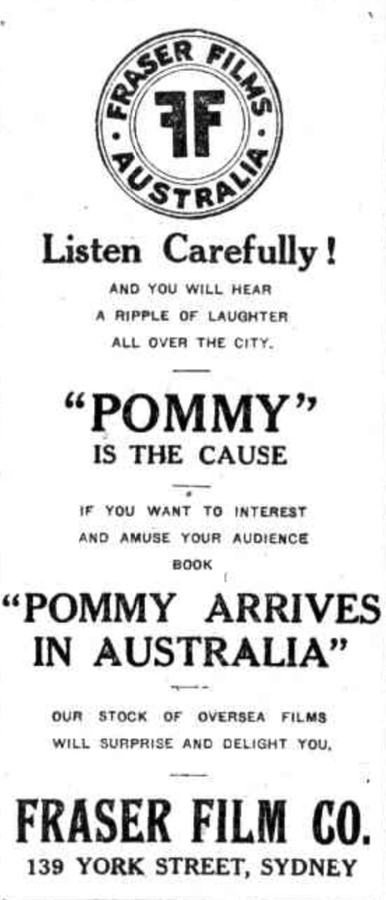
Somewhere between the first lie a colony tells itself and the last prayer it pretends to believe, Raymond Longford presses the shutter—and the continent flinches.
There are films you watch; there are films that watch you. Pommy Arrives in Australia belongs to the second, rarer species. Ninety-odd years have done nothing to cool its contradictions. The nitrate may have yellowed, yet every frame still hisses like fat on a campfire, releasing ghosts of entitlement and desperation we’d rather keep buried under bitumen and shopping malls.
Forget the tidy three-act diagram they teach in screenwriting seminars. Longford’s structure mimics the continent’s own geology: sedimentary layers of rumor, eroded by wind, half-swallowed by the ocean of time. The titular Pommy—never graced with a surname, as if the land itself refuses to memorize it—washes up in media res, already a scapegoat. A single customs stamp on his trunk labels him "Imperial Remittance," and that’s all the exposition we get. From there, the narrative fractures like shale under a prospector’s pick: a magistrate’s garden party suddenly overrun by starving shearers; a midnight baptism in a billabong that doubles as kangaroo court; a station owner’s daughter trading Shakespeare quotes for matches because matches can burn a ledger as easily as they can light a stove.
Longford refuses to privilege any vantage. One instant we’re aligned with Pommy’s disoriented pupils, the next we’re complicit in the squatter’s panoramic gaze, the camera perched on a veranda as if property itself were looking back. The effect is vertiginous: you taste soap in your mouth, the flavour of complicity.
Tom Cosgrove plays dual roles—not literally, but spiritually. His station heir carries the languid cruelty of someone who has never risked refusal; his bushranger shadow, glimpsed in flickering candlelight, is all the resentments the colony won’t name. Watch how he doffs his hat to ladies with the same hand that later grips a stockwhip. The gesture doesn’t change; only the context does, and that’s the moral crater Longford wants us to fall into.
Lottie Lyell—often reduced in film histories to “Longford’s muse”—here weaponises the governess trope. Her voice, conveyed through bravura title cards swirling like calligraphy, oscillates between prayer book and ransom note. In one scene she teaches a child to conjugate “possess,” and the word lingers on screen just long enough to indict every squatter in the room.
Helen Fergus, comparatively underused, delivers the film’s volta. Entering late as a photographer from Sydney, she points her tripod lens at the homestead like it’s a crime scene. The moment she clicks the shutter, the frame freezes, tinting blood-red—a rare stencil-colour flourish that feels less like ornament than evidence. We realise every preceding shot has already been a mugshot; we simply hadn’t been handed the file.
Forget the polite mise-en-scène of contemporaries like From the Manger to the Cross or Oliver Twist. Longford’s frames are dioramas of unfinished conquest. Note the recurring doorway motif: characters pass through thresholds but the camera stays put, trapping us on the inside of history’s hallway. Or the sheep-shearing sequence, shot in vertiginous close-up, where the animals’ eyes reflect a sky bruised by drought. The wool falls like stolen clouds; the shearers’ sweat sprinkles the fleece, a baptism of salt and guilt.
Sound, of course, is absent, yet Longford engineers a phantom soundtrack through rhythm. The intertitles arrive in staccato bursts—sometimes mid-sentence—mirroring the clipped cadences of Australian vernacular. The effect anticipates the jump-cut pranks of the Soviets by a decade, but without the ideological cheer squad. Here, montage doesn’t educate; it indicts.
Scholars often cite The Corbett-Fitzsimmons Fight or Traffic in Souls as proto-genre experiments. Pommy deserves a seat at that table, but for different reasons: it invents colonial noir, a mode where the gumtree substitutes for the Venetian blind, where the femme fatale is replaced by the unforgiving land itself. The conspiracy isn’t urban but topographical; the loot isn’t jewels but acreage measured by the murder of Indigenous custodians.
Look at the night sequence around a dying campfire. The smoke curls in such voluptuous spirals it feels like the bush is exhaling opium. Faces half-lit, half-devoured. A stolen pocket watch passes from palm to palm, ticking off the seconds until someone is expelled into darkness. It’s a heist film in which the thing stolen is the right to belong.
Let’s confront the gaping absence: First Nations people appear only as silhouettes on a distant ridgeline, corralled into the aesthetic of threat. Longford doesn’t grant them dialogue; their feet barely touch the same optical plane as the settlers. Contemporary viewers will bristle—and rightly so—yet the elision itself becomes a historical document: a snapshot of how white Australia practised its own brand of selective blindness. The film exposes the settler unconscious by failing to question it, a self-incrimination more damning than any sermon.
Recent restorations by the National Film and Sound Archive have salvaged up to 18 of the original 35 minutes, culled from vinegar-smelling canisters discovered in a Tasmanian barn. The digital scan reveals hairline cracks dancing across faces like lightning forks, an accidental metaphor for a nation still fracturing along fault lines of class and ancestry. The tinting—tobacco amber for interiors, cyan for exteriors—has been recreated using nth-generation documentation, though archivists admit the original fire-scene red was probably achieved by hand-dipping each frame in cochineal, the same dye used on British uniforms. History, ever the sardonic poet, ensures even the colouring of cinema is steeped in imperial blood.
Unlike The Story of the Kelly Gang, which mythologises the outlaw as nationalist avatar, Pommy refuses catharsis. Its bushranger figure dies off-screen, denied the operatic flourish of armour and lantern speeches. Contrast also with What Happened to Mary, whose serial heroines conquer adversity through pluck; Longford’s women survive through complicity, collaboration, or erasure—there are no medals, only scars.
More illuminating is the dialogue—well, monologue—with With Our King and Queen Through India, another colonial travelogue-cum-power-pageant released the same year. Where the latter flatters empire with jewelled processions, Pommy drags the whole pageant into the dust and watches the jewels turn to glass.
Because the Great Australian Dream of owning a quarter-acre slice is still fenced by invisible surveyor’s lines drafted on blood-stained parchment. Because refugee boats keep arriving, and the language of “invasion” is weaponised by politicians who never learned the difference between a welcome and a warrant. Pommy is a time machine powered by shame: step inside, and you’ll recognise airport detention centres in the quarantine tents, mining conglomerates in the pastoral companies, talk-back radio in the shearing-shed rumours.
The camera, hand-cranked by Ernest Higgins, achieves proto-Steadicam mobility during a horse-chase through spear-grass: the lens ducks beneath branches, splashes through creeks, the horizon tilting like a drunk sailor. Historians argue this sequence influenced the landmark location work in Robbery Under Arms, but Longford’s chaos feels less choreographed, more documentary—a newsreel from a war nobody declared.
Pommy Arrives in Australia is not a comfort blanket for nationalist nostalgia; it is a splinter under the fingernail of any audience that dares cosy amnesia. Its politics are messy, its racial omissions unconscionable, its form ground-breaking. It offers no redemption, only reflection—a tarnished mirror in which the viewer’s own visage flickers between settler and trespasser. Watch it on the largest screen you can find, preferably under storm clouds that threaten blackout. When the power fails, the after-image will keep burning, a retinal scar you’ll carry like inherited property you never asked for.
Rating: ★★★★☆ (4.5/5)—Half a star deducted for the silence forced upon its First Nations ghosts.
IMDb —
1932
Community
Log in to comment.