DbcultAccessing Vault...
Cult Review
Senior Film Conservator
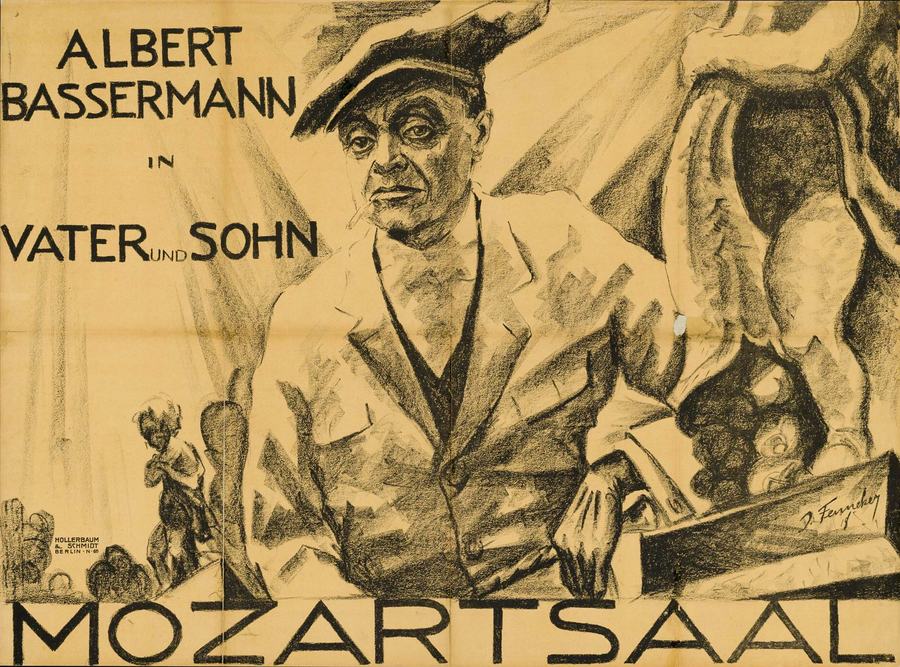
Stepping back into the annals of early cinema, one occasionally unearths a gem whose thematic resonance feels startlingly contemporary, even through the prism of time and the absence of spoken dialogue. Such is the case with 'Vater und Sohn,' a German silent drama that, despite its vintage, speaks volumes about the eternal struggle between expectation and aspiration, tradition and individual will. Featuring the formidable talent of Albert Bassermann, alongside the nuanced performances of Elsa Bassermann and Gertrud Kanitz, this film offers a profound, if at times somber, exploration of familial bonds under duress. The narrative, penned by Elsa Bassermann herself, weaves a tapestry of domestic conflict that is both intensely personal and broadly universal, a testament to her keen understanding of human psychology.
The film opens on a scene of stark contrast, immediately establishing the chasm that divides the eponymous father and son. Herr Schmidt, portrayed with a masterful blend of sternness and underlying vulnerability by Albert Bassermann, is introduced as a man of iron will, his very posture exuding an aura of command. He is the patriarch, the industrialist, his life a testament to relentless industry and the accumulation of wealth. His factory, a sprawling edifice of brick and smoke, is not merely a business; it is an extension of his ego, a monument to his legacy. Bassermann’s ability to convey this unyielding resolve through gesture and facial expression alone is nothing short of mesmerizing. His eyes, often narrowed, speak of calculation and an unwavering vision for the future—a future he intends for his son, Karl, to inherit and perpetuate. The early scenes meticulously establish Schmidt's world, a realm of order, efficiency, and the cold, hard reality of commerce. The camera often frames him against the backdrop of his industrial empire, emphasizing his dominance and the weight of his responsibilities.
In stark opposition stands Karl, whose sensitive nature and artistic inclinations are immediately apparent. While his father navigates the complexities of the market, Karl finds solace in the gentle caress of a paintbrush on canvas, or the melancholic strains he coaxes from his violin. These early sequences are bathed in a different light, often softer, more ethereal, hinting at Karl's yearning for beauty and expression beyond the mundane. The cinematography here subtly shifts, using composition and light to highlight the son's inner world, contrasting it sharply with the grittier, more defined world of his father. The conflict isn't merely one of differing interests; it's a clash of fundamental philosophies, a struggle between the utilitarian and the aesthetic, the material and the spiritual. Albert Bassermann's portrayal of the father is not one-dimensional; beneath the gruff exterior, one can discern the deep-seated fear of seeing his life's work diminish, a paternal desire, however misguided, to protect his son from what he perceives as the impracticalities of an artistic life.
Elsa Bassermann, as Frau Schmidt, delivers a performance of profound subtlety and emotional depth. Her character is the silent observer, the emotional linchpin, caught between the two immovable forces of her husband and son. Her expressions, often tinged with a delicate sorrow, convey the immense burden of her position. She is a woman of her time, her influence often exerted through quiet intercession rather than overt confrontation. Yet, her presence is undeniably powerful. When she attempts to mediate, her hands clasped, her gaze imploring, the audience feels the weight of her unspoken pleas. Her love for both men is palpable, making her predicament all the more tragic. She embodies the sacrifices often made within the confines of a traditional family structure, her personal desires subsumed by the need to maintain peace, however fragile. Her performance elevates what could have been a secondary role into a central pillar of the film's emotional architecture.
The narrative gains further momentum with the introduction of Lena, portrayed by Gertrud Kanitz. Lena is not merely a love interest for Karl; she is a catalyst, a disruptive force to Herr Schmidt's carefully constructed world. Hailing from a modest background, Lena represents a different set of values, a refreshing independence of spirit that both captivates Karl and incenses his father. Kanitz imbues Lena with a vibrant energy, her character a stark contrast to the more subdued world of the Schmidts. Her very presence challenges the rigid class distinctions and societal expectations that Herr Schmidt so fervently upholds. The scenes between Lena and Karl are imbued with a youthful idealism, a sense of shared dreams and mutual understanding that further alienates Karl from his father's pragmatic worldview. The father sees Lena as a distraction, a threat to his son's 'proper' future, while Karl sees her as an embodiment of the freedom and authenticity he desperately craves. This triangle of desires—father's expectation, son's aspiration, and Lena's influence—propels the story towards its inevitable dramatic climax.
The dramatic confrontations in 'Vater und Sohn' are masterfully staged, relying heavily on the expressive power of the actors and the careful use of mise-en-scène. The arguments between father and son are not mere shouting matches; they are silent battles of wills, conveyed through intense close-ups, sharp edits, and the symbolic placement of characters within the frame. A particularly poignant scene involves a heated exchange in Herr Schmidt's study, where the father is seated behind a large, imposing desk, a symbol of his authority, while Karl stands before him, dwarfed and defiant. The tension in these moments is almost unbearable, a testament to the actors' ability to communicate deep-seated emotions without uttering a single word. The film's direction understands the power of the unspoken, allowing the audience to project their own understanding onto the characters' internal struggles, making the experience deeply personal.
Elsa Bassermann's screenplay is notable for its psychological realism. It doesn't shy away from the complexities of familial love, revealing its capacity for both profound connection and devastating pain. The characters are not archetypes but fully formed individuals, each with their own motivations, flaws, and desires. The father, while seemingly tyrannical, is driven by a genuine, if misguided, love for his son and a desire to secure his future. The son, while yearning for independence, struggles with the guilt of disappointing his father. This intricate web of emotions is what gives 'Vater und Sohn' its enduring power. It's a testament to the fact that even in an era of nascent cinematic language, profound human stories could be told with immense sophistication.
Comparing 'Vater und Sohn' to other films of its era, one can draw parallels in its exploration of societal pressures and individual desires. While it lacks the fantastical elements of a film like The Dream Doll, or the frontier ruggedness of A Tale of the Australian Bush, it shares a thematic kinship with dramas that delve into the human heart. One might consider it alongside the social commentary found in films like The Shadows of a Great City, though its focus remains firmly on the domestic sphere rather than broader urban issues. The film's strength lies in its intimate portrayal of a family fractured by differing visions of happiness and success. The emotional intensity is reminiscent of some of the more dramatic offerings of the period, demonstrating the silent era's capacity for raw, unvarnished emotion.
The visual language employed in 'Vater und Sohn' is remarkably effective given the technological limitations of the time. The use of intertitles is judicious, never overbearing, allowing the actors' expressions and body language to carry the bulk of the narrative. The cinematography, while perhaps not as innovative as some of its contemporaries, is always purposeful. Close-ups are employed to great effect, drawing the audience into the characters' inner turmoil. The framing often emphasizes the isolation of characters, even when they are in the same room, visually reinforcing the emotional distance between them. For instance, a scene where Frau Schmidt sits alone in a dimly lit parlor, her hands idle in her lap, speaks volumes about her quiet despair, a visual motif that would be echoed in countless dramas for decades to come. The film understands that silence, when wielded skillfully, can be far more eloquent than any dialogue.
The climax of the film is a masterclass in silent storytelling, culminating in a devastating rupture that leaves all characters irrevocably changed. The father, in a moment of extreme frustration and anger, banishes Karl from the family home, a decision that is as much an act of self-mutilation as it is of paternal authority. Albert Bassermann's portrayal of this moment is particularly powerful; one sees not just rage, but a profound sadness, a man tearing apart the very fabric of his existence in a desperate attempt to impose his will. Karl's departure is a scene of quiet desperation, his artistic tools clutched tightly, a symbol of his unwavering commitment to his own path. Frau Schmidt's reaction, a silent scream of anguish, is one of the most heartbreaking moments in the entire film, a testament to Elsa Bassermann's ability to convey overwhelming grief without a sound. This dramatic peak is handled with a restraint that only amplifies its emotional impact, eschewing melodrama for a more profound sense of tragedy.
The film's resolution, or lack thereof, is perhaps its most striking feature. It avoids a neat, saccharine ending, opting instead for a bittersweet understanding, a tentative reconciliation that acknowledges the scars left by the conflict. Years pass, marked by subtle changes in the characters' appearances and demeanors. Karl, having pursued his artistic dreams, achieves a measure of success, but at what cost? Herr Schmidt, softened by time and perhaps loneliness, begins to understand the depth of his son's convictions. The final scene, where father and son meet again, is devoid of grand pronouncements or effusive displays of affection. It is a quiet moment of recognition, a silent acknowledgment of their shared history and the enduring, if altered, bond between them. The film suggests that while wounds may heal, they often leave indelible marks, and that true understanding sometimes only comes after immense suffering. This refusal to offer a simplistic happy ending elevates 'Vater und Sohn' beyond mere entertainment, cementing its status as a serious dramatic work.
The performances across the board are uniformly excellent, a testament to the rigorous training and expressive capabilities of silent film actors. Albert Bassermann's commanding presence anchors the film, his portrayal of Herr Schmidt a complex study in paternal authority and human fallibility. Elsa Bassermann's quiet dignity and profound emotional transparency provide the film's beating heart, her performance a masterclass in understated grief and resilience. Gertrud Kanitz, as Lena, brings a much-needed spark of youthful idealism and independent spirit, her character serving as a vital counterpoint to the more rigid world of the Schmidts. The chemistry between the actors, particularly between Albert and Elsa Bassermann, is palpable, lending an air of authenticity to the family dynamics. Their shared name and real-life relationship likely contributed to this seamless portrayal of a married couple facing profound challenges.
From a technical perspective, the film, while adhering to the conventions of its time, utilizes its resources effectively. The sets are detailed, conveying the opulence of the Schmidt household and the grittiness of the factory. The lighting, though rudimentary by modern standards, is used to evoke mood and emphasize emotional states. The pacing is deliberate, allowing the audience to fully absorb the emotional weight of each scene. While not as visually experimental as some of the later German Expressionist films, 'Vater und Sohn' demonstrates a clear understanding of visual storytelling, a fundamental requirement for successful silent cinema. The film serves as a valuable historical document, showcasing the capabilities of early German filmmakers to craft compelling human dramas that resonated with audiences of the era and continue to do so today.
In conclusion, 'Vater und Sohn' stands as a powerful example of early German dramatic cinema. It is a film that, despite its lack of spoken dialogue, communicates with remarkable clarity and emotional depth. The themes of generational conflict, the pursuit of artistic passion versus familial duty, and the quiet sacrifices made in the name of love and tradition are handled with a sensitivity and nuance that belies its age. The superb performances, particularly by Albert and Elsa Bassermann, elevate the material, making the characters' struggles feel intensely real and profoundly moving. For anyone interested in the rich history of silent film, or indeed in timeless stories of human connection and conflict, 'Vater und Sohn' is an essential viewing experience. It reminds us that the language of cinema, in its purest form, transcends words, speaking directly to the heart.
The enduring appeal of films like 'Vater und Sohn' lies not just in their historical significance, but in their ability to tap into universal human experiences. The struggle between a father's expectations and a son's individual aspirations is a narrative that has been replayed across countless cultures and generations. Here, it is given a particularly poignant treatment, devoid of the distractions of modern cinematic techniques, forcing the viewer to engage directly with the raw emotions on screen. Albert Bassermann's portrayal of the resolute patriarch is a masterclass in conveying authority and vulnerability simultaneously. His character, Herr Schmidt, is not simply an antagonist; he is a man shaped by his own struggles and successes, genuinely believing he is acting in his son's best interest. This complexity prevents the film from devolving into a simple good-versus-evil narrative, instead presenting a nuanced look at the intricacies of family dynamics.
The subtle nuances of Elsa Bassermann's performance as Frau Schmidt are equally compelling. Her character often serves as the emotional barometer of the film, her silent reactions reflecting the unspoken tensions and heartaches within the family. Her quiet strength, her attempts to mediate, and her profound sorrow are conveyed with an authenticity that is truly remarkable. In an era where female roles could often be stereotypical, Frau Schmidt emerges as a fully realized individual, whose inner world is as rich and complex as that of her husband or son. Her scenes often provide moments of quiet contemplation, allowing the audience to reflect on the deeper emotional currents flowing beneath the surface of the narrative. This film, in many ways, is as much her story as it is the father's and son's, highlighting the often-overlooked emotional labor performed within a family.
Gertrud Kanitz's role as Lena is pivotal in injecting a different kind of energy into the narrative. She represents not just a romantic interest for Karl, but a symbol of the changing times, of burgeoning individualism and a challenge to rigid societal norms. Her character's free spirit and artistic appreciation serve as a direct foil to Herr Schmidt's pragmatism, accelerating the inevitable clash. The film uses her presence to explore themes of social class and the pursuit of love outside conventional boundaries. Her interactions with Karl are imbued with a youthful idealism that contrasts sharply with the somber atmosphere of the Schmidt household, offering glimpses of a world where passion and personal fulfillment might take precedence over duty and tradition.
The visual storytelling, while characteristic of its era, is particularly effective in 'Vater und Sohn.' The use of composition to emphasize power dynamics, the subtle shifts in lighting to reflect emotional states, and the reliance on expressive acting over verbose intertitles all contribute to a deeply immersive experience. One might compare its earnest dramatic approach to films like Shirley Kaye, which also explored family and societal expectations, though often with a more overt romantic angle. The German film, however, leans into a more profound psychological realism, focusing on the internal lives of its characters rather than external plot machinations. The narrative avoids excessive melodrama, opting instead for a more grounded portrayal of human conflict, a quality that gives it lasting weight.
The screenplay by Elsa Bassermann demonstrates a keen understanding of narrative structure and character development. The progression of the conflict feels organic and inevitable, building steadily towards its dramatic crescendo. The intertitles, when they appear, are concise and impactful, providing necessary exposition or highlighting key emotional beats without interrupting the flow of the visual narrative. This judicious use of text is crucial in silent cinema, and Bassermann's writing ensures that the audience remains engaged with the characters' journeys. The film's themes—duty, artistic freedom, parental love, and the pain of misunderstanding—are universal, making 'Vater und Sohn' accessible and resonant even to contemporary viewers who may be unfamiliar with the conventions of silent film.
The legacy of 'Vater und Sohn' also lies in its contribution to the broader landscape of German cinema. It showcases the talent of its actors, particularly Albert Bassermann, who would go on to have a distinguished career in both silent and sound films, eventually finding success in Hollywood. The film's exploration of family dynamics and societal pressures set a precedent for future German dramas, influencing later filmmakers who would delve into similar psychological territories. While not as avant-garde as some of the Expressionist masterpieces that would follow, 'Vater und Sohn' firmly establishes itself as a significant work of early German realism, demonstrating a sophisticated approach to character-driven storytelling.
The decision to opt for a more ambiguous, rather than definitively happy, ending further solidifies the film's artistic integrity. It acknowledges that not all conflicts have easy resolutions, and that the passage of time, while it may heal some wounds, often leaves indelible scars. This nuanced approach to resolution is a hallmark of mature storytelling, refusing to sugarcoat the complexities of human relationships. The final scene, a quiet reunion, speaks volumes through its subtlety, suggesting a mutual understanding born of shared pain and the wisdom that comes with age. It is a powerful reminder that love, in its myriad forms, can endure even the most profound disagreements, finding new ways to express itself after years of silence.
Ultimately, 'Vater und Sohn' is far more than a historical curiosity; it is a timeless drama that explores the intricate dance between individual will and familial obligation. Its powerful performances, thoughtful screenplay, and effective visual storytelling combine to create a deeply affecting cinematic experience. It serves as a testament to the fact that the early days of cinema were not merely about spectacle, but about the profound exploration of the human condition. It invites us to consider the enduring questions of identity, legacy, and the true meaning of happiness within the complex tapestry of family life. A truly remarkable achievement that deserves rediscovery and appreciation.
It's fascinating to observe how films of this era, like 'Vater und Sohn,' mastered the art of non-verbal communication. The actors' reliance on exaggerated yet precise gestures, nuanced facial expressions, and powerful body language is a lost art form in many ways. Albert Bassermann, in particular, showcases an incredible range, conveying anger, disappointment, love, and regret with just a shift in his gaze or the set of his jaw. This demands a different kind of engagement from the audience, inviting them to interpret and connect with the characters on a deeper, almost instinctual level. The absence of dialogue forces a heightened awareness of every visual cue, making the viewing experience intensely immersive and emotionally charged. This is a significant aspect of why these films continue to captivate, offering a unique window into a bygone era of storytelling.
While 'Vater und Sohn' offers a singular experience, its core themes resonate across cinematic history. The tension between a parent's aspirations for their child and the child's own burgeoning identity is a narrative well-trodden, from ancient myths to modern blockbusters. Films like The Tempting of Justice, while perhaps focused on legal or moral dilemmas, often touch upon the pressure of upholding a family name or legacy. Similarly, the struggle for personal autonomy, particularly for women, seen in films like Wild Women or The Girl from the Marsh Croft, speaks to a broader societal shift towards individualism that 'Vater und Sohn' subtly explores through Karl's artistic rebellion and Lena's independent spirit. The film's enduring power lies in its ability to articulate these timeless struggles with such clarity and emotional depth, proving that a story well-told transcends its medium and its era.
IMDb —
1920
Community
Log in to comment.