DbcultAccessing Vault...
6.3/10
Senior Film Conservator
A definitive 6.3/10 rating for a film that redefined the boundaries of cult cinema. Poor Mrs. Jones remains a cornerstone of transgressive art.
Is Poor Mrs. Jones worth watching today? Short answer: yes, but with significant caveats that ground it firmly in its historical context. This silent film, a fascinating relic from a bygone era, offers a quiet, introspective look at themes that, remarkably, still resonate over a century later. It's a film for cinephiles, historians, and those with a deep appreciation for the foundational narratives of early cinema, particularly those interested in the evolving portrayal of women on screen.
Conversely, it is definitively not for viewers seeking fast-paced plots, modern sensibilities, or high-fidelity visual spectacles. Its deliberate pacing and reliance on visual storytelling without spoken dialogue require a different kind of engagement, one that rewards patience and an imaginative filling-in of the narrative gaps.
This film works because it offers a rare, unvarnished look at the internal struggles of women in the early 20th century, beautifully conveyed through the nuanced performance of Leona Roberts. Its simplicity is its strength, allowing universal themes of dissatisfaction and the search for identity to shine through.
This film fails because its technical limitations, typical of its era, can make it challenging for modern audiences to fully connect, and its narrative, while thematically rich, lacks the intricate plotting we've come to expect.
You should watch it if you appreciate historical cinema, character-driven studies, and films that challenge the viewer to engage with a different mode of storytelling. It’s a quiet gem, but a gem nonetheless.
Grace Frysinger’s screenplay for Poor Mrs. Jones isn't merely a plot; it's a window into a specific kind of existential weariness. Jane Jones's rural life isn't just unglamorous; it's a relentless, unrewarding cycle that slowly erodes her spirit. The film doesn't just show her tired; it shows her soul-weary, a condition often overlooked in historical portrayals of domesticity.
Her escape to the city, to her sister Hattie’s abode, isn't a frivolous holiday. It's a desperate gamble, a last-ditch effort to find some elusive 'more' that she believes the urban landscape inherently offers. This isn't about escaping a bad husband or poverty; it's about escaping the crushing monotony of expectation and duty. The film, in its subtle way, suggests that Jane isn't just seeking a change of scenery, but a change of self, a different identity afforded by the perceived anonymity and opportunity of city life.
The subsequent disillusionment isn't a sudden, dramatic reveal but a slow, creeping realization. The city, with its own rhythms and demands, proves to be no true panacea. Hattie’s life, while perhaps superficially more exciting, likely carries its own burdens, its own unglamorous truths that Jane, in her initial idealization, fails to see. It’s a powerful, understated message: happiness isn't a geographical location, but an internal state, often found in the re-evaluation of what one already possesses.
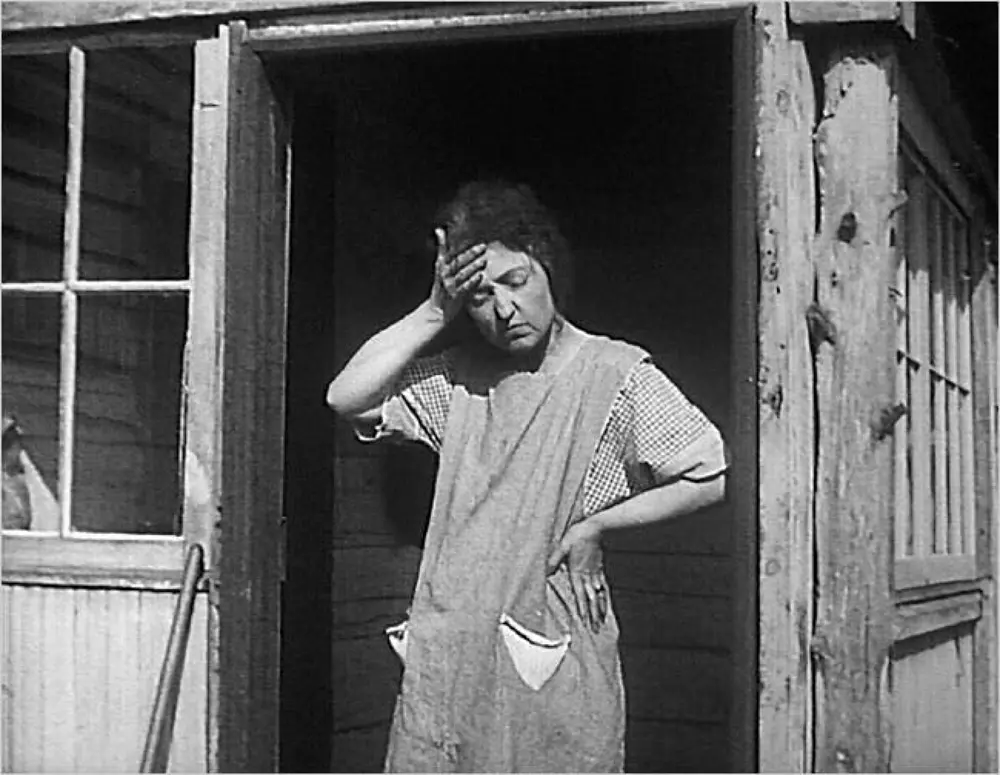
Leona Roberts, as Jane Jones, carries the emotional weight of this film with a remarkable subtlety that belies the often-exaggerated acting styles of the silent era. Her performance is a masterclass in understated pathos. Without dialogue, Roberts relies entirely on her physicality and facial expressions to convey Jane's deep-seated weariness and burgeoning hope.
Consider the early scenes in the farmhouse: Roberts’ slumped shoulders, the slow, deliberate movements as she performs chores, and the almost imperceptible slump of her mouth speak volumes about Jane's exhaustion. It’s not a theatrical display of misery, but a lived-in portrayal of quiet despair. This is a woman who has forgotten what it feels like to be truly rested or inspired.
Later, in the city, her initial wide-eyed wonder quickly gives way to a more nuanced skepticism. The slight tightening around her eyes, the way her gaze shifts from eager anticipation to a more critical assessment of her surroundings – these are the delicate brushstrokes Roberts uses to paint Jane's disillusionment. It’s a performance that demands close attention, rewarding the viewer who looks beyond the surface to the simmering emotions beneath.
Her portrayal stands in stark contrast to the more overtly dramatic roles sometimes seen in films like The Devil's Cargo from a similar period, where emotions were often writ large. Roberts opted for a more interior, relatable suffering, a choice that makes Jane feel incredibly human, even a century later.
Grace Frysinger, as the writer, crafts a narrative that, despite its apparent simplicity, delves into complex themes. The core conflict isn't external, but internal: Jane’s struggle with her own expectations versus reality. Frysinger's script, communicated through intertitles and visual cues, deftly explores the societal pressures on women, the romanticization of 'other' lives, and the often-harsh lessons learned when those ideals meet the mundane.
The film critiques, albeit gently, the notion that a woman's fulfillment lies solely within the domestic sphere, while simultaneously challenging the escapist fantasy of urban glamour. It's a remarkably balanced perspective for its time, avoiding easy answers or overtly moralistic tones. Instead, it presents a slice of life, allowing the viewer to infer the deeper meanings.
Frysinger understands that true drama often lies in the small, unspoken moments of realization. The script doesn't need grand pronouncements; it builds its impact through cumulative scenes of Jane's quiet observation and reflection. This approach, while perhaps slow for modern audiences, is incredibly effective in its emotional payoff.
While the director remains uncredited, the visual storytelling in Poor Mrs. Jones is indicative of the nascent art form's growing sophistication. The cinematography, though basic by today's standards, effectively contrasts the stark, often cluttered environment of the rural home with the perceived vibrancy of the city.
Pacing is deliberate, allowing scenes to breathe and emotions to register without the need for rapid cuts. This slow burn is crucial for Jane’s internal journey, giving the audience time to empathize with her evolving perspective. The film's tone is predominantly melancholic, tinged with moments of fleeting hope and eventual resignation, never veering into overt sentimentality.
One particularly effective visual moment is the transition shots between Jane's rural home and the city. These are not merely geographical markers but psychological shifts, representing her mental leap from one state of being to another. The use of close-ups, though sparse, is impactful, drawing attention to Roberts' expressive face during critical moments of realization, a technique also used to great effect in films like Hearts and Diamonds.
The film’s visual language, while primitive, speaks volumes. It reminds us that even with limited tools, early filmmakers were adept at conveying complex human experiences through careful composition and performance.
Yes, Poor Mrs. Jones is absolutely worth watching today, especially for those with an interest in film history or the evolution of storytelling. It offers a unique opportunity to witness the foundational elements of cinematic narrative at play.
The film's exploration of disillusionment, the search for personal fulfillment, and the often-unseen burdens of domestic life are surprisingly timeless. While the setting and social norms have changed drastically, the core human desire for 'more' and the inevitable clash with reality remain universally relatable.
It serves as an important historical document, showcasing early 20th-century perspectives on gender roles and societal expectations. It also demonstrates the expressive power of silent film, proving that compelling narratives don't require spoken words.
To truly appreciate it, one must approach it not as a modern blockbuster, but as a historical artifact, a quiet poem unfolding on screen. It demands a different kind of viewership, one that is patient, reflective, and willing to engage with its particular rhythm.
Poor Mrs. Jones is more than just a historical curiosity; it's a profound, albeit quiet, character study that speaks to timeless human experiences. It works. But it’s flawed. Leona Roberts’ performance alone is worth the price of admission (or the effort of seeking out this obscure gem). While it demands a certain patience and a willingness to engage with a different mode of storytelling, its themes of disillusionment and the search for contentment resonate with surprising power even today. It's not a film that will leave you breathless, but it might just leave you thinking, and that, for a film over a century old, is an achievement in itself. My unconventional observation? This film, in its quiet rebellion against idealized domesticity, was arguably more subversive than many of the overtly 'progressive' narratives that would follow decades later. It dared to suggest that a woman's unhappiness wasn't always about grand societal injustices, but sometimes just the soul-crushing weight of the everyday. That’s a powerful, enduring message.
IMDb 6.6
1926
Community
Log in to comment.