DbcultAccessing Vault...
Cult Review
Senior Film Conservator
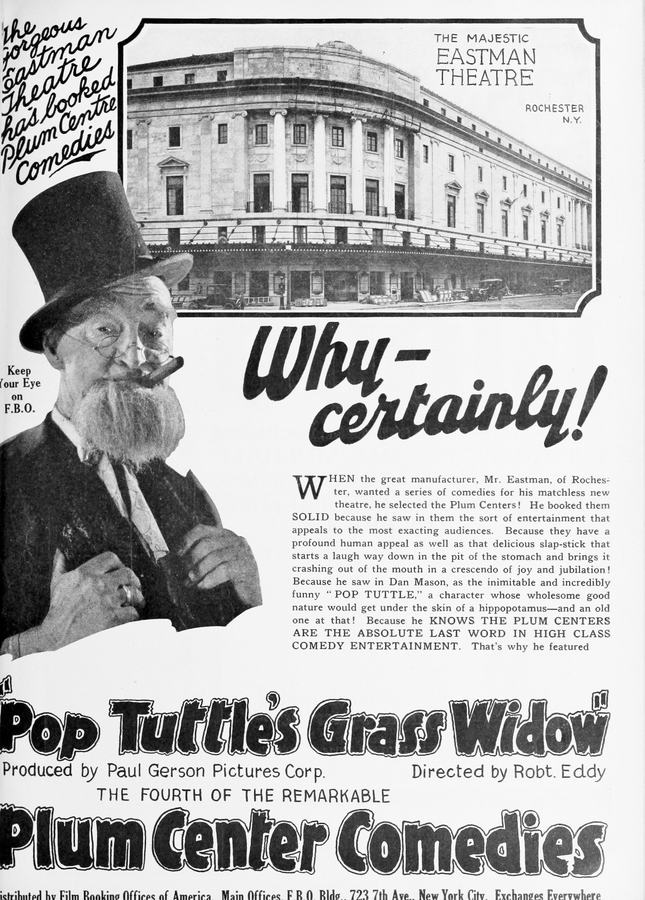
The year 1920 was a crossroads for the cinematic medium. While the industry was beginning to flirt with the sprawling, high-concept narratives found in epics like Les Misérables, Part 1: Jean Valjean, there remained a robust appetite for the localized, character-driven shorts that defined the vaudeville-to-screen transition. Pop Tuttle's Grass Widow, directed with a keen eye for rural absurdity and written by the sharp-witted Al Giebler, stands as a quintessential artifact of this era. It is a film that doesn't just ask for laughs; it demands an acknowledgment of the fragile human ego, specifically the aging male ego, as it navigates the treacherous waters of social performance.
At the center of this whirlwind is Dan Mason. To understand Mason’s appeal is to understand the 'rube' archetype—a character who is simultaneously a victim of his own provincialism and a hero of his own internal mythology. In this installment, Mason’s Pop Tuttle is not merely a caricature; he is a vessel for the universal desire to feel relevant. When he enters the dance hall, his movements are a choreographed struggle against the stiffness of time. There is a specific kind of physical intelligence required to play a man who lacks it, and Mason delivers this with a sincerity that elevates the slapstick into something bordering on the tragicomic.
Unlike the athletic, almost superhuman feats seen in Marvelous Maciste, Mason’s comedy is grounded in the mundane. It is the comedy of a collar that is too tight, a dance step that is half a beat late, and a smile that carries too much hope. This performance style bridges the gap between the broad strokes of early silent film and the more nuanced character studies that would follow in the mid-1920s.
Wilna Wilde provides the perfect foil as the 'grass widow.' For the uninitiated, the term historically referred to a woman whose husband was away for a prolonged period, though in the context of 1920s comedy, it often implied a woman playing at being single. Wilde’s performance is a masterclass in the 'tease.' She utilizes the visual language of mourning—the slight downturn of the eyes, the delicate handling of a handkerchief—to signal a vulnerability that Tuttle finds irresistible. It is a deception that mirrors the social anxieties of the time regarding the shifting roles of women in the post-war landscape.
While a film like A Butterfly on the Wheel treats the theme of marital fidelity with the gravity of a courtroom drama, Pop Tuttle's Grass Widow leans into the farce. The 'widow' is not a villain, but a participant in a game of social survival. Her interactions with Tuttle are framed through a series of medium shots that emphasize their physical disparity—his withered frame against her youthful, vibrant presence—creating a visual dissonance that foreshadows the inevitable collapse of Tuttle’s romantic house of cards.
The centerpiece of the film is the dance. Here, Al Giebler’s writing shines through the staging. The dance is a microcosm of the community’s social hierarchy. Tuttle, in his attempt to woo the widow, becomes a spectacle of misplaced energy. The cinematography, while static by modern standards, captures the claustrophobia of the small-town hall. We see the judgmental glares of the townspeople, which contrast sharply with Tuttle’s oblivious joy. This sequence reminds me of the rural tensions found in Far from the Madding Crowd, though stripped of its Wessex gloom and replaced with the frantic pacing of American slapstick.
The climax of the film—the arrival of the jealous husband—is a trope as old as the medium itself, yet Giebler handles it with a specific rhythmic precision. The husband’s entrance is not merely a plot device; it is the intrusion of reality into a fever dream. The shift in Tuttle’s demeanor, from the peak of infatuation to the depths of 'painful disillusionment,' is a transition Mason handles with exquisite timing. The comedy quickly pivots into a chase, a frantic effort to escape the consequences of a misunderstanding that was entirely self-inflicted.
In many ways, this film serves as a lighter, comedic cousin to the themes of mistaken identity and social peril found in A Broadway Scandal. Where the latter explores the dangers of the city, Pop Tuttle's Grass Widow explores the dangers of the heart. The husband is a force of nature, a personification of the 'stay in your lane' ethos that governed much of early 20th-century social comedy. The 'grass' in 'grass widow' is revealed not to be the lush field of a new beginning, but the hay of a stable where Tuttle is about to be kicked by the mule of reality.
Technically, the film is a product of its time, but it displays a sophisticated understanding of 'the gag.' Al Giebler, a veteran of the short-form comedy, understands that a joke is only as good as its setup. The way the 'widow's' husband is hinted at through subtle cues before his grand entrance shows a level of narrative foreshadowing that many of Giebler’s contemporaries lacked. It isn't just random chaos; it is a structured descent into embarrassment.
Consider the pacing compared to something like The Frozen North. While Buster Keaton’s later work would lean into surrealism and parody, Giebler and Mason remain firmly rooted in the character’s reality. The stakes for Pop Tuttle feel real, which is why the humor lands so effectively. We aren't just laughing at a man falling down; we are laughing at a man whose dignity is falling down around his ankles.
To truly appreciate this film, one must look at what else was playing in the nickelodeons. While Christus was reaching for the heavens with religious fervor, Pop Tuttle was just trying to get a dance. There is something profoundly human in that contrast. The film shares a certain DNA with Tillie Wakes Up, particularly in the way it uses a social outing as the catalyst for a breakdown in decorum. Both films use the 'escape' from domesticity as a primary motivator for their protagonists, only to show that domesticity—and its jealous guardians—is never far behind.
Furthermore, the tension between the 'widow' and the husband echoes the darker undercurrents of films like The Thunderbolt or Schuld oder Schein, where the legal and social ramifications of marital discord are explored. Tuttle’s story is the 'lite' version of these dramas, a way for the audience to process the anxieties of infidelity and marital strife through the safe lens of laughter.
Why do we still talk about these shorts? It is because they capture a lost world of American social life. The 'grass widow' is a term that has largely faded from our lexicon, but the situation—the aging man making a fool of himself over a woman who is using him for entertainment or social leverage—is eternal. The film’s resolution, where Tuttle is left alone, perhaps a bit wiser but certainly more battered, resonates with a truth that transcends the era of silent film.
In the broader context of the series, this entry stands out for its tight narrative focus. It doesn't rely on the high-stakes tension of Time Lock No. 776 or the adventurous spirit of Oh, Johnny!. Instead, it finds its power in the intimate, the awkward, and the embarrassing. It is a reminder that sometimes the greatest 'scandal' isn't a million-dollar reward—as in The $1,000,000 Reward—but the look on a man's face when he realizes he’s been flirting with a woman whose husband is standing right behind him.
Pop Tuttle's Grass Widow is a gem of early comedic timing. It manages to balance the broad requirements of slapstick with a surprisingly keen observation of human behavior. Dan Mason’s performance is a masterclass in the 'slow burn' of realization, and Wilna Wilde plays her role with a deceptive charm that makes Tuttle’s infatuation entirely believable. While it may not have the epic scope of Konkurrencen or the emotional weight of One Clear Call, it succeeds in its primary mission: to poke fun at the absurdity of our own desires.
For the modern viewer, the film is a window into a past where the dance hall was the center of the universe and a 'grass widow' was the most dangerous woman in town. It is a short, sharp shock of comedy that reminds us that no matter how old we get, we are all capable of being 'Tuttled' by a pretty face and a well-told lie. In the end, the film is a celebration of the 'rube' in all of us, the part that wants to believe in the impossible, even when the jealous husband of reality is knocking at the door.
IMDb —
1924
Community
Log in to comment.