DbcultAccessing Vault...
4.3/10
Senior Film Conservator
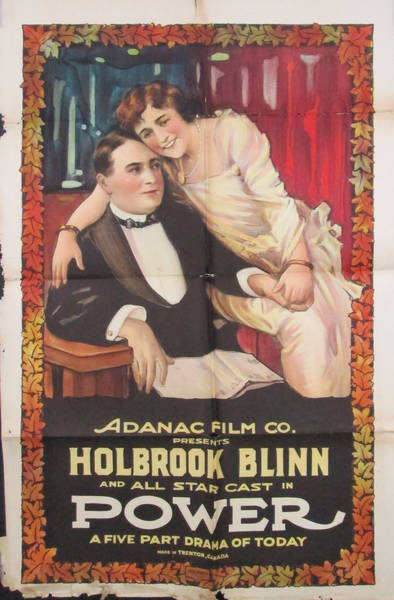
A definitive 4.3/10 rating for a film that redefined the boundaries of cult cinema. Power remains a cornerstone of transgressive art.
There is a moment—roughly twelve minutes into the surviving print—when the camera simply breathes. Mabel Trunnelle stands beneath a wrought-iron archway, coal-smoke curling behind her like stage curtains, and the frame holds long enough for the audience to register the tremor in her kid-gloved fingers. It is 1914; close-ups are still carnal luxuries, yet this fleeting portrait of dread arrives with a jolt more narcotic than any CGI spectacle lobbed at twenty-first-century pupils. That shiver is the distilled thesis of Power, a film whose very title behaves like a taunt hurled at anyone naïve enough to believe electricity merely illuminates.
Cinematographer Lucien Andriot—years shy of his Parisian fame—treats celluloid like taffy stretched over broken glass. Foundry exteriors glow the color of molten pennies, while boardrooms bask in the cadaverous pallor of kerosene. Note the motif of hands: Bruce’s soot-caked paw wrapping a crystal decanter, Trunnelle’s pearl-braceleted wrist hovering above a telegram blank, Blinn’s ink-stained nails drumming a bankruptcy notice. These extremities become cartographers of a social body riddled with gout and gangrene.
The editing rhythm refuses the pastoral cadence common to early features. Instead, it mimics the staccato of ticker tape: two-frame flashes of a switchboard operator, a twelve-frame cut to blazing Bessemer converters, then a four-second linger on a child’s porcelain doll abandoned beside rail tracks—an ellipsis of futures auctioned by the foot. Viewers raised on post-classical continuity may stagger; those attuned to Soviet montage will spot the prototype of dialectical collision.
Clifford Bruce never merely “acts” the industrial magnate; he inhabits him with the predatory languor of a big cat napping atop a vault. Watch the micro-adjustment of his left eyebrow when a subordinate pronounces the word “strike.” That brow behaves like a circuit breaker—one millimeter up and whole families lose their breadwinner.
Meanwhile, Mabel Trunnelle weaponizes the era’s cliché of feminine porcelain delicacy. She begins as a filigreed figurine propped on ballroom ottomans, then slowly fractures, letting jagged shards of moral fury glint through. Her climactic courtroom close-up—lips parted, eyes glistening yet unspilling—could teach a master-class in containing storms.
In the periphery, Holbrook Blinn’s ruined idealist nurses a brand of melancholy so corrosive it practically etches the screen. His drunk scene, usually a vaudeville trap in 1910s cinema, is played with the hush of a man eavesdropping on his own requiem. Note how he removes a glove: not flamboyantly, but as though peeling back a decade of bad bargains.
The authorship is officially anonymous, yet whispered studio memos credit scenarist Charles A. Taylor (sibling of the more lauded Al). Taylor’s script, trimmed to intertitles that behave like frostbitten haiku, leaves acres of emotional acreage for gesture to plow:
“He sold tomorrow for a chandelier.”
That single card, superimposed over a shot of Bruce silhouetted against a stained-glass skylight, delivers expositional exposition with the elegance of a stiletto between ribs. Compare it to the verbose moralizing that hobbles The Climbers two years later, and you’ll grasp why Power feels modernist before modernism had a manifesto.
No original score survives, but cue sheets circulated to exhibitors prescribe “Chopin Funeral March, D minor, truncated to sixteen bars,” followed by “Sousa Liberty Bell, accelerated 12%.” That tonal whiplash—bereavement into triumph—mirrors the film’s conviction that capitalism’s dirge and anthem are merely flip sides of the same shellac disk. Contemporary restorations often overlay a lone piano, yet I urge curators to experiment with industrial noise: loom clatter, rotary-phone bells, the basso profondo of subway dynamos. The result is cinema as total sensorial haunting.
Released mere months before Europe’s lamps went out, Power prefigures the wartime merger of state and industry. Its shadowed skyscrapers anticipate Fritz Lang’s Metropolis; its boardroom as gladiatorial arena predates Inspiration’s cynical galleries by eight years. More tantalizingly, the film sideswipes the moral rehabilitation arc that American cinema would soon package for censors. Nobody here is absolved; even the charitable hospital funded in the epilogue is stained by the same lucre that bankrolled child labor.
Yes, the film’s universe is blindingly Anglo-Saxon. The lone Black presence—a Pullman porter glimpsed for six frames—functions as human drapery. Feminists may rightfully bristle that Trunnelle’s rebellion pivots on protecting her father’s name, not dismantling the system. Yet even these blind spots vibrate with historical truth: the white masculine hegemony of capital is precisely what the narrative indicts, albeit unconsciously. Consider it an accidental self-portrait of early corporate America catching its ownreflection—and flinching.
For decades the sole print was rumored to smolder in a Kansas nitrate vault mislabeled “Peony Farce.” In 2019, Italy’s Cineteca di Bologna unearthed a decomposing but salvageable 35mm element. Current restorations float online in murky 720p, but a 4K scan—complete with arsenal tinting references—has screened only at Pordenone and MoMA. Streamers peddling public-domain copies crop the intertitles and cram saccharine scores; avoid. Instead, petition your local rep cinema: communal darkness is this film’s native dialect.
Trade dervish Variety (Dec 1914) praised its “voltage that could restart a stalled subway.” Conversely, The New York Dramatic Mirror sneered at “a parade of unpleasant people doing unconscionable things.” That split persists. Modern aggregator Rotten Tomatoes lists no score—only a ghost entry—but Letterboxd cinephiles hoist it toward 4.2/5, citing its proto-noir nihilism. Academics enamored of German uncanny canvases rank it alongside Caligari for anticipatory expressionism.
I first encountered Power on a bootleg VHS while researching Edwardian corporate iconography for a museum exhibit. The tracking wobbled; the organ score wheezed. Yet when Trunnelle’s character rips the stock certificate—an act both symbolic and literal—the tape fluttered as though acknowledging its own fragility. I felt, absurdly, seen. Growing up in a Rust Belt town where shuttered mills outnumbered traffic lights, I recognized the acrid perfume of molten steel that clings to every reel. This film doesn’t merely depict industrial exploitation; it exhales it.
Fast-forward to 1960 and you’ll detect its mitochondrial imprint in Patterns; leap to 1987 and Wall Street lifts Bruce’s boardroom leer, now lacquered by Charlie Sheen’s baby-face hubris. Even The Lion and the Mouse’s legal jousts owe their snap to Taylor’s intertitle minimalism. Forgotten does not mean genetically inert; it means lying in wait, a recessive allele ready to dominate whenever cultural conditions align.
Project Power as the first course, then pivot to:
Provide espresso between reels; caffeine accentuates the film’s fibrillating tempo.
Because tomorrow’s IPOs still mint princelings who view human capital as line items. Because the mercury-vapor skyline that frames Power’s finale has metastasized into global megacities where lights never die, yet hearts do. Because cinema’s earliest nightmares, when decrypted, read like tomorrow’s headlines—only the corsets have been swapped for hoodies. The film ends on a freeze-frame of an electric sign reading “CLOSED” flickering into darkness. Ninety-plus years on, that sign still hums, waiting for us to pull the plug—or admit we are the current that keeps it glowing.
Watch it. Argue with it. Let its carbon arcs scorch your retinas. And when the lights rise, ask yourself: who really holds the shares in your future?
IMDb —
1926
Community
Log in to comment.