DbcultAccessing Vault...
Cult Review
Senior Film Conservator
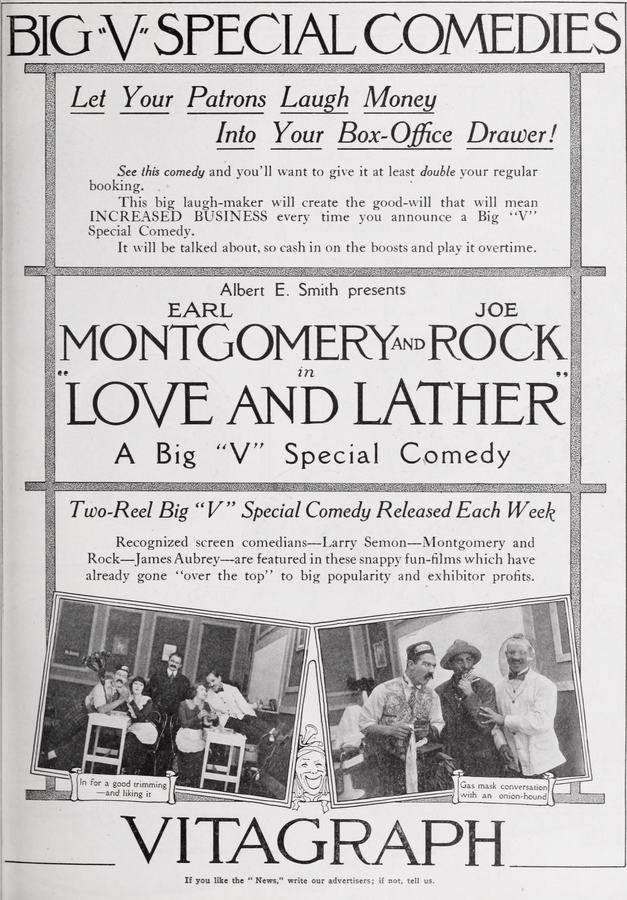
When the curtains parted on Love and Lather in 1920s nickelodeons, audiences witnessed the surgical deconstruction of masculine sanctity. Directors Montgomery and Rock transform the traditional barber shop - that hallowed ground of straight-razor masculinity - into a kinetic asylum where Newton's laws appear suspended by sheer comedic will. Unlike the restrained sophistication of The Fair Pretender or the operatic tragedy of Anna Karenina, this two-reeler plants its polished boots firmly in the territory of controlled bedlam. Montgomery's shoe-shine stand operates as the epicenter of destruction, each vigorous buff sending polish projectiles arcing toward unsuspecting patrons with ballistic precision. The brilliance resides in how Rock's barber initially presents as a pillar of professional decorum - until his implements betray him. Combs develop minds of their own, scissors transform into predatory birds, and the razor becomes a malevolent entity with personal vendettas.
What elevates Love and Lather beyond mere slapstick is its meticulous architecture of disaster. Observe the sequence where a banker requiring a simple trim becomes the fulcrum for five simultaneous calamities: Montgomery's polish rag en route to stain cream trousers, a manicurist's emery board launching like a javelin, hot towels descending as smothering projectiles, hair tonic transforming into an adhesive tsunami, and Rock's razor executing a pas de bourrée toward the gentleman's cravat. Unlike the broad strokes of Wild Youth, the comedy here operates with Swiss watch precision. Each disaster interlocks with the next through Rube Goldberg causality - a flying brush handle tips a tonic bottle whose contents lubricate a rolling stool that propels a customer into a waiting shampoo basin. The shop reveals itself as an ecosystem where every element exists to conspire against human dignity.
"The straight razor becomes a conductor's baton directing an orchestra of disaster, each flick of the wrist unleashing new crescendos of chaos."
Beneath the lathery surface bubbles a radical subversion of gender dynamics. The manicurists - often confined to decorative roles in contemporaneous films like She Couldn't Grow Up - emerge as anarchic agents of disruption. Their nail files become tools of sabotage, their laughter the soundtrack to masculine dissolution. In one subversive moment, a client's amorous advance results in his moustache accidentally styled into twin corkscrews - a visual punchline rendering him simultaneously ridiculous and emasculated. This gender warfare anticipates the domestic battlegrounds of The Unwelcome Mother, but with talcum powder substituting for psychological warfare. Montgomery and Rock make themselves equal targets, their dignity dissolving in direct proportion to the height of their comedic hubris.
The film operates with rhythmic sophistication that puts later sound comedies to shame. Note the recurring motif of circular motion - spinning barber chairs become turntables of disaster, whirling shoeshine brushes transform into abstract expressionist tools, even a dropped penny rolls with malicious intent toward the most precarious stack of tonics. This visual jazz finds its counterpoint in the performers' physicality: Montgomery's bootblack contortions suggest a demented cobbler elf, while Rock's barber evolves from crisp professional to flailing marionette. Their partnership generates a comedic alchemy reminiscent of Der Bergführer's mountain misadventures, but distilled into the compressed intensity of a single setting. Each gesture carries polyrhythmic potential - a simple reach for scissors might initiate three simultaneous chains of disaster.
Beyond the flying hair clippings lies trenchant commentary on class aspiration. The barber shop serves as democracy's waiting room where bankers and laborers momentarily occupy adjacent chairs. Yet Montgomery and Rock's antics expose the fragility of these social distinctions - a broker's pinstripes offer no protection against errant dyes, a working man's cap proves the perfect repository for discarded hair. This leveling through humiliation predates the upstairs-downstairs dynamics of The Family Skeleton by decades. The film's ultimate heresy resides in transforming a space dedicated to bourgeois respectability into a carnival of grotesquerie. Patrons enter seeking the grooming that reinforces their social standing only to emerge as walking critiques of vanity itself - their elaborate coiffures now resembling exploded pillows, their tailored suits transformed into abstract art canvases.
Earl Montgomery transforms shoe polishing into a kind of deranged ballet. His arms piston with unnatural velocity, the rag snapping like a bullwhip. In his most inspired moment, he buffs a customer's oxfords with such vigor that the man begins rotating like a human top, eventually spinning into a pyramid of towels. The genius lies in Montgomery's deadpan concentration - a study in focused absurdity.
Joe Rock wields his straight razor like a fencer's épée - until chaos intervenes. Watch how his initial graceful sweeps degenerate into frantic parries against imaginary foes. The blade becomes magnetically attracted to neckties, its edge seemingly developing personal vendettas against haberdashery. His battle with a particularly resilient chin whisker escalates into a silent-era Rite of Spring performed on facial topography.
The DNA of Love and Lather manifests in unexpected quarters decades later. Jacques Tati's meticulously orchestrated public spaces owe debts to this barbershop pandemonium. The escalating disasters foreshadow Blake Edwards' Pink Panther sequences, while the transformation of professional spaces into playgrounds of absurdity anticipates the workplace surrealism of The Office. Unlike the patriotic fervor of How We Beat the Emden, Montgomery and Rock direct their subversion inward, attacking the rituals of daily life with anarchic glee. Even the dream logic of The Truant Soul finds its comic counterpart in the way barber chairs seem to develop predatory instincts.
Confining the action to a single establishment proves a masterstroke. Where Robbery Under Arms required expansive landscapes, Montgomery and Rock find infinite possibilities within four walls. The barber shop reveals itself as a self-contained universe with its own physics: gravity seems strongest near breakable bottles, surfaces develop sudden inclines when trolleys pass, and time accelerates precisely when razors approach jugulars. Production design becomes comedic artillery - every hung mirror multiplies disasters, every display shelf offers payloads of impending projectiles. The confined space intensifies the comic pressure like steam in a boiler, until the final sequence releases it in a geyser of hair cream and flying aprons.
Like many silent-era treasures, Love and Lather narrowly escaped the nitrocellulose graveyard. The surviving print shows scars of its journey - scratches that serendipitously resemble stray hair clippings, emulsion bubbles that mirror soap suds. These imperfections now form part of its charm, a palimpsest of physical history. Recent restorations reveal astonishing details previously swallowed by time: the precise arc of a flung towel, the nuanced terror in a customer's eyes as Rock's razor approaches his earlobe, the almost imperceptible wink between manicurists before they initiate chaos. Viewed alongside the exoticism of Salome or the moralizing of As a Man Sows, the film's purity of comedic purpose feels revolutionary.
"In the economy of silent film, a single raised eyebrow could convey paragraphs of social commentary. Montgomery and Rock wrote novels with flailing limbs."
Nearly a century later, the film's genius resides in its balance between precision and pandemonium. Every custard pie trajectory feels calculated, every stumble adheres to choreographic principles. Unlike the sentimental resolutions of The Conqueror, Love and Lather offers no redemption - only the promise of fresh victims approaching the shop door as the final title card appears. The manicurists reset their stations, Rock's razor regains its gleam, Montgomery's polish rag coils like a sleeping viper. The cycle of beautifully orchestrated disaster prepares to repeat, an eternal recurrence of comedic rebirth. In this barber shop purgatory, we recognize the absurd poetry of daily rituals gone gloriously awry - a testament to silent cinema's ability to find universality in a well-aimed splash of bay rum.

IMDb —
1925
Community
Log in to comment.