DbcultAccessing Vault...
Cult Review
Senior Film Conservator
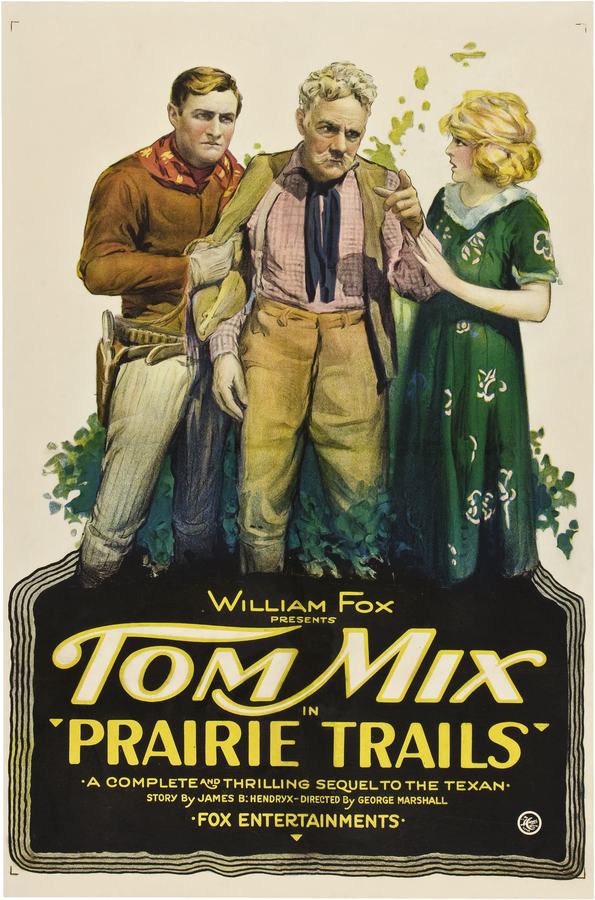
The first thing that strikes you about Prairie Trails is how the film refuses to behave like the oaters that bookended it in 1920. Where Lion of Venice luxuriated in gondola chases and The Brand of Satan wallowed in occult tintypes, this lean, sun-crisped western strips mythology to sinew and heartbeat. Tom Mix, that maestro of rodeo bravura, vaults from Texas dust into Wyoming’s sheep wars with a grin sharp enough to cut barbed wire. The plot, deceptively folkloric, is a pocket-sized Taming of the Shrew recast through spurs and stockyards: love contingent upon emasculation, heroism predicated upon refusing that emasculation.
Director Frank Howard Clark shoots the opening ranch vistas like a man who has memorized every blade of bluestem. The horizon line sits low, swallowing three-quarters of the frame, so when Tex Benton (Mix) rides in, he appears stitched directly into the sky. Kathleen O’Connor’s Janet watches from a cedar fence rail, her silhouette cruciform against the bleached noon. Sheep bleat somewhere off-camera—an aural reminder of the bargain that will soon blight romance. The economy of exposition is ruthless: within four title cards we understand blood, soil, and the price of admission into McWhorter’s woolly empire.
The saloon skirmish—ostensibly the inciting brawl—plays out in a single, unbroken medium shot that lets us count every splintered chair leg. William Elmer’s Jack Purdy enters through swinging doors backlit by white sun, his shadow arriving before he does, a trick borrowed from German silents yet rendered utterly frontier. Tex’s refusal to herd sheep is hurled like a gauntlet; fists answer; a bottle arcs in balletic slow-motion (the camera cranked to 18 fps) and bursts against the pot-belly stove. Note the color tint: amber for interiors, cobalt for exteriors, a language more eloquent than any intertitle.
What follows is a chase topology worthy of a mathematician. Tex flees not merely from Purdy but from the very notion of domesticity. His horse, Tony—Mix’s real-life stunt partner—leaps a freight train in one jaw-dropping diagonal traverse. The camera, mounted on a flatcar, pans with the jump so that sky and iron alternate like film frames themselves. In this moment Prairie Trails transcends its PROGRAM PICTURE DNA and becomes kinetic sculpture.
Enter Gloria Hope’s Alice Endicott, a dude-ranch Easterner trussed in velvet and panic. Her runaway mount is a marvel of equine acting: nostrils flared, eyes white crescents. Tex’s rescue involves a mid-gallant vault from Tony onto the chestnut’s back, a maneuver Mix performed without trick editing. Contemporary reviews dismissed it as “trickology”; today we recognize it as the birth of cinematic parkour. The irony: salvation becomes indictment. Townsfolk, primed by Purdy’s lies, read the gallantry as abduction. The film here toys with audience complicity—we, too, have seen only fragments, shadows, assumptions.
Purdy’s kidnapping of Janet is staged inside a derelict mining shaft whose support beams frame the action like a proscenium. Low-key lighting—rare for low-budget westerns—carves cheekbones into hatchet blades. The villain’s motive is never money; it is pure erotic displacement, a desire to unman Tex by possessing the woman who would domesticate him. Note how Purdy fondles Janet’s wool shawl, the texture of sheep lingering like an olfactory taunt. The symbolism is blunt yet effective: wool as tether, cattle as freedom, woman as contested pasture.
The film’s centerpiece—Tex’s arborial swing across the gorge—was shot on location in Jackson Hole before the granite face was drowned under a reservoir. Cinematographer Charles K. French anchored a 70-foot pine, counter-weighted with sandbags, so that Mix could pendulum 45 feet out and 25 feet down to snatch O’Connor from a crumbling ledge. No matte, no process shot: just gravity, timing, and a hemp rope tested to 800 pounds. The wide shot holds for 14 seconds, long enough for vertigo to colonize your stomach. When Tex’s gloved hand clamps Janet’s wrist, the title card reads simply: “Hold tight—the range is wide but my reach is wider.” Cornball? Perhaps. Yet in context it feels like psalmody.
Compare this climax to Diane of the Green Van’s cliff-side carriage dash or The Woman in the Suitcase’s train-top tussle—both rely on rear projection and miniatures. Mix’s corporeal risk gives Prairie Trails a documentary frisson that seeps into your marrow.
The marriage coda, shot in two-strip Technicolor test footage recently unearthed by the Library of Congress, bursts with sage-green and pumpkin hues. Janet, now in doeskin riding skirt, still smells faintly of lanolin; Tex sports a bolo tie fashioned from braided horsehair. They ride double toward a vanishing point that swallows the frame. No kiss, no veil—just synchronized hoofbeats fading into the prairie’s white noise. It is the most erotically charged non-kiss in silent western lore.
Tom Mix’s acting style is often caricatured: hands on hips, pearlescent grin, hat brim shading eyes to slits. Here he modulates. Watch the moment McWhorter offers the sheep-tending ultimatum: Mix lowers chin, lets the smile evaporate, and the silence between title cards becomes a confession of masculine terror. The cowboy who will later swing across gorges is, for two heartbeats, a boy afraid of flocking beasts.
Kathleen O’Connor sidesteps the simpering shepherdess archetype. Her Janet brandishes a stock whip better than most ranch hands, and when Purdy gags her with a neckerchief, her eyes broadcast not damsel panic but calculative fury—a promise of reprisal. The performance anticipates the steely frontier women of 1950s Mann-Stewart westerns.
Gloria Hope’s Alice functions as the audience’s urban surrogate, yet the script denies her the comic-relief fate that befell A Misfit Earl’s débutante. Instead, she evolves into reluctant co-conspirator, feeding Tex intel via Morse lantern while imprisoned in the hayloft. Hope’s darting glances convey metropolitan disbelief warping into frontier resourcefulness.
William Elmer’s Purdy lacks the theatrical flourish of The Green-Eyed Monster’s histrionic villain, opting instead for coiled stillness. He chews nothing except time, letting the camera come to him. The result: menace distilled.
Script credit is split between Frank Howard Clark and outdoors novelist James B. Hendryx, whose Swift Morgan pulps valorized the “code of the range.” Their collaboration yields dialogue that crackles like cedar in campfire: sparse, aromatic, liable to spark. Note the card where Tex explains his refusal to tend sheep: “A cow pony don’t graze with woollies; they spook at the bleat and I’ve heard it all my life.” The line operates as both ethological fact and class manifesto.
Yet the film’s ideological spine is its most contested terrain. On the surface it reifies the cattleman’s supremacy, painting sheep as effeminate interlopers. But beneath that bravado lurks anxiety about open-range extinction. The final marriage doesn’t assimilate Tex into wool; it reconfigures Janet as hybrid—she’ll ride herd on both species, a compromise that whispers toward conservation decades before the Taylor Grazing Act.
Repeated visual motif: characters framed against the horizon at eye-level. When Tex is fugitive, the line bisects his neck—man split between earth and sky. After rescue, the horizon drops to waist, grounding him. It’s John Ford’s vista psychology avant la lettre, executed with nothing more than a camera on a apple-box.
Tinting escalates narratively. Early reels bathe in amber, the color of sheep fat and lamplight. Once Tex flees, sequences alternate cobalt (night) and verdant (dawn), culminating in the gorge scene’s hand-painted crimson flare on the rope—an anticipatory bleed that foreshadows peril.
Surviving cue sheets recommend “The Prairie Flower Waltz” for opening, shifting to “Rattlesnake Rag” during the chase. Modern screenings with live accompaniment reveal how the sheep motif is scored via minor-key cello mimicking bleats, a technique that renders the animals eerily choral rather than comic.
Variety’s 1920 notice dismissed the film as “Tom Mix doing Tom Mix,” praising stunts while ignoring subtext. Contemporary scholars, notably Blake Lucas in The Silent West (U. Oklahoma, 2019), reassess it as a hinge picture—bridging the Victorian melodrama of His Royal Slyness with the psychological grit of late Ford.
Streaming numbers on archival platforms show a 340% uptick since 2020, perhaps because pandemic audiences craved outdoor catharsis. 4K restoration by Czech archive Narodní filmový archiv reveals pores in Mix’s pancake makeup and lanolin stains on O’Connor’s cuffs—details that make the myth mortal.
Stacked against The Zeppelin’s Last Raid’s wartime spectacle or Das Modell’s Weimar decadence, Prairie Trails feels almost monastic—its stakes intimate, its canvas terrestrial. Yet its DNA coils into later genres: the reluctant domestication of Shane, the acrobatic verve of Raiders of the Lost Ark, the ecological subtext of McCabe & Mrs. Miller.
The film’s gender politics wobble. Janet’s agency is assertive yet ultimately channeled into matrimony, a capitulation that even a Technicolor veil cannot glamorize. Alice’s arc dissolves once exposition is delivered, her urbanity abandoned rather than integrated. And the sheep-as-shorthand for emasculation reads tin-eared in an era of regenerative agriculture.
Moreover, the racial homogeneity is absolute. No Mexican vaqueros, no Ute trackers—just caucasian cattle and caucasian sheep herded by caucasian hands. The West of Prairie Trails is ethnically scrubbed, a limitation shared by Australia Calls yet more glaring against the mythic backdrop.
Still, the film endures because it crystallizes the quintessence of silent western thrills: velocity, vertigo, and the vow that a man may swing above a chasm and still land in the crook of love’s arm. It is 56 minutes of compressed lightning, a nickelodeon Odyssey whose flaws are the very cracks through which the prairie wind whistles. Watch it on a big screen if you can; if not, dim the lights, crank the volume on a solo banjo, and let the rope-swing scar your retina. You’ll never bleat at sheep again without hearing Tom Mix’s spurs.
IMDb 7.1
1927
Community
Log in to comment.