DbcultAccessing Vault...
Cult Review
Senior Film Conservator
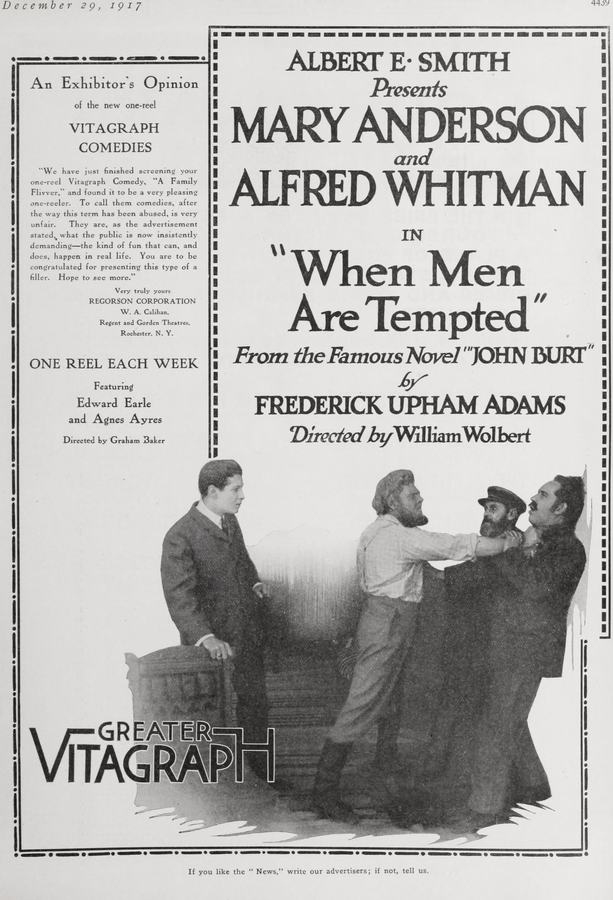
"When Men Are Tempted" unfurls a gripping narrative, a compelling tapestry woven with threads of fervent rivalry, perilous financial machinations, and the indomitable spirit of love. This cinematic endeavor, penned by George H. Plympton, plunges its audience into a world where youthful passions escalate into life-altering conflicts, where the pursuit of fortune intertwines with the quest for affection, and where the shadows of past deeds loom large over present dilemmas. It’s a quintessential drama of its era, echoing the moral complexities and high-stakes emotional landscapes that captivated audiences, drawing them into a universe where character is forged in the crucible of adversity. The film masterfully explores the intricate dance between ambition and ethics, presenting a stark examination of human nature when pushed to its very limits.
At its core lies the volatile dynamic between two college friends, John Burt and Arthur Morris, portrayed with an intensity that transcends mere archetypes. Their initial camaraderie curdles into a bitter animosity, ignited by their shared desire for Jessie Garden, a character whose presence acts as both muse and catalyst for the unfolding tragedy and triumph. This foundational love triangle, a perennial favorite in dramatic storytelling, is rendered here with a raw emotional force that feels both timeless and deeply personal. The rivalry isn't just a superficial squabble; it delves into the very essence of their beings, challenging their loyalties and ultimately defining their destinies. The cast, featuring talents like Mary Anderson, Robert N. Bradbury, Otto Lederer, S.E. Jennings, and Gayne Whitman, undoubtedly brought these complex roles to life, imbuing them with the necessary gravitas and emotional depth to make their struggles resonate.
The narrative takes a dramatic turn when a heated confrontation between John and Arthur culminates in a violent physical altercation. John, in a moment of sheer panic and misjudgment, believes he has fatally wounded his rival. This pivotal incident propels him into a self-imposed exile, a desperate flight westward not merely to escape legal repercussions, but perhaps more profoundly, to outrun the specter of his own perceived culpability. His journey is imbued with an almost mythical quality, a quest into the unknown in search of a fabled mine belonging to his grandfather. This pursuit of ancestral wealth serves as both a practical means of survival and a symbolic path to redemption, a way for John to reconstruct a life shattered by a single, desperate act. The isolation and hardship of this Western sojourn would undoubtedly have sculpted his character, hardening his resolve and sharpening his intellect, preparing him for the trials yet to come.
Upon his triumphant return, transformed into a millionaire by the fruits of his arduous quest, John anticipates a fresh start, perhaps even a reunion with Jessie. However, fate, in its cruel and ironic fashion, has other plans. He discovers Jessie entangled in a web of despair, contemplating a sacrificial marriage to Arthur Morris – the very man John believed he had dispatched. This shocking revelation reintroduces Arthur not merely as a survivor, but as a malevolent force, a puppet master manipulating the lives of others for his own nefarious gain. Arthur's villainy is painted in strokes of avarice and ruthless calculation; he has orchestrated the financial ruin of Jessie's father through cunning stock manipulations, thereby cornering Jessie into a desperate bargain. This turn of events elevates the stakes beyond a simple love triangle, transforming it into a battle for economic justice and moral rectitude. The film here touches upon themes reminiscent of Politik och brott, where power and corruption often intertwine to devastating effect, or even The Dictator, in its portrayal of an individual wielding immense, destructive influence over others.
John's newfound fortune, initially sought for personal restoration, now becomes a weapon in a righteous crusade. He places his entire wealth at the disposal of Jessie's father, embarking on a strategic campaign to dismantle Arthur’s financial empire. This is where the film transcends a mere romantic melodrama, venturing into the thrilling territory of corporate warfare, a high-stakes game of economic attrition. The tension would have been palpable, as audiences watched John systematically unravel Arthur’s ill-gotten gains, turning the tables on the manipulator. This segment of the narrative showcases John's intelligence and unwavering commitment, demonstrating that his journey West not only brought him wealth but also honed his strategic acumen. It is a testament to the idea that true strength lies not just in physical prowess, but in the intelligent application of resources and an unyielding moral compass.
Arthur, cornered and facing utter ruin, responds with the desperate ferocity of a trapped animal. His anger and hatred, previously channeled into insidious financial schemes, now erupt into a direct, murderous assault on John. This climactic confrontation is the ultimate showdown between good and evil, a visceral battle that has been simmering since their initial college rivalry. The failure of Arthur's attempt, however, marks the absolute nadir of his moral descent, culminating in his tragic, self-inflicted demise. This act of suicide, rather than providing an easy escape, serves as the ultimate condemnation of his character, a stark illustration of the destructive power of unchecked greed and envy. It’s a potent conclusion to a character arc steeped in malevolence, ensuring that justice, albeit grim, is ultimately served. The dramatic weight of this resolution resonates with the profound moral choices explored in films like Thou Shalt Not Steal, where the consequences of unethical actions are laid bare with uncompromising clarity.
With the menacing shadow of Arthur finally removed, the path is cleared for John and Jessie to embrace a future together. Their marriage symbolizes not just the triumph of love, but the restoration of order and justice. Their happiness is hard-won, forged in the crucible of profound adversity, making it all the more meaningful. The film concludes on a note of serene resolution, a testament to enduring love conquering formidable obstacles. This narrative arc, though seemingly straightforward, is rich with thematic depth. It explores the corrosive nature of envy, the redemptive power of perseverance, and the timeless appeal of a hero who fights not just for personal gain, but for the honor and happiness of those he cherishes.
"When Men Are Tempted" operates on multiple thematic levels, each contributing to its enduring resonance. The most overt, of course, is the concept of temptation itself. John is tempted to flee, tempted by wealth, but ultimately tempted by the opportunity to right a wrong. Arthur, conversely, succumbs entirely to the temptations of greed and power, twisting his intellect for nefarious ends. Jessie, too, faces the temptation of despair, almost sacrificing her future for her father's honor. This exploration of moral fortitude in the face of overwhelming desire or pressure gives the film a profound psychological dimension. The film deftly portrays how individuals respond when faced with choices that challenge their core values, making it a timeless study of ethical dilemmas.
The theme of rivalry is central and deeply impactful. It's not merely a superficial contest for a woman's hand; it's a clash of ideologies, a battle between two fundamentally different approaches to life. John represents an earnest, if sometimes flawed, pursuit of justice and honest gain, while Arthur embodies the corrosive effects of unchecked ambition and manipulative cunning. This intense personal rivalry, which escalates from fisticuffs to financial warfare and ultimately to attempted murder, provides the driving force of the narrative. It reminds us of the destructive potential when personal grievances are allowed to fester and consume individuals. One might draw parallels to the competitive dynamics found in The Rival Actresses, though perhaps with less life-or-death stakes, highlighting how competition can define and sometimes destroy relationships.
Justice and redemption form another crucial pillar. John’s journey West, initially an escape, transforms into a quest for self-redemption and ultimately, a vehicle for delivering justice to Jessie and her father. His return as a millionaire is not just a plot device; it signifies his earned capacity to confront the injustice perpetrated by Arthur. The resolution, with Arthur's self-destruction, serves as a powerful, if dark, affirmation of cosmic justice. The narrative arc suggests that while the path to justice may be circuitous and fraught with peril, it is ultimately attainable through persistence and moral clarity. This echoes the moral fortitude seen in tales like The Challenge, where protagonists often face immense odds to uphold their principles.
The film also delves into the complex relationship between wealth and morality. John's wealth is acquired through honest, albeit arduous, means and is ultimately used for altruistic purposes – to save Jessie and her father. Arthur's wealth, on the other hand, is amassed through deceit and manipulation, leading to the suffering of others. This stark contrast underscores a timeless message about the ethical implications of financial power. It’s a compelling argument that money itself is morally neutral; its impact is determined by the character of those who wield it. The film, in this regard, offers a cautionary tale about the corrupting influence of avarice and a celebration of wealth utilized for benevolent ends.
Furthermore, the theme of sacrifice is beautifully embodied by Jessie. Her willingness to enter a loveless marriage to salvage her father's honor and financial standing speaks volumes about her character and the societal pressures placed upon women in that era. Her potential sacrifice elevates the emotional stakes significantly, making John's eventual intervention all the more heroic. It transforms her from a mere object of affection into a figure of quiet strength and profound loyalty, challenging the audience to consider the depths of familial devotion. This selfless act resonates with the spirit of devotion and resilience often explored in dramatic narratives of the time.
While specific directorial choices are not detailed in the plot synopsis, one can infer certain stylistic approaches common to films of this dramatic caliber. The pacing would likely have been deliberate, allowing the emotional arcs of the characters to fully develop, punctuated by moments of intense action and revelation. The portrayal of the Western journey, for instance, would have relied on visual storytelling to convey John's solitude and determination, perhaps with sweeping vistas or stark contrasts between the urban and wilderness environments. The confrontation scenes, particularly the initial fight and Arthur's final desperate assault, would have demanded a visceral immediacy, drawing the audience into the raw emotional stakes.
The performances of the cast would have been paramount in conveying the nuanced emotional landscape. Mary Anderson, as Jessie Garden, would have needed to embody both vulnerability and a quiet strength, making her sacrifice believable and her eventual happiness earned. Robert N. Bradbury, as John Burt, would have carried the weight of the protagonist's journey, from the initial shock and flight to his resolute return and ultimate triumph. His portrayal would have required a compelling blend of heroism, introspection, and strategic acumen. Otto Lederer, S.E. Jennings, and Gayne Whitman, presumably filling the roles of Arthur Morris and supporting characters, would have been crucial in providing the necessary dramatic foils and depth to the narrative. The antagonist, Arthur, would have demanded a performance that conveyed both his cunning intellect and his spiraling descent into desperation and malevolence, making his eventual downfall feel both inevitable and cathartic.
The screenplay by George H. Plympton clearly demonstrates a strong grasp of dramatic structure, building tension progressively and delivering payoffs that are both emotionally satisfying and morally resonant. The shift from a personal rivalry to a grander battle for financial justice is a clever narrative device that broadens the scope of the film, elevating it beyond a simple love story. This layered approach ensures that the audience remains invested not only in the romantic outcome but also in the broader struggle against injustice. The careful crafting of plot points, from John's flight to his return as a millionaire, and Arthur's stock manipulations, creates a complex web of cause and effect that drives the story relentlessly forward.
"When Men Are Tempted" stands as a powerful exemplar of early cinematic storytelling, a testament to the enduring appeal of classic dramatic tropes. Its narrative, while rooted in a specific era, explores universal themes that continue to resonate with contemporary audiences. The eternal struggle between good and evil, the complexities of human relationships, the corrupting influence of power, and the redemptive journey of a hero are all masterfully woven into its fabric. The film serves as a reminder that even in an age of rapid technological advancement in filmmaking, the fundamental elements of compelling storytelling remain unchanged.
The dramatic tension, the moral dilemmas, and the eventual triumph of virtue provide a cathartic experience that audiences have always sought from cinema. The journey of John Burt, from a man burdened by perceived guilt to a resolute champion of justice, is a deeply satisfying one. His transformation and his unwavering commitment to Jessie and her family offer an inspiring portrayal of integrity and perseverance. The film's ability to combine personal tragedy with grander societal conflicts ensures its place as a significant piece of cinematic history, offering insights into the human condition that are as relevant today as they were upon its initial release.
Moreover, the film's title itself encapsulates its core philosophical inquiry: what happens "When Men Are Tempted"? It invites us to reflect on our own moral compasses, to consider the choices we make under duress, and to appreciate the strength required to resist the siren call of greed, revenge, or despair. The ultimate message is one of hope and the potential for renewal, even after profound setbacks. It suggests that while temptation is an inherent part of the human experience, so too is the capacity for courage, selflessness, and ultimately, enduring love. It's a powerful reminder that while the world may present myriad challenges, the human spirit, when guided by integrity, can overcome even the most formidable adversaries.
In conclusion, "When Men Are Tempted" is far more than a simple melodrama; it is a profound exploration of character, conflict, and consequence. It leverages its dramatic premise to delve into the very heart of human motivation, showcasing how love can inspire heroism, how rivalry can breed destruction, and how justice, though sometimes delayed, can ultimately prevail. For enthusiasts of classic cinema and those interested in the foundational narratives that shaped early film, this picture offers a rich and rewarding viewing experience, a timeless testament to the power of storytelling.
IMDb —
1924
Community
Log in to comment.