DbcultAccessing Vault...
7.2/10
Senior Film Conservator
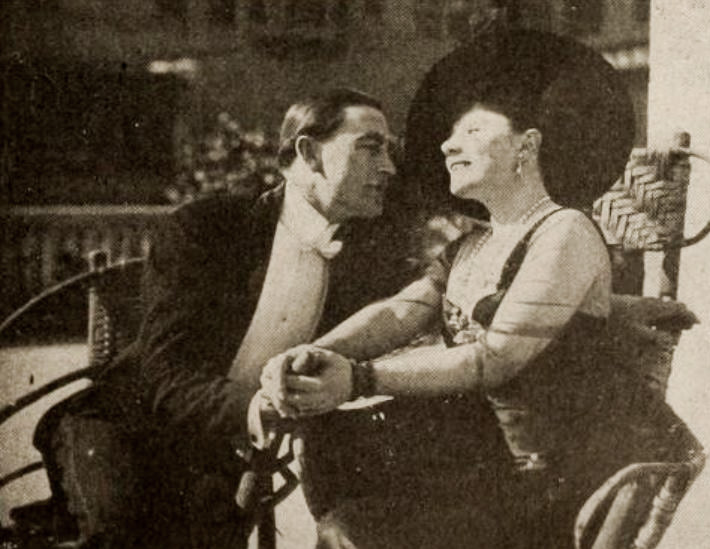
A definitive 7.2/10 rating for a film that redefined the boundaries of cult cinema. Pretty Mrs. Smith remains a cornerstone of transgressive art.
Picture, if you can, a heroine whose moral compass spins like a roulette ball—every number it lands on is another husband. Pretty Mrs. Smith (1918) is less a narrative than a matrimonial kaleidoscope: each twist rechips the colored glass until the pattern glitters with sin and slapstick in equal measure. Paramount’s publicity boys billed it as a “society comedy,” but the film plays more like a sly anthropological study of monogamy imploding under the weight of its own promises.
The opening reel drops us into a parlour so stiff with antimacassars you could snap one and butter it. Drucilla—Fritzi Scheff’s operatic eyes forever halfway between aria and yawn—escapes this mausoleum by latching onto Ferdinand (Hobart Bosworth), a missionary whose smile never quite reaches the frostbitten blue of his irises. Africa, painted in hallucinatory tints of ochre and malachite, is no Lucille Love serial adventure; it is a penal colony of the soul, where piano wires snap in the humidity and evening prayers echo like warrant sheets.
Scheff, a coloratura soprano moonlighting in celluloid, lets her mouth tremble with the exact vibrato she once reserved for La bohème. You can almost hear the silent soundtrack—a tremulous high C—when she peels leeches from her ankles and realizes that salvation, once again, wears a man’s collar and carries a whip.
Enter Forrest Smith, portrayed by Forrest Stanley—yes, the actor and character share a name, a metatheatrical wink that feels utterly modern. He is all ink-stained cuffs and sonnets about gulls. Their Manhattan walk-up, wallpapered with rejection slips, becomes a pocket utopia until the grocer starts sniffing for unpaid tabs. In one luminous gag, Drucilla pawns her wedding spoon to buy him a typewriter ribbon; the next intertitle reads: “Poetry—like love—requires stationery.” Cue rim-shot from the orchestra pit.
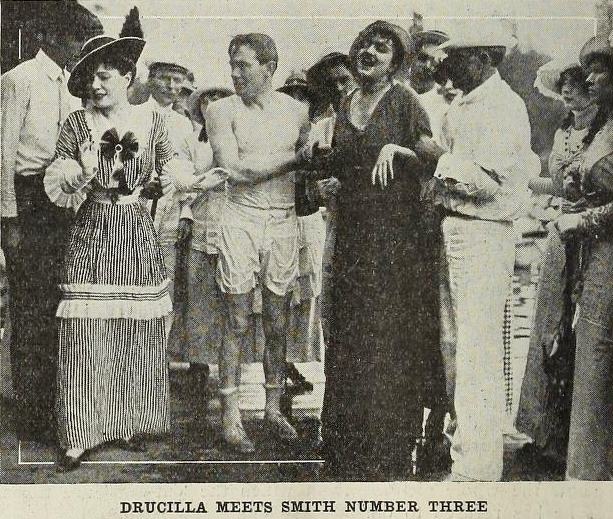
When Forrest vanishes, leaving only his coat and a note on a rock, the film tilts into mythic territory reminiscent of Sodoms Ende—a suicide that may be mere sleight-of-hand, a disappearance act performed for an audience of waves.
Frank Smith (Louis Bennison) arrives as the corrective: solvent, athletic, scented with cologne distilled from trust funds. His jealousy, however, is a carnivorous plant—every reassurance Drucilla offers only waters it. Watch the seaside boardwalk scene where a casual glance at the lifeguard sends Frank’s pupils into pinpricks. Director Elmer Harris blocks the trio—husband, wife, and intrusive gaze—inside a decorative beach hut whose slats stripe their faces like prison bars. It’s Carmen’s fate compressed into a single, suffocating shot.
The final act is a masterclass in farce geometry: three identical tweed suits converging on one breezy resort corridor. Ferdinand, sun-leathered and Bible-battered, stalks in from the east wing; Forrest, eyes starved for metaphor, drifts in from the west; Frank, orchid in lapel, storms up the service stairs. Meanwhile Drucilla, draped in a negligee the shade of anxious seas, ricochets between parlour, pantry, and pier, accumulating husbands like loyalty cards.
The screenplay’s coup is that none of these reunions feels impossible; each man carries the bruise of his own myth. When Ferdinand intones, “The Lord preserved me on a raft of providence,” the line lands with zero irony—until you remember he’s technically dead in the eyes of the law. The film wants us to ponder: if resurrection is doctrinally routine, why shouldn’t divorce be equally reversible?
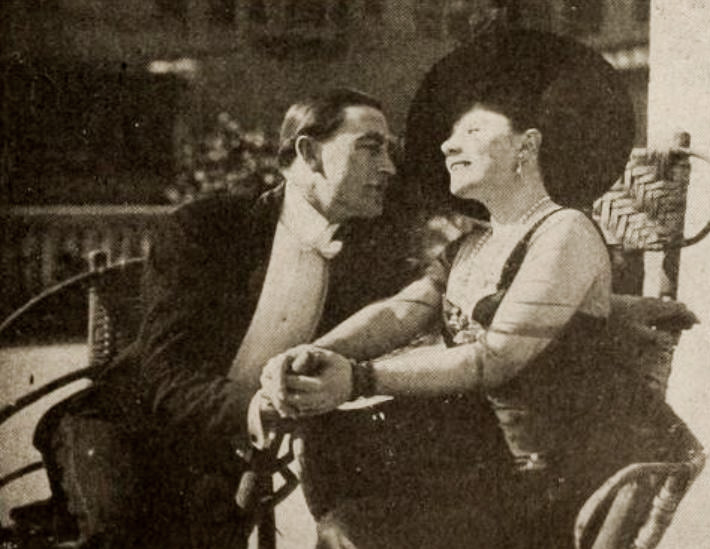
Scheff’s acting oscillates between grand opera and nickelodeon wink. In close-up, she can shrink her gestures to a single raised brow that speaks volumes about alimony statutes. Beside her, Owen Moore (playing a comic hotel clerk) times his double-takes with Swiss precision—watch him register the revolving door of Smiths, each entrance another dagger of disbelief into his ledger.
The restoration I viewed (courtesy of a 4K scan from nitrate held in the Rochester vault) alternates amber for American interiors, viridian for African exteriors, and a bruised lavender for hotel corridors—each hue a moral weather report. Intertitles, peppered with alliteration (“matrimonial monsoon”), flirt with the viewer, daring us to keep pace with the tonal hopscotch.
Unlike Jane Eyre, whose heroine must wait for fiery fate to clear the manor, Drucilla actively engineers her exits—each a small revolution funded by pawned jewelry or borrowed steamer trunks. Yet the film refuses to crown her proto-feminist; her agency is always reactive, a series of leaps between frying pans. The true radical gesture is the script’s refusal to punish her legally. In 1918, when the Mann Act still loomed like a paternalistic gargoyle, letting a woman bigam-adjacent skip off unscathed feels deliciously seditious.
Where The Mail Order Wife treats marriage as contract law, Pretty Mrs. Smith treats it as performance art—each vow another role to try on, discard, resurrect. Its DNA shares strands with Mrs. Black Is Back’s anarchic domestic sabotage, yet anticipates 1930s screwball in its velocity and cynicism. Imagine if The Vicar of Wakefield took a honeymoon in Bali and came back drunk on bathtub gin—that’s the tonal aftertaste here.
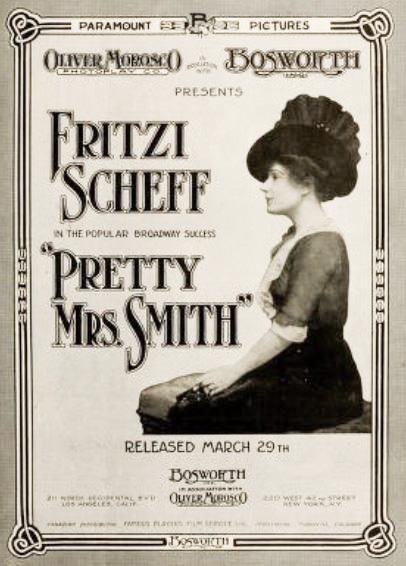
At 68 minutes, the film sprints. Transitions that would today trigger a writers’ room revolt—say, a husband’s off-screen resurrection via newspaper headline—are handled with a shrug and a iris wipe. Yet the velocity is the point: life, the movie insists, is stitched from abrupt jump-cuts. One frame you’re shackled to a missionary; the next you’re divorced, remarried, and booking oceanfront spa treatments.
The Mont Alto Motion Picture Orchestra’s new score channels Korngold-lite strings for the poet’s wooing, then pivots to xylophone patter when hotel doors start slamming. Silence itself becomes a character: in the moment Drucilla discovers all three husbands in the lobby, the conductor briefly drops the baton—an aural gasp that lets the audience’s own panic flood the soundtrack.
We live in an era where relationship statuses update faster than metadata. A story that treats marriage as infinitely rewritable feels prophetic rather than quaint. Moreover, the movie’s refusal to moralize—no thunderbolts, no fallen woman montage—places it closer to Tigris’s existential swirl than to any Hays-Code morality play that would follow a decade later.
Pretty Mrs. Smith is a champagne cocktail spiked with arsenic: effervescent, deadly, gone too fast. Seek it at any archive screening, then spend the cab ride home counting your own hyphenated last names. If you emerge with fewer than three, you’ve led a comparatively dull life—congratulations, or condolences.
Rating: 4.5 out of 5 antique typewriter ribbons.
IMDb 7
1937
Community
Log in to comment.