DbcultAccessing Vault...
Cult Review
Senior Film Conservator
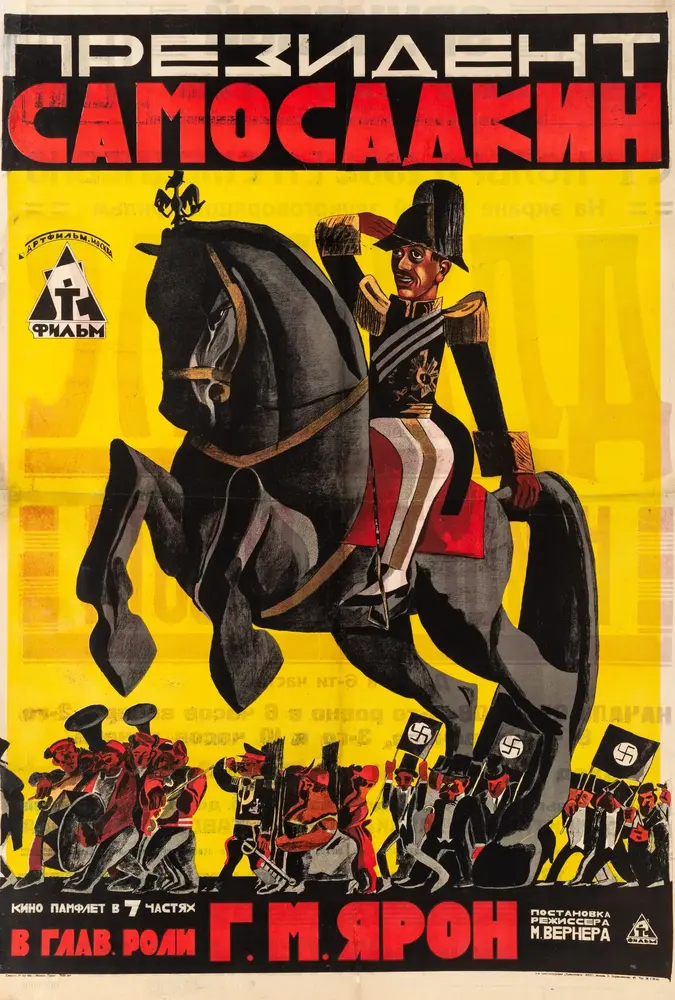
Is Prezident Samosadkin worth watching today? Short answer: yes, but only if you have a tolerance for the jagged edges of early silent satire. This film is for the historian who loves deconstructing social hierarchies and the cinephile who finds beauty in archival grit; it is absolutely not for anyone who requires a high-definition, fast-paced narrative to stay engaged.
The film exists as a fascinating relic of a time when the rules of cinema—and society—were being written on the fly. It is a work that feels both urgent and archaic. It captures a specific cultural anxiety about who gets to lead when the old world burns down. If you come looking for a polished masterpiece, you will be disappointed. If you come looking for a raw, cynical joke told through the lens of 1920s experimentation, you might find something special.
1) This film works because it leans into the physical comedy of Yakov Volkov, whose performance turns a simple political premise into a masterclass of silent-era gesticulation.
2) This film fails because its editing is frequently disjointed, often losing the thread of its own satire in favor of repetitive sight gags that don't always land.
3) You should watch it if you have an interest in early Soviet cinema or enjoyed the frantic, almost desperate energy of films like Frenzied Film.
Lev Nikulin’s script for Prezident Samosadkin is a biting critique of the 'new man' in a post-revolutionary landscape. Samosadkin is not a hero. He is a placeholder. The film spends a significant amount of time showing him interacting with objects of status—desks, pens, telephones—as if they were alien artifacts. There is a specific scene where he attempts to sign a document while simultaneously dealing with a fly on his nose; it’s a simple gag, but it perfectly encapsulates the film’s theme: the triviality of the man versus the weight of the office.
The pacing is peculiar. Unlike the more structured narratives found in Western films of the same era, such as A Gentleman of Leisure, Prezident Samosadkin feels like a collection of editorial cartoons brought to life. It doesn't move in a straight line. It stumbles. It loops. This can be frustrating for a modern audience, but it reflects the chaotic atmosphere of the 1920s. The film doesn't just depict a mess; it is a mess. And in that mess, there is truth.
Yakov Volkov carries the weight of the film on his shoulders. His face is a landscape of bewilderment. When he sits in the presidential chair, he doesn't look like a leader; he looks like a child who has climbed onto his father's throne. This is a deliberate choice. Volkov uses his eyes to communicate a sense of impending doom that contrasts sharply with the slapstick nature of his movements. It’s a nuanced performance hidden inside a broad comedy.
Grigory Yaron and Uliya Dizhur provide solid support, though they often feel like archetypes rather than characters. Yaron, in particular, plays the foil with a rigidity that makes Volkov’s looseness even more apparent. The direction is static, typical of the era's lower-budget productions. The camera rarely moves, preferring to let the actors move within the frame. This gives the film a theatrical feel, similar to Sten Stensson Stéen från Eslöv, where the environment serves as a stage for character-driven absurdity.
Visually, the film is a product of its constraints. The lighting is often harsh, and the sets feel flimsy. Yet, there is a creative ambition in how Nikulin and the director use these limitations. The office of the 'President' is cluttered and claustrophobic, symbolizing the trap of bureaucracy. This isn't the lush world of The Girl Who Came Back; this is a world of paper, dust, and ink.
One of the most striking elements is the use of title cards. They aren't just dialogue; they are commentary. They mock Samosadkin even as he tries to succeed. This meta-narrative layer adds a depth that is often missing from contemporary comedies. It reminds the viewer that we are watching a farce, not a drama. The film is self-aware. It knows it is ridiculous. It embraces the absurdity of its own existence.
If you are looking for a definitive answer, it depends on your appetite for cinematic archaeology. Prezident Samosadkin is a valuable document of 1920s social satire. It offers a glimpse into how a society in flux viewed its own leadership. However, for a casual viewer, the lack of a traditional 'hero's journey' and the dated nature of the humor might make it a chore. It is a film that requires work. You have to meet it halfway. It doesn't entertain you; it challenges you to find the joke.
Compared to something like The Pousse Cafe, which leans more into tonal experimentation, Samosadkin is firmly rooted in political mockery. It is a niche film for a niche audience. But for that audience, it is a rewarding experience. It is a reminder that the struggle between the common man and the machinery of the state is a timeless story, even when told through the flickering light of a century-old projector.
Pros:
- Sharp, cynical wit that still feels relevant.
- Excellent lead performance that transcends the silent medium.
- A unique historical perspective on post-revolutionary bureaucracy.
- Short runtime that prevents the premise from wearing too thin.
Cons:
- Disjointed editing that can be disorienting.
- Low production quality even by 1920s standards.
- Some jokes are too culturally specific to translate well to modern audiences.
- Secondary characters are underdeveloped and forgettable.
Prezident Samosadkin is a fascinating failure that manages to be more interesting than many successful films of its era. It is a brave, if clumsy, attempt to use cinema as a weapon against the pomposity of the state. It lacks the grace of Love's Boomerang, but it makes up for it with sheer, unadulterated cynicism. It isn't a masterpiece. It’s a smudge on the window of history. But sometimes, you can see more through a smudge than through a clean pane of glass. It works. But it’s flawed. Watch it for the history, stay for the bizarre, rubber-faced antics of a man who never should have been president.
IMDb 5.5
1915
Community
Log in to comment.