DbcultAccessing Vault...
5.8/10
Senior Film Conservator
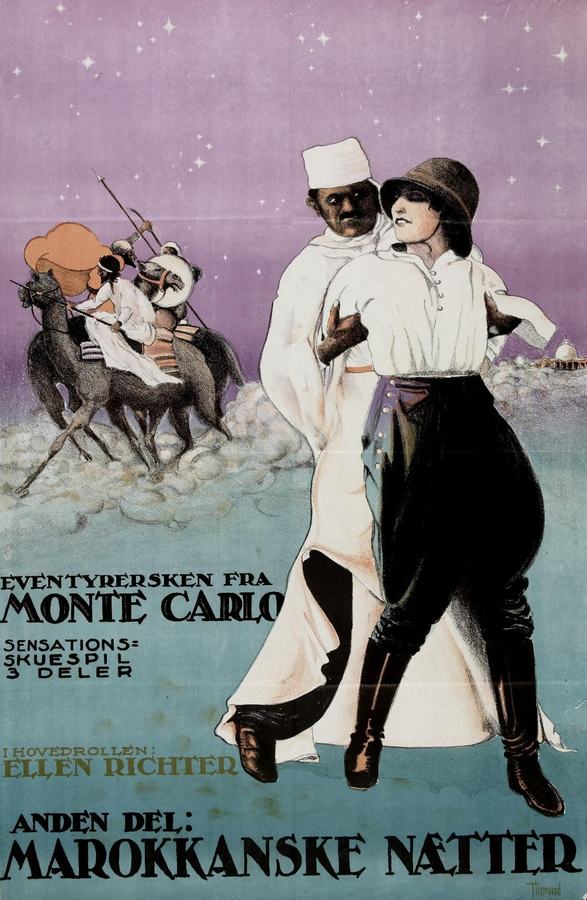
A definitive 5.8/10 rating for a film that redefined the boundaries of cult cinema. Die Abenteuerin von Monte Carlo - 2. Marokkanische Nächte remains a cornerstone of transgressive art.
The first thing that strikes you is the temperature: even in grayscale the film feels sunburnt, as though the celluloid itself absorbed the throb of the Maghreb midday and now radiates it back through the projector bulb. Director Willi Wolff—often dismissed as Ellen Richter’s studio spouse rather than auteur—engineers a fever dream that begins in the frost of European high society and ends amid the thermals of North African nocturne. The tonal shift is so abrupt you can practically hear the mercury burst.
Because the film is silent, every hue must be inferred from contrast: the bone-white burnouses against obsidian doorways, the saffron flare of a match illuminating kohl-rimmed eyes, the sudden intrusion of a pistachio-green silk scarf that the adventuress twirls like a matador’s flag. Wolff and cinematographer Axel Graatard push the envelope of orthochromatic stock, filtering skies until they resemble bruised plums and faces until they glow like porcelain lanterns. The result is a chiaroscuro carnival closer to The Crimson Dove than to the frothy Riviera romps Ufa marketed in the same breath.
Richter’s persona here is less a character than a constellation of gestures: the half-shuttered smile borrowed from Pola Negri, the fencer’s poise from Musidora, the entrepreneurial hustle from her own biography. She produced the picture through her firm Richter-Film, ensuring every close-up is a stake in the heart of patriarchal capital. Notice how she enters the frame rear-first, shoulders already negotiating space, before her gaze skewers the lens. That entrance is repeated with variations—once through a kasbah gate, once through a train corridor, once through a tent flap—until it becomes a motif of perpetual arrival, perpetual escape.
The men orbit her like dead satellites. Karl Günther’s legionnaire sports a jawline sharp enough to slice couscous; his backstory is conveyed only through a tattered photograph of a demolished Balkan village, yet the tremor in his salute speaks whole campaigns. Hugo Hummel’s banker is a marvel of perspiration—beads of sweat become miniature crystal balls foreclosing futures. Hungarian character actor Károly Huszár, usually typecast as a bumbling waiter, here morphs into a Sephardic smuggler whose sidelong grin could sell sand in the Sahara. Their collective incompetence at ensnaring the heroine feels less like plot armor than geopolitical commentary: empire’s machinery creaks, but the cosmopolitan woman pirouettes through its gears.
Wolff shot on location in 1922, when the Protectorate was still a rough sketch on French military parchment. Thus the film straddles two impulses: the colonial postcard—snake charmers, water-sellers, veiled harem girls—and the proto-ethnographic curiosity. In one astonishing shot, the camera simply lingers on a tanner’s square, observing lime-slaked hides being stretched under the Saharan sun. No white protagonist intrudes; the narrative yields to lived space. That moment feels closer to Who Knows? in its vérité candor than to the studio-bound exotica of, say, A Man’s Man.
The screenplay, credited to Artúr Somlay, adopts a spiral structure: each act is a gamble whose stakes are reinscribed into the next. Monte Carlo’s roulette table is mirrored by a dusty plaza de toros outside Tangier, which in turn dissolves into a midnight poker game inside a moving train. Every locale is a felt-green battlefield where identity is staked, split, re-dealt. The adventuress’s final wager is not currency but her own silhouette: she backs herself into a shadow-play against a palace wall, and when the torches extinguish, the silhouette keeps moving—autonomous, un-ownable.
Contemporary exhibitors were instructed to accompany the Marokkanische Nächte with a melange of Debussy’s “Iberia,” military marches, and improvisations on the gimbri. Yet at the recent Bonn retrospective, curator Lina Bhattacharya opted for a single ondes Martenot, its glissandi evoking the muezzin’s call ricocheting off Art Deco façades. The result is a sonic mirage that makes the silence visible—every time the electronic wail rises, the on-screen world seems to shiver, as though the celluloid itself is remembering futures lost to talkies.
Unlike the flappers of You Never Saw Such a Girl who merely toy with male prerogatives, Richter’s adventuress re-scripts the economy of looking. She returns the gaze, sells it, buys it back at inflated rates. In a pivotal sequence she swaps her sequined gown for a male caftan, strides into a café chantant, and lights a cigarette for a bewildered odalisque. The genderfuck is not subtext; it is transaction. Masculinity becomes couture to be donned, discarded, repurposed.
Post-colonial critics will flinch at the indigène extras relegated to backdrop, yet the film sporadically grants them agency. When the adventuress bargains passage from a Riffian guide, the negotiation unfolds in Tamazight subtitled only by gesture; the guide names his price by holding up three cartridges and a sprig of rosemary—an olfactory contract that bypasses Francophone bureaucracy. These micro-gestures complicate the film’s complicity in imperial spectacle, suggesting a counter-archive that flickers just outside the frame.
Place this artifact beside The Unpardonable Sin and you’ll notice a shared obsession with borders—national, corporeal, moral. Yet where the earlier film moralizes, Marokkanische Nächte monetizes. Its ethical vacuum is its radicalism: no divine retribution, no matrimonial closure, only the perpetual deferral of the spinning coin. Conversely, stack it against Too Many Crooks and the difference between Weimar cynicism and British bedroom farce becomes a thesis on continental drift.
Film historians whisper of a tenth reel in which the adventuress pilots a downed Luftwaffe biplane across the Gibraltar strait. No print has surfaced, yet production stills show Richter in aviator goggles, scarf whipping like a battle standard. The absence is itself poetic: a woman whose trajectory exceeds the medium’s capacity to contain her.
The 2022 4K restoration by the Deutsche Kinemathek sources a Czech nitrate print and a French Éclair backup, scrubbing mold blooms yet retaining cigarette burns as stigmata of exhibition history. It streams on MUBI in rotation and screens at cinematheques with live accompaniment. For home cinephiles, the out-of-print Palisades Tartan Blu-Ray—region-free, with a booklet by Tag Gallagher—commands upwards of €120 on secondary markets. Bootlegs circulate on soulless forums; resist them. The film deserves better than compression artifacts smudging its desert mirages.
Because movies that end with coins still spinning are rare. Because women who gamble with their own shadows rarer still. Because the desert wind that lifts Ellen Richter’s veil carries a century of unresolved desires asking you, across the flicker, to place your bet on perpetual motion. Fold your expectations, shuffle your certainties, and let the Moroccan night ante up your soul.
Community
Log in to comment.