DbcultAccessing Vault...
Cult Review
Senior Film Conservator
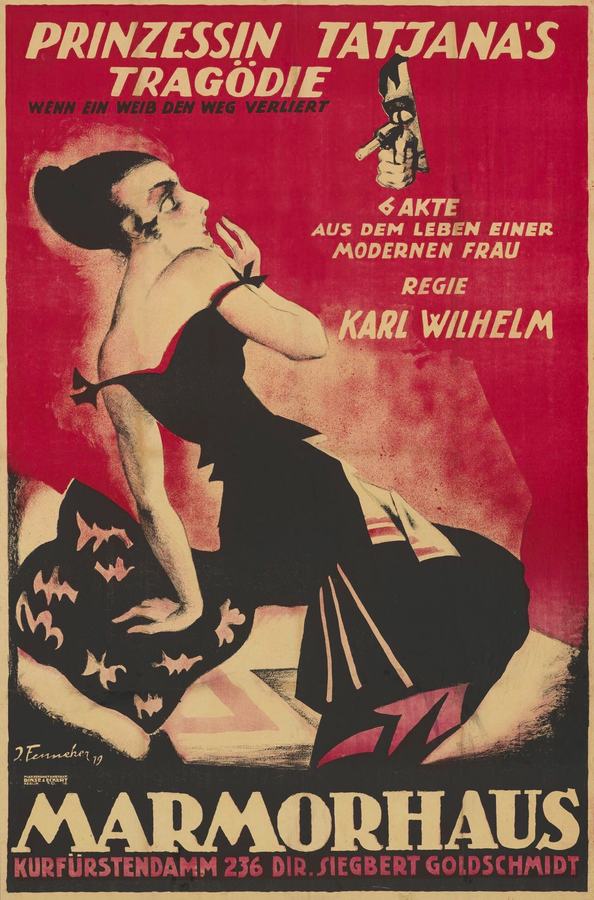
Stepping back into the annals of early 20th-century European cinema, one encounters a fascinating, albeit often overlooked, gem in Hans Gaus’s ‘Prinzessin Tatjanah’. This cinematic excursion into a fictionalized pre-war kingdom, Eldoria, is far more than a simple period piece; it's a profound meditation on the crushing weight of duty against the incandescent flame of personal desire. The film, a lavish production for its time, immerses its audience in a world where geopolitical machinations dictate the most intimate aspects of royal existence, particularly for its titular character, Princess Tatjanah. From the outset, the narrative establishes a palpable tension, a sense of impending inevitability that hangs heavy over every frame. It’s a drama that unfolds with a stately, almost operatic, cadence, drawing viewers into a labyrinth of courtly intrigue and heart-wrenching emotional turmoil.
Magda Almo, in the role of Princess Tatjanah, delivers a performance that is nothing short of captivating. Her portrayal is a masterclass in nuanced expression, particularly crucial in a film that, depending on its original release format, might have relied heavily on visual storytelling and intertitles. Almo imbues Tatjanah with an arresting blend of regal bearing and youthful vulnerability. One can discern the immense pressure of her station in her tightly held posture, the fleeting shadows across her eyes, and the subtle tremor in her hands during moments of intense emotional duress. She is not merely a figurehead; she is a woman grappling with an impossible choice, a living embodiment of her kingdom's precarious future. Her love for Janos, the charismatic architect played by Paul Moleska, feels genuinely fervent, a defiant spark against the pragmatic chill of statecraft. Moleska, too, brings a magnetic intensity to Janos, portraying him not just as a romantic lead but as a man of conviction, his ideals a dangerous counterpoint to the established order. Their chemistry, subtle and yearning, forms the emotional core of the film, rendering their forbidden romance both believable and deeply tragic.
The supporting cast of ‘Prinzessin Tatjanah’ is equally formidable, each actor contributing to the rich tapestry of the court. Eduard von Winterstein, as the austere Baron von Eisenhardt, Tatjanah's guardian and the kingdom's chief diplomat, is a towering presence. His performance is a study in unyielding resolve, a man whose every decision is dictated by the perceived needs of the state, regardless of personal cost. Von Winterstein masterfully conveys the baron’s conviction, even making his rigid adherence to tradition seem, at times, tragically logical. He is not a mustache-twirling villain but a formidable antagonist driven by a sense of duty as profound as Tatjanah’s own, albeit expressed through a different lens. His clashes with Tatjanah are not mere arguments; they are titanic struggles between individual liberty and collective survival, imbued with a gravitas that elevates the film beyond simple melodrama.
Henny Steimann, as Countess Ilona, Tatjanah's confidante, offers a fascinating portrayal of a character caught between worlds. Initially appearing as a loyal friend, Ilona's subtle shifts in allegiance, driven by her own burgeoning political ambitions, provide a compelling subplot. Steimann’s performance is understated yet potent, her facial expressions and body language conveying a complex inner life of calculation and conflicted loyalty. Her character serves as a stark reminder that in the high-stakes world of court politics, even the closest bonds can be tested and, at times, betrayed. Josef Ewald and Gustav Adolf Semler, in their respective roles, contribute further layers to the courtly intrigue. Ewald, perhaps as Prince Viktor, brings a quiet dignity to a character who, despite being a political pawn, is not without his own sense of honor, adding a layer of pathos to Tatjanah’s impossible situation. Semler, potentially as a rival diplomat or a more subtle schemer, excels in portraying the nuanced power plays inherent in the royal court, his presence often signaling a shift in the narrative’s tension. Wilhelm Prager and Gertrude Hoffman round out the ensemble, their performances, even in smaller roles, contributing to the film’s immersive atmosphere, painting a vivid picture of a kingdom teetering on the brink.
Hans Gaus’s screenplay for ‘Prinzessin Tatjanah’ is a masterclass in dramatic construction. Gaus eschews simplistic narratives, instead weaving a complex tapestry of personal sacrifice, political necessity, and the inexorable march of fate. The pacing is deliberate, allowing moments of profound emotional resonance to breathe and resonate with the audience. There's a classical elegance to the story's arc, reminiscent of ancient Greek tragedies where individual desires are often crushed by the demands of a larger, impersonal destiny. Gaus’s genius lies in his ability to make these grand, sweeping themes feel intensely personal, focusing on the intimate struggles of Tatjanah while never losing sight of the broader political implications. The dialogue, even if primarily conveyed through intertitles in its original form, likely possessed a poetic quality, reflecting the formal elegance of the era while conveying deep emotional truths. The narrative structure, building inexorably towards Tatjanah’s agonizing choice, is a testament to Gaus’s skill in maintaining suspense and emotional investment.
The film’s thematic explorations are remarkably sophisticated. It delves into the nature of leadership, the burden of inherited responsibility, and the often-irreconcilable conflict between individual happiness and collective good. These are not novel concepts in cinema, but Gaus approaches them with a sincerity and depth that feel timeless. In an era where many films focused on simpler moral dichotomies, ‘Prinzessin Tatjanah’ dares to present a world of moral ambiguity, where heroes are flawed, and antagonists are driven by their own, often understandable, convictions. This complexity is what lends the film its enduring power, making it relevant even to contemporary audiences who might find parallels in modern political landscapes and personal sacrifices.
Visually, ‘Prinzessin Tatjanah’ is a feast for the eyes. The sets, depicting the opulent interiors of Eldorian palaces and the bustling, yet constrained, cityscape, are meticulously crafted, transporting the viewer directly into this imagined world. The cinematography, likely a marvel of its time, would have utilized dramatic lighting and carefully composed shots to enhance the emotional weight of each scene. Consider the contrast between the grandeur of the royal ballrooms and the intimate, shadowed spaces where Tatjanah and Janos steal their moments of forbidden affection. This visual storytelling amplifies the narrative, making the clash between their private world and public duty all the more stark. The costumes too, would have been exquisite, reflecting the historical period with an artistic flourish that speaks volumes about the characters' stations and inner lives.
Comparing 'Prinzessin Tatjanah' to other films of its era, one might draw parallels with the intense emotionalism found in films like Gefangene Seele (Captured Soul) or the societal critiques present in Man's Desire. While sharing a penchant for exploring the human condition under duress, 'Prinzessin Tatjanah' distinguishes itself with its focus on the royal dilemma, a narrative niche it fills with remarkable grace and gravity. It possesses a certain grandeur, a sweeping romanticism that sets it apart from the more intimate, domestic dramas of the time. One could also see echoes of its themes in later works that explore the tragic consequences of love and duty, though few capture the specific blend of courtly splendor and personal anguish quite so effectively. The film doesn't shy away from the harsh realities of its premise; it embraces them, allowing the audience to feel the full weight of Tatjanah’s predicament. The meticulous attention to detail in production design, from the intricate tapestries adorning palace walls to the period-accurate military uniforms, grounds the fictional kingdom in a convincing reality, making the stakes feel profoundly tangible.
The climax of 'Prinzessin Tatjanah' is handled with a masterful touch, avoiding easy resolutions or saccharine conclusions. Tatjanah’s choice, to either secure her kingdom's precarious peace through a political marriage or to embrace her forbidden love, is presented as an agonizing, no-win scenario. The film understands that true tragedy often lies not in clear-cut villainy, but in the collision of legitimate, yet conflicting, desires and responsibilities. Her decision, whatever its specifics, resonates with a profound sense of sacrifice, leaving an indelible mark on the viewer. It’s a moment that speaks volumes about the character’s inner strength and her ultimate understanding of the monumental burden placed upon her shoulders. This isn't a story about a princess being rescued; it's about a princess making an impossible decision for the sake of her people, even if it means shattering her own heart in the process.
The film’s legacy, despite its relative obscurity today, is significant. It stands as a testament to the sophisticated storytelling and artistic ambition of early European cinema. While it might lack the avant-garde experimentation of some contemporaries, its strength lies in its timeless narrative and powerful performances. ‘Prinzessin Tatjanah’ offers a compelling window into a particular historical and cinematic moment, yet its central themes of love, duty, power, and sacrifice remain eternally relevant. It urges us to consider the personal cost of political decisions, the quiet heroism found in self-abnegation, and the enduring power of a love that, even when unfulfilled, shapes destiny. For cinephiles and historians alike, rediscovering ‘Prinzessin Tatjanah’ is an enriching experience, a chance to appreciate a film that, through its emotional depth and narrative complexity, transcends the limitations of its era to deliver a truly impactful cinematic statement. It is a film that lingers in the mind long after the final frame, prompting reflection on the choices we make and the unseen forces that often dictate our paths. Its exploration of the human heart, caught between the demands of the state and the whispers of personal longing, is as resonant today as it was a century ago, solidifying its place as a poignant, if often unsung, masterpiece.
IMDb —
1929
Community
Log in to comment.