DbcultAccessing Vault...
5.2/10
Senior Film Conservator
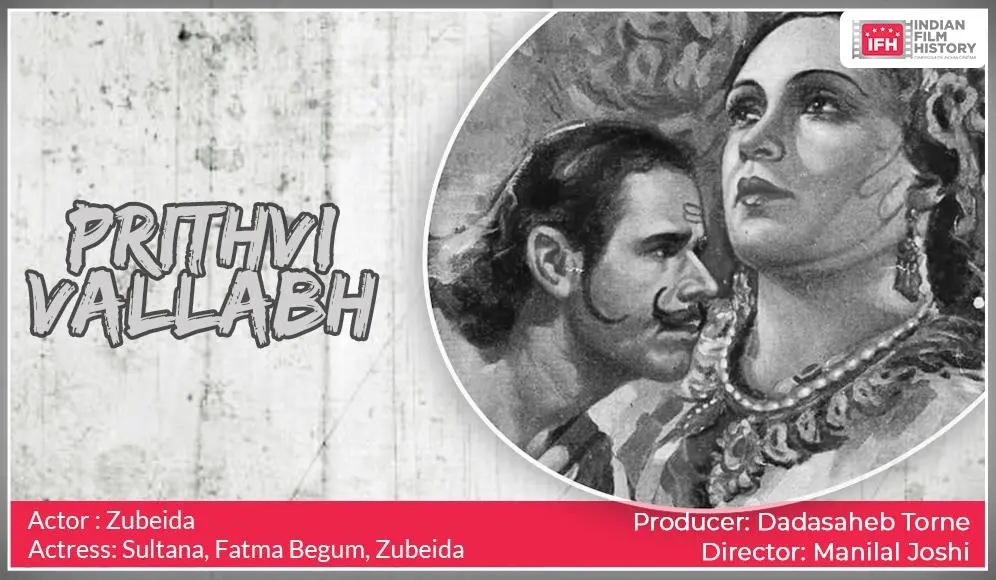
A definitive 5.2/10 rating for a film that redefined the boundaries of cult cinema. Prithvi Vallabh remains a cornerstone of transgressive art.
Stepping into the world of Prithvi Vallabh feels like unearthing a forgotten scroll, an ancient tapestry woven with threads of valor, vengeance, and a love so potent it dares to defy the very foundations of enmity. This seminal silent historical film, a jewel from a bygone cinematic epoch, transcends its technical limitations to deliver a narrative of profound emotional resonance. Released at a time when cinema was still finding its voice, literally and figuratively, it stands as a testament to the universal power of storytelling, proving that spectacle and sentiment do not require spoken dialogue to stir the soul. The film doesn't just present a story; it evokes a grand historical canvas, brimming with the ambitions and frailties of kings and queens, a narrative that feels as immediate and compelling today as it must have nearly a century ago.
At its heart, Prithvi Vallabh chronicles the tragic odyssey of King Munja of Aranti, portrayed with an arresting blend of regal bearing and artistic sensibility by Wagle Sandow. Munja is not merely a conqueror; he is a connoisseur, a patron whose appreciation for beauty runs as deep as his strategic acumen on the battlefield. His very existence, however, is a thorn in the side of Tailap, his relentless adversary. The film plunges us into the immediate aftermath of Munja’s capture, a calamitous event orchestrated with the perfidious assistance of Bhillam (Parshwanath Yeshwant Altekar), the monarch of Dharavati. Tailap, fueled by an insatiable thirst for retribution, initially decrees a swift and ignominious end for his captured rival. Yet, fate, or perhaps a more intricate design, intervenes in the form of Tailap’s formidable sister, Minalvati. Portrayed by the luminous Fatma Begum, Minalvati is a widow, a figure of compelling gravitas and unyielding resolve. Her intervention is not born of clemency, but rather a calculated desire to inflict a more profound, psychological torment upon Munja, to systematically dismantle his spirit before his physical demise. This cruel intention, however, becomes the unlikely crucible for an unforeseen and ardent romance. The very act of attempting to break Munja’s will inadvertently forges an unbreakable bond between them, a love that blossoms amidst the bitterest of enmities. The lovers, emboldened by their shared affection, hatch a daring plan for escape, a gamble against the overwhelming odds stacked against them. But in this treacherous landscape of ancient rivalries, secrets rarely remain buried. Tailap, a man consumed by his own brand of justice, discovers their audacious scheme. His reaction is swift, brutal, and utterly devastating: Munja is condemned to a horrific end, trampled beneath the colossal feet of war elephants, a grim spectacle that underscores the narrative’s profound and inescapable despair. This is a story that doesn't shy away from the cruel realities of power and the devastating consequences of forbidden love, reminiscent of the stark, unyielding fates often depicted in works like The Price They Pay, where individual desires clash violently with the broader, unforgiving structures of society.
The success of a silent film hinges entirely upon the evocative power of its actors, their ability to convey complex emotions and intricate character arcs through gesture, expression, and physicality. In Prithvi Vallabh, the cast rises magnificently to this challenge. Wagle Sandow, in the titular role of Munja, delivers a performance that is both commanding and deeply vulnerable. His portrayal of the king's initial pride, his descent into captivity, and the unexpected blossoming of love, is conveyed with a nuanced elegance that belies the absence of dialogue. We witness his internal struggle, his regal bearing gradually softening under the influence of Minalvati, only to be replaced by a defiant resolve as his tragic fate approaches. Sandow's physical presence, a hallmark of his career, is utilized to its fullest, projecting both warrior strength and the quiet dignity of a man facing his destiny. One might draw parallels to the powerful yet often understated performances in other silent dramas, where the sheer force of an actor's presence could carry an entire scene, much like the compelling central figures in The Courtship of Myles Standish, who communicate volumes through their stances and gazes.
Fatma Begum, as Minalvati, is nothing short of mesmerizing. Her character is a tour de force: initially a cold, calculating figure bent on psychological torture, she undergoes a profound transformation, her steely demeanor yielding to the tenderness of love. Begum navigates this complex emotional landscape with remarkable subtlety, her eyes conveying the shifting tides of her heart, her gestures speaking volumes where words are absent. Her portrayal imbues Minalvati with a strength that is both formidable and deeply human, making her tragic trajectory all the more poignant. The chemistry between Sandow and Begum is palpable, a silent dialogue of longing and despair that anchors the film’s emotional core. Even in the supporting roles, such as Parshwanath Yeshwant Altekar's treacherous Bhillam, and the contributions of G. Bhal Pendharkar, Sultana, Zubeida, and Miss Jaina, there is a commitment to conveying character through the heightened, yet precise, language of silent cinema. Their collective efforts ensure that the film’s dramatic weight is borne not by exposition, but by the raw, unfiltered power of human emotion.

IMDb —
1915
Community
Log in to comment.