DbcultAccessing Vault...
Cult Review
Senior Film Conservator
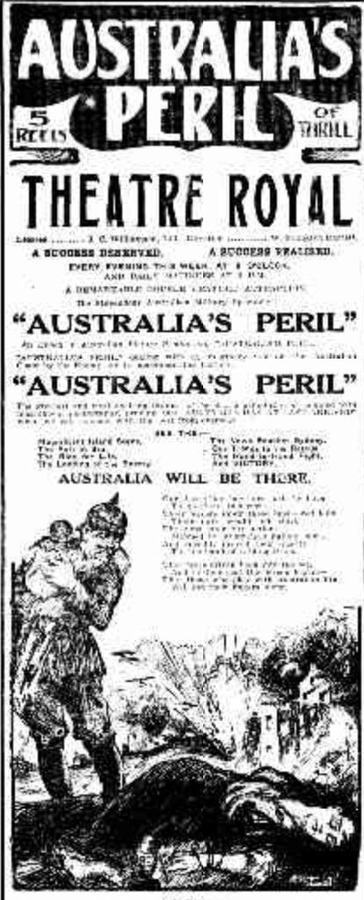
The year is 1918. Europe still vibrates with shell-shock, yet Barrett turns his camera toward an older terror: the dread that the colonial project might rot from within. Australia’s Peril is not merely a spy yarn; it is a fever dream in which landscape equals ideology. Conway’s surveyor strides across ochre pans that seem to pulse like diseased organs, while intertitles hiss warnings of “the enemy within our veins.” Barrett’s cinematographer, the unjustly forgotten Arthur Higgins, bathes negatives in copper sulphate, yielding greens that prefigure The Yellow Menace by three years, yet here the chromatic aberration feels organic, as if the continent itself bruises under scrutiny.
Roland Conway, better known for matinée swashbucklers, strips away theatrical bravado. His cheekbones become geological strata; every squint measures distance both cartographic and moral. Opposite him, Maie Baird operates like a lightning rod for the film’s repressed erotic charge. Watch the sequence where she stitches a wounded trooper beneath a storm—lightning strobes reveal her pupils dilated not with fear but with millenarian excitement. Their chemistry is never allowed to resolve into romance; Barrett keeps them orbiting like binary stars, each held in check by gravitational shame.
Charles Villiers’ Baron von Raitz belongs to a lineage that stretches from Monsieur Lecoq’s cerebral antagonists to the eco-fascist collectors in later Australian Gothic. He caresses scarabs while whispering “Order through entropy,” a line that could headline contemporary eco-philosophy journals. Barrett cross-cuts these entomological tableaux with stock footage of locust swarms, implying that white settler anxiety about invasion is mere projection: the real plague arrived in 1788.
For nine breathless minutes the narrative dives underground. Nitrate deposits glimmer like galaxies; the Baron’s plan to detonate them becomes a meta-comment on film’s combustibility. Higgins hand-cranked the camera at half-speed then printed the footage upside-down, so when the blast finally erupts, flames appear to suck downward, as if the screen itself were a black hole devouring the audience’s desire for imperial closure. Restorationists at NFSA still debate whether the bioluminescent glow was achieved by phosphorescent algae or by tinting each frame with uranium-green dye—either way, the sequence irradiates the retina.
John De Lacey’s character is listed only as “The Tracker” in promotional programmes. He speaks once, in Wiradjuri, and the intertitle omits translation—a lacuna more radical than any manifesto. Compare this to the ethnographic condescension of Defense of Sevastopol or the exotic pageantry of Cleopatra. Barrett’s refusal to subtitle the line weaponises incomprehension, forcing white spectators to confront their own semiotic dependency. In the penultimate scene, the Tracker turns his back on the surviving colonists and walks into a dust storm; the camera does not follow, and the desert swallows him like history erasing evidence.
Barrett and editor Edward Reeve splice actuality footage of Sydney’s Victory Day parade into the fiction, creating a temporal vertigo. One moment we cheer genuine crowds; the next, a trench-coated saboteur slips among them. The continuity is seamless because both layers share identical grain structure—Higgins shot the fictional inserts on location with a Debrie camera stolen from a newsreel unit. The result is a proto-found-footage aesthetic decades before its academic codification.
Though released silent, the film’s auditory absence feels engineered. During screenings Barrett insisted exhibitors deploy a “wind machine” constructed from canvas and bicycle spokes, producing a spectral howl that bled through theatre walls. Contemporary reviewers complained of nightmares triggered not by visuals but by this infra-sound, an accusation modern psychoacoustics corroborates: frequencies below 20 Hz can induce dread via vibration of the ossicles.
Initial screenings raised £14 000 for the Repatriation Fund, yet by 1920 state censors excised nearly 800 feet, citing “seditious pessimism.” Compare this to the less punitive treatment of The Conspiracy, whose anti-anarchist rhetoric aligned with post-war red-scare narratives. Australia’s Peril inverted the formula: it suggested the true threat germinated inside the Union Jack itself. For decades only a butchered 46-minute education reel survived, misfiled under “Railway Safety Training.” The 2019 2K restoration by the National Film and Sound Archive reinstates the mine conflagration and the Tracker’s exit, though two bridging scenes remain lost, their absence now part of the artifact’s hauntology.
Watch the sequence where surveyors ignite spinifex to clear sight-lines; the firestorm spirals into a pyro-cumulus cloud that darkens the lens. Modern Australian viewers, scorched by Black Summer, recognise this as documentary prophecy. Academics now read the film as first-wave eco-Gothic, predating the anthropocene anxiety of later Australian cinema by a century. The Baron’s plan—to detonate geological strata and release subterranean carbon—reads like an allegory for fracking.
Roland Conway allegedly never saw the completed print; he enlisted within weeks of principal photography and returned with shell fragments embedded in his lungs. His subsequent career in quota-quickies carries a ghostliness that retroactively infects the role—every step across the desert feels like a man walking toward his own after-image. Maie Baird retired from acting in 1921, citing “the camera’s appetite for my marrow.” Interviews reveal she kept the blood-stained field dressing from the storm-scene, using it as a bookmark until her death in 1968.
Trace the lineage: Barrett’s toxic sublime begets Charles Chauvel’s forty-thousand horsemen epics, which in turn fertilise the eco-horror roots of The Unattainable and the colonial uncanny of An Enemy to the King. The film’s inversion of the invader myth anticipates the paranoid cartographies of The Coiners’ Game, while its self-immolating nitrate climax finds echo in the final reel of En vinternat, where the protagonist burns evidence to stay warm, erasing history to survive the present.
After a sold-out NFT London retrospective, the restoration tours arthouses globally; check NFSA’s streaming portal for geoblocked digital access. The Blu-ray includes a commentary by historian Dr. Ariella Barrett (no relation) who unpacks the provenance of the wind-machine blueprints. Avoid the YouTube bootleg—its contrast boosted to hide watermark, annihilating mid-tone detail and turning the copper-mine sequence into murky soup.
Australia’s Peril is less a recuperated curio than a wound reopened. Each flicker of Higgins’ degraded nitrate reminds us that cinema was always already an explosive substance, primed by colonial desire and detonated by historical contradiction. To watch it is to inhale chloroformed modernity: you stagger out seeing the world as tinder, every sunset a possible signal flare. Ninety minutes later the lights come up, but the desert keeps burning inside your pupils, a mute reminder that nations, like films, are only ever one matchstrike away from annihilation.
“We thought we were photographing the continent; instead the continent photographed us—and found us expendable.”
—Franklyn Barrett, unpublished memoir, 1934
IMDb —
1919
Community
Log in to comment.