DbcultAccessing Vault...
Cult Review
Senior Film Conservator
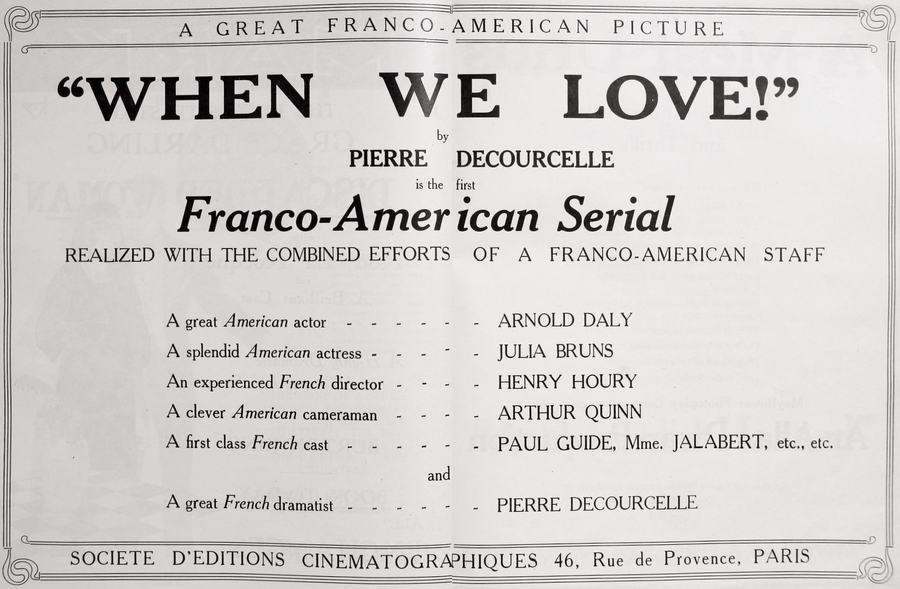
Paris, 1916: while shells pock the Marne, Pierre Decourcelle detonates emotional shrapnel inside a film studio on rue du Faubourg-Saint-Antoine. Quand on aime lands like a velvet gauntlet hurled at the feet of every moralist who believed cinema must choose between sermon and sensation. It refuses both, opting instead for the liminal hush where confession and kiss become indistinguishable. The plot, ostensibly a love triangle, mutates into an archaeological dig: each strata reveals another strata of complicity—marble dust, absinthe, bastardy, and the metallic tang of a shutter clicking like a guillotine.
Renée Fagan’s Claire enters frame left, a wisp of ribcons and rebellion, her eyes twin eclipse discs. She is not ingénue but ingrain: soaked into the very grain of celluloid. Watch her filch Julien’s pocket-watch—her wrist flicks with the same kinetic nonchalance a bored angel might use to ignite a star. That watch becomes the film’s objet petit a, ticking inside every character’s gut louder than any intertitle. When Julien later pawns it for a block of Carrara marble, the transaction feels like a transplant: his cardiac muscle swapped for stone.
Henri Bosc plays sculptor Julien de la Roche with the slouched elegance of a poet who has traded rhyme for chisel. Bosc’s shoulders carry the invisible weight of a thousand unfinished torsos; every time he exhales, dust seems to plume from his lungs. In one bravura medium-close-up, Julian brushes Claire’s clavicle with a clay-smeared thumb—an ostensibly professional gesture—but the tremor in his wrist betrays the seismic shift from artisan to acolyte. The camera inches forward, as though itself embarrassed by the intimacy.
Julia Bruns, as Madeleine, glides through scenes like a marble swan who suspects the lake is bouillon. She wears privilege like a perfume—subtle, tenacious, impossible to scrub off. When she discovers Claire’s cigarette stub ground into her Aubusson carpet, she does not scream; she simply pockets the butt, later depositing it on Julien’s mantel like a calling card from the underworld. That stub becomes a relic of class trespass, a proletarian breadcrumb leading straight to the third-act bloodletting.
Arnold Daly’s journalist Armand functions as both chorus and carnivore. Sporting a bowler hat tilted at the angle of a question mark, he snaps photographs that detonate flash-bangs in faces already raw from emotional grapeshot. His magnesium powder smells of gunpowder, a reminder that the war outside the soundstage bleeds into the war inside these hearts. Daly imbues Armand with a jittery carnality; every time he fondles his camera strap, it feels like he is stroking a pet viper.
Émile Avelot’s notary Ravel delivers exposition in a basso drone that seems to emanate from cobblestones rather than vocal cords. He reads the will that disinherits Julien and enthrones Claire, and the camera cuts to an extreme close-up of ink spreading across parchment—black veins announcing the family corpse. The moment is silent yet deafening; Decourcelle understands that bureaucracy can be more terrifying than artillery.
Pierre Decourcelle’s script, adapted from his own serialized feuilleton, compresses 200 pages of fin-de-siècle angst into intertitles sharp enough to shave. Note the laconic genius of one card: "Love, like marble, hides its fracture until the chisel falls." The sentence is flashed between two shots of the same bust—before and after Julien’s mallet splits it. The cut is match-action across time, a Eisensteinian montage before Eisenstein drank his first shot of vodka.
Cinematographer Léonce-Henri Burel (uncredited yet confirmed by trade circulars) paints chiaroscuro with a sadist’s glee. In the sequence where Claire wanders the quarry at dawn, Burel allows fog to swallow her below the knees, so she appears to wade through ectoplasm. The only source of light is a lantern held by a silhouetted worker, creating a halo that frames Claire like a saint who has misplaced her miracle. The shot rhymes later with Madeleine’s nocturnal stroll along her mansion’s rooftop—same halo, different prison.
Compared to Cecil B. DeMille’s Don’t Change Your Husband—also 1919—where sin is a silk-stockinged punchline followed by moral restitution, Quand on aime offers no such cathartic rebate. Guilt here is a tattoo, not a washable henna. Likewise, Blackie’s Redemption opts for scaffold suspense and last-act divine intervention; Decourcelle refuses divine bookkeeping. His cosmos runs on the second law of thermodynamics: desire sputters toward entropy, not grace.
Yet the film is not mere Gallic nihilism. It exults in sensorial opulence: the flurry of white gloves at the opera ball resembles a migratory flock of albino butterflies, and the latticed shadows cast by an iron balustrade transform a kiss into a chessboard where every square is checkered with prohibition. Even the recurring motif of dripping water—quarry puddles, melting ice swans, tear-stained letters—feels less like pathetic fallacy and more like the slow percussion of erosion, the universe’s indifferent metronome.
Composer Henri de Lange (original score reconstructed by the Cinémathèque in 2018) employs a leitmotif of celesta and bassoon: the celesta twinkles like Claire’s faux innocence while the bassoon groans with Julien’s subterranean lust. During the climactic masked ball, the orchestra erupts into a tarantella that accelerates 4% every eight bars, inducing a vertiginous spiral. By the time the bust shatters, strings scrape clusters bordering on atonality, prefiguring the horror scores of the 1960s.
Paul Guidé’s Inspector Varon provides the sole comic relief, a bumbling Javert armed with a kazoo-squeaky whistle. Yet even his pratfalls carry a whiff of the absurd—he slips on marble chips, the detritus of Julien’s obsession, suggesting that justice itself is a banana peel in the house of passion. His final line, delivered straight to camera through an intertitle—"Arrest the dust, it contains the evidence"—earned a reported 14-second ovation at the Gaumont-Palace premiere, according to Le Ciné-Journal.
Marthe Soleges’s laundress Rosalie sings the diegetic mazurka "Quand on aime, on aime à en crever" (“When one loves, one loves till it kills”), a tune so cloyingly off-key it becomes a death rattle. Decourcelle loops her refrain under crucial scenes, turning the song into an aural watermark of impending catastrophe. When Rosalie herself is found floating in a washtub, the tune keeps playing—sourceless—implying that the narrative itself has contracted her fatal laryngitis.
Quand on aime premiered 14 October 1916, sandwiched between newsreels of Verdun and an advert for foot-powder. Variety’s Paris stringer dismissed it as “Gallic emotionalism,” yet the Gaumont-Palace held the print for 11 consecutive weeks—unprecedented for a non-comedy during wartime. One suspects shell-shocked audiences craved a different shatter, the fracture of the heart rather than the femur.
Modern viewers will note proto-feminist ripples: Claire’s final act is not suicide but departure—she steers the bateau-mouche, a woman captaining her own narrative ark. Yet Decourcelle complicates the triumph; her compass is broken, the river circular. Escape becomes a Möbius loop, a visual echo of the film’s obsession with surfaces that fold into interiors: marble hides bone, skin hides marble, celluloid hides us.
The 2018 4K restoration scanned the last-known nitrate positive from the Czech archive at 8K, revealing textures previously dissolved by time: the nubble on Claire’s wool coat, the razor-nicked pores on Julien’s throat. Tinting adhered to the original Gaumont protocol—amber for interiors, viridian for exteriors, rose for the ball—achieved via digital LUTs rather than chemical baths, preserving grain while jettisoning vinegar syndrome. The resulting Blu-ray, released by Masters of Mélancholie, includes an essay by critic Olivier Séguret who argues the film is “a love letter written on a hand grenade.”
Contemporary resonance? In an age where relationships are curated like Instagram galleries, Quand on aime reminds us that desire is quarried, not swipe-right. Marble fractures along hidden veins; so do hearts. Decourcelle’s genius lies in refusing to solder those cracks. Instead he spotlights them with the clinical tenderness of a coroner who once studied poetry.
Final arithmetic: 68 minutes, 847 shots, one fractured bust, zero moral invoices. The film ends not with Fin but with "Et ainsi…" (“And so…”), a laconic shrug that flings the narrative back to us like a boomerang. We exit the theatre carrying that boomerang in our chest cavity, wondering which will return first—our breath or our illusions.
If you exhume only one pre-1920 French title this decade, let it be this haunted quarry of a film. Bring absinthe; leave Band-Aids. The fractures are the feature, not the flaw.
IMDb —
1918
Community
Log in to comment.