Summary
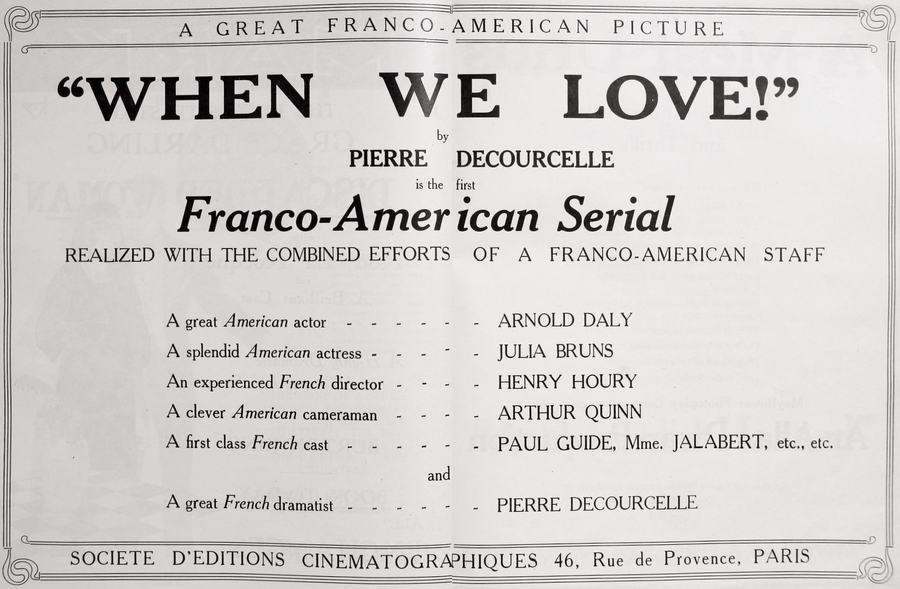
A sepia-toned fever dream of Belle-Époque Paris, Quand on aime pirouettes along the razor’s edge between ardor and annihilation. Renée Fagan’s Claire—part sylph, part street urchin—drifts from the gas-lit quais of the Seine into the velvet-swathed salon of Henri Bosc’s world-weary sculptor, Julien, whose chisel once liberated marble nymphs and now only liberates splinters of his own sobriety. Their first collision is a tango of cigarette smoke and sarcasm inside a Montparnoise café where absinthe drips like liquid emerald; she filches his pocket-watch, he steals her retort, and both discover the clock has already stopped on their former lives. Enter Julia Bruns as Madeleine, Julien’s patrician fiancée, her pearls glinting like cold moons against a throat that never swallows regret—until she senses the musky threat of Claire’s bohemian pheromones. Arnold Daly’s shutterbug journalist, Armand, circles the triangle with a magnesium flash, freezing every flinch and flutter, promising to expose the rot beneath satin gloves. Émile Avelot’s paternal notary, Monsieur Ravel, brandishes a will like a death warrant, revealing that Claire is the illegitimate heir to the very stone quarry that supplied Julien’s marble, turning desire into a Möbius strip of ownership and obliteration. Paul Guidé’s gendarme, Inspector Varon, sniffs opium-laced scandal, while Marthe Soleges’s laundress, Rosalie, sings off-key mazurkas that foretell doom with every cracked note. Alexandre Colas’s hunchbacked archivist, Grégoire, unearths a cache of letters in which Claire’s dead mother confesses she once posed for Julien’s most celebrated sculpture—thus fusing mother and daughter in the same sinuous silhouette of stone and skin. The camera, drunk on its own dolly-zoom epiphanies, lingers on a rain-slick bust of Claire’s face half-finished: a half-life, half-death artifact. In the climactic masked ball at the opera, everyone dons Minotaur masks; shadows prowl like mythic guilt across a labyrinth of staircases. Shots ring out, not from a gun but from the shattering of the bust—Julien has hacked it to pieces, convinced marble can be punished for pulsing with forbidden blood. Claire flees wearing Madeleine’s pearl collar, now snapped; the beads cascade down the grand staircase like albino comets. She boards a bateau-mouche at dawn, but the steamer’s whistle is Julien’s sculpted scream; as the vessel glides under Pont Neuf, she sees his silhouette plunge into the water, arms cruciform, holding the marble heart he never could carve. The final iris-in closes on the Seine swallowing both sculptor and sculpture—leaving only Claire’s reflection trembling atop the waves, a living epitaph inked in ripples.
Review Excerpt
"
a{color:#0E7490;text-decoration:none;border-bottom:1px dotted #0E7490}
a:hover{color:#EAB308;border-bottom:1px solid #EAB308}
blockquote{margin:2em 0;padding:1em 1.5em;border-left:4px solid #C2410C;font-style:italic;color:#EAB308;background:#111}
h2{color:#C2410C;font-size:1.8em;margin-top:2.2em}
h3{color:#EAB308;font-size:1.4em;margin-top:1.8em}
ul{list-style:square inside;color:#0E7490}
li{margin:.6em 0}
strong{color:#EAB308}
Paris, 1916: while shells pock the Marne, Pierre Decourcelle det..."