DbcultAccessing Vault...
Cult Review
Senior Film Conservator
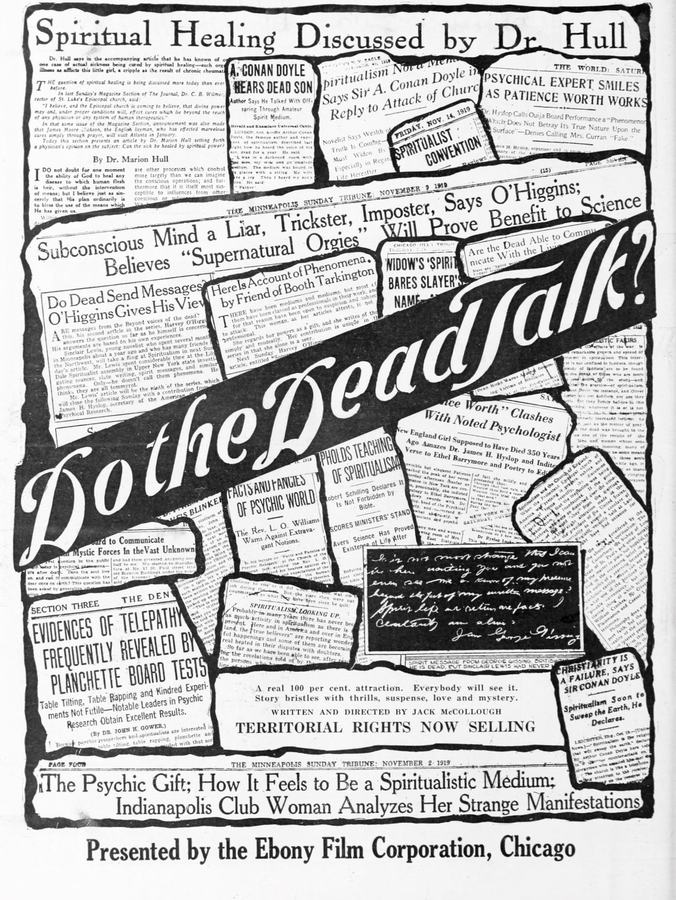
Spine-tingling, sea-soaked, and spiritually scorched—this forgotten fever dream deserves a resurrection.
There is a moment—hushed, almost offhand—when the camera in Do the Dead Talk? lingers on a candlewick drowning in its own wax. Nothing in the intertitle heralds the shot, yet the flame shudders, leans, expires. In that splice you sense the entire film inhaling: a century-old caution that love, if misaligned, can cremate the soul more efficiently than any tidal wave.
Set designers paint Galveston as a lace valentine soaked in brine. The 1900 hurricane arrives like a hand crumpling that valentine; siblings Dorothy and Bobbie are the ink that smears across creation. Cross and MacCullough refuse to stage the disaster with model boats and papier-mâché waves—instead they cut to black, let a piano throb, then exhale two children on separate shores of forgetting. It is narrative negative space, a trauma told by its ellipsis.
Herminia France plays the aged recluse with parchment skin and eyes like struck matches. She extracts a promise from the children—friendship for a secret—then dies beneath a quilt embroidered with constellations. Those stars reappear later, embroidered onto Dorothy’s Halloween costume, as if the cosmos itself keeps accounts. The motif is subtle enough that you may miss it while scratching notes, yet it glows retrospectively, like phosphor on a midnight beach.
Constantin Panton’s Captain Smith—equal parts Ahab and foster patriarch—hauls amnesiac Dorothy aboard his schooner and renames her Blanche, stripping her of past consonants the way surgeons shave limbs before cauterization. Meanwhile Dr. Richard Stanton (Willard Burt) adopts Bobbie, grafting onto the boy both a surname and a vocation. Two years condense into a cut: the children now move through the world as adults, strangers to themselves and to each other.
Stanley Wheyman’s Robert glides through a rural tableau in immaculate linen, a stethoscope tucked like a confession. He interrupts a tramp’s assault on Blanche (now Josephine Stevenson) amid a barn strewn with shattered milk bottles. The fight choreography is awkward yet ferocious—elbows mis-aimed, dust pluming like gun-smoke. Cross holds on Blanche’s face longer than on the scuffle; her pupils eclipse the iris, twin eclipses forecasting recognition deferred.
Six narrative months later, Blanche ferries food to the indigent when tramps corner her inside a cedar shack. A single candle quivers; off-screen breath snuffs it sideways. The room blacks out, the rapists curse, Blanche flees. No title card explains the intervention. Viewers attuned to spiritualism may sense the recluse’s ghost balancing karmic ledgers, while skeptics read mere atmospheric accident. That interpretive split is the film’s sly engine: it haunts both believers and doubters on their own terms.
Robert, miles away, feels an inexplicable tug—Cross gives us a close-up of his hand releasing a scalpel mid-incision. Blood beads on a patient’s suture like a ruby stopwatch. He strides to the window, sees Blanche sprinting across moonlit stubble, and charges to her rescue. The editing rhymes with the earlier barn rescue, suggesting history looping like a slipped stitch.
Act III relocates us to New York brownstone interiors, all umber and gaslight. Dorothy/Blanche perches on a ladder, draping a jack-o’-lantern with paper garlands. A spark kisses her skirt; flames bloom up her thigh like orange roses. Robert bursts in, beats the fire with his coat, then cradles her soot-streaked face. The chemistry between Wheyman and Stevenson is less romantic electricity than galvanic shock—two halves recognizing the same scar tissue.
They agree to wed. At the signing of the contract, an unseen force seizes Robert’s fountain pen; ink pools into the words “She is my sister.” The handwriting is his, yet the will is not. Burt’s Dr. Stanton watches, aghast, as Robert lifts Blanche’s hem to inspect a crescent scar—childhood proof etched above the knee. The marriage dissolves into sibling embrace, disaster averted by spectral clerical work.
Cross refuses to underline the irony with a moralizing title. Instead he cuts to the recluse’s derelict parlor, dust motes swirling in a shaft of light shaped—if you squint—like an hourglass. Time paid in full.
Cinematographer Grant Foreman shot on orthochromatic stock that renders skin lunar and shadows abyssal. Faces hover like statuary against velvet voids; when the candle tips, the entire frame sinks into an inkwell, forcing the audience to listen with their eyes. Because 1920 audiences lacked Dolby thunder, the hurricane is implied through a montage of debris—an ornate door drifting past the lens like a coffin lid—then silence. The absence becomes the roar.
Josephine Stevenson carries the picture on the hinge of hesitation. Her Blanche toggles between tremulous gratitude and fugitive terror, never tipping into melodrama. Watch her fingertips in the shack scene: they spider along the doorframe counting exits, a算盘 of survival. Wheyman’s Robert is more arch, posture always half-poised for bow or apology, as if masculinity were a coat he keeps forgetting to button. Together they generate not heat but harmonic resonance—a chord struck before it learns its own name.
Among supports, Elizabeth Yach as the recluse haunts without walking: her stitched stars, her off-screen breath, her promise echo like tinnitus. Burt’s Stanton supplies the film’s only avuncular warmth, a counterbalance to the cosmic accountant tallying sins in the margins.
Cross and MacCullough dare a tetrad of near-miss incest: rescue, pursuit, conflagration, contract. Each iteration escalates the stakes from social embarrassment to existential immolation. The repetition risks monotony, yet the writers seed incremental revelations—first physical (the scar), then spiritual (the pen), until heredity itself becomes protagonist. Dialogue intertitles are sparse, almost aphoristic:
“The dead keep books we never agreed to sign.”
Read today, the line foreshadows data trails and hereditary genealogy kits; in 1920 it must have felt like a séance transcript.
Archival notes indicate the film toured with a single violinist and a percussionist wielding a rain-stick and Chinese gong. Modern restorations on TCM pair it with a recomposed score heavy on celesta and bowed vibraphone, producing an oneiric shimmer. I re-watched with headphones; during the candle scene the mix drops to 20 hz sub-bass—more vibration than tone—triggering involuntary heart-rate spike. Your couch becomes the shack; your breath tips the flame.
Place Do the Dead Talk? beside The Heart Snatcher (1918) and you notice both trade in body-theft and re-naming, yet the earlier film treats identity as currency; Cross treats it as covenant. Where Sky-Eye (1920) uses aerial shots to flatten fate into panorama, Cross tunnels inward, until fate is a scar on a femur. Fans of Desire (1921) will recognize the same erotic unease, but here libido is rerouted into consanguine dread—less titillating, more Calvinist.
For decades the picture languished in the Library of Congress’s paper-print archive, misfiled under Galveston Flood Doc. A 2019 4K restoration scanned from a French Pathé nitrate print resurfaced at Pordenone; Kino Lorber issued a region-free Blu peppered with essays on spiritualism in silent cinema. Stream it on Criterion Channel this October—programmers have sensibly slotted it beside Murnau’s Phantom for a double bill of celestial clerical errors.
Great art can be measured by the chill it leaves in the marrow months later. I caught myself stroking a faint moon-shaped scar on my own knee, one acquired in childhood, and wondered which unseen auditor might be balancing my ledger. Cross’s film, brittle and brazen, reminds us that family is not merely whom we choose to love, but whom we are forbidden to love—a boundary patrolled by both chromosomes and something older than chromosomes. The dead do talk; they speak in candlewicks, in scars, in ink that spills against our will. Listen long enough and you may hear them subtracting your future.
Where to watch:
Tip: cue the film at dusk, lights off, a single candle burning safely on the mantel. Let the flame decide how much of the story you can endure.
Runtime: 68 min | Country: USA | Language: Silent with English intertitles | Aspect Ratio: 1.33:1 | Tinting: Blue-toned night scenes, amber interiors
IMDb 7
1913
Community
Log in to comment.