DbcultAccessing Vault...
4.3/10
Senior Film Conservator
A definitive 4.3/10 rating for a film that redefined the boundaries of cult cinema. Quartette from 'Rigoletto' remains a cornerstone of transgressive art.
Is 'Quartette from 'Rigoletto' worth watching today? Short answer: yes, but with significant caveats. This fascinating, if somewhat stilted, early film offers a unique window into both the history of cinema and the enduring power of Verdi's opera. It’s a film for cinephiles, opera enthusiasts, and anyone curious about the foundational steps of narrative filmmaking, but it is emphatically not for those seeking fast-paced entertainment or a conventional cinematic experience.
For those who appreciate historical artifacts and the evolution of artistic mediums, it delivers. For the casual viewer, its deliberate pacing and limited scope might prove a test of patience.
The ambition inherent in 'Quartette from 'Rigoletto'' (directed by Angelo Bianchi, circa 1910s) is undeniable. To attempt to translate such a complex and vocally demanding operatic scene to the nascent silver screen was a bold move, one that speaks volumes about the early filmmakers' desire to elevate their craft beyond mere curiosities. This isn't just a recording; it's an interpretation, however rudimentary, of a dramatic moment.
The film works because it attempts to capture pure, raw emotion through a combination of theatrical staging and the then-revolutionary close-up. It understands, at a fundamental level, that the power of opera lies in its heightened emotional states, and it strives to convey that visually.
This film fails because its technical limitations often overshadow its artistic aspirations. The performances, while earnest, are frequently hampered by the constraints of silent film acting, which often leaned towards exaggerated gestures. The sound, or rather its absence, is the elephant in the room when adapting opera.
You should watch it if you are fascinated by the intersection of early cinema and classical music, or if you want to understand how filmmakers first grappled with adapting complex theatrical works for a new medium. It's an educational experience as much as it is an artistic one.
Angelo Bianchi's direction of 'Quartette from 'Rigoletto'' is, by modern standards, incredibly static, yet within the context of its era, it represents a careful, almost reverent approach to source material. The camera largely remains a fixed observer, framing the scene as if it were a proscenium arch. This choice, while limiting dynamic movement, places an intense focus on the performers' facial expressions and body language, which were crucial for conveying the operatic drama without spoken dialogue.
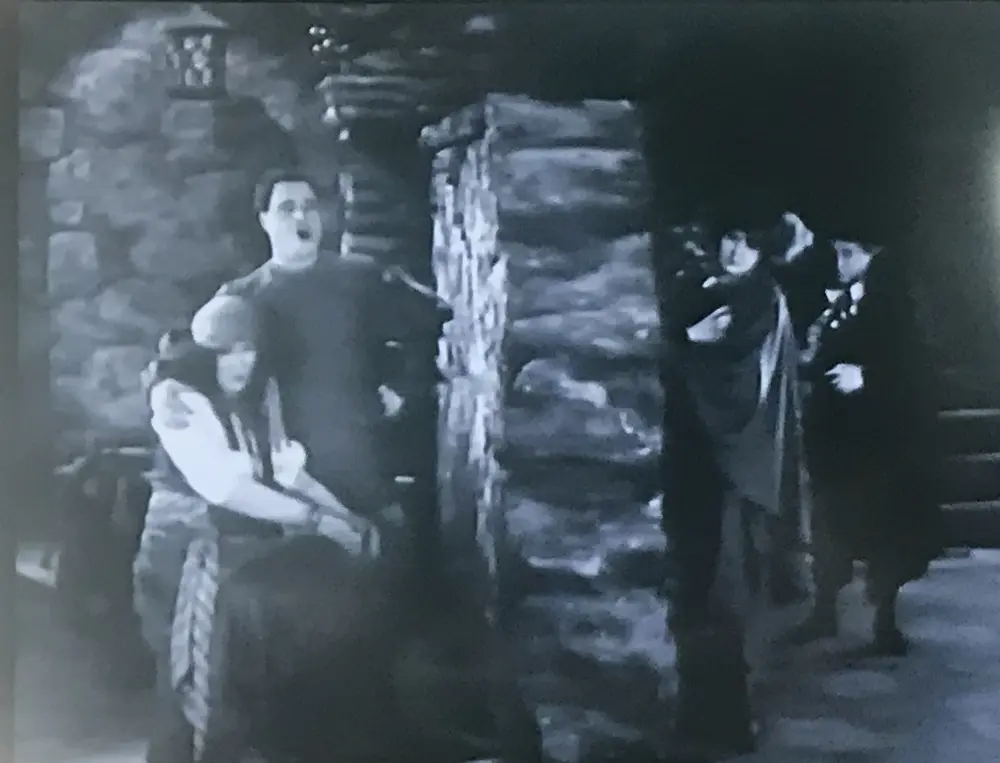
Consider the scene where Gilda (Maria Rossi) is brought by Rigoletto (Alessandro Ricci) to witness the Duke's (Giovanni Moretti) infidelity. Bianchi's camera holds a medium shot, allowing us to see Gilda's initial disbelief morph into profound anguish. The subtle trembles of Rossi's hand, the slow dawning of horror in her eyes – these are the visual cues designed to replace the soaring vocal lines that would typically convey her despair. It's a testament to the actors' ability to project emotion without sound, a skill honed on the stage.
The staging itself is minimalist, yet effective. The tavern interior, with its heavy drapes and simple furniture, feels appropriately claustrophobic, mirroring the emotional entrapment of the characters. The exterior, where Rigoletto and Gilda hide, is bathed in shadow, a stark contrast to the deceptive allure within. This visual dichotomy, though simple, effectively underscores the thematic divide between innocence and depravity.
However, this adherence to theatricality also becomes the film's most significant hurdle. The lack of cinematic language – dynamic cuts, varied camera angles, or movement within the frame – means the film struggles to escape its stage-bound origins. Unlike later, more adventurous adaptations, Bianchi seems content to present a filmed play, rather than a cinematic reimagining. This isn't necessarily a flaw, but a characteristic of its time, and a point of fascination for film historians.
The cast of 'Quartette from 'Rigoletto'' faces the monumental task of conveying operatic-level emotions without the very medium that defines opera: the voice. Maria Rossi as Gilda is particularly compelling. Her portrayal of heartbreak is rendered with a fragility that feels genuine, even through the lens of early silent acting conventions. Her wide, sorrowful eyes and the way she clutches her chest communicate a profound sense of betrayal.
Rossi's Gilda is the emotional anchor, her silent agony serving as a powerful counterpoint to the Duke's boisterous charm. It's a performance that truly transcends its limitations.
Giovanni Moretti's Duke is a study in arrogant swagger. He preens, he gestures grandly, and his facial expressions convey a self-satisfied depravity that is instantly recognizable to anyone familiar with the character. While perhaps a touch over-the-top for modern sensibilities, it perfectly fits the operatic archetype and the demands of silent film projection. His performance is a masterclass in how to command the screen without uttering a single word, relying solely on presence and mime.
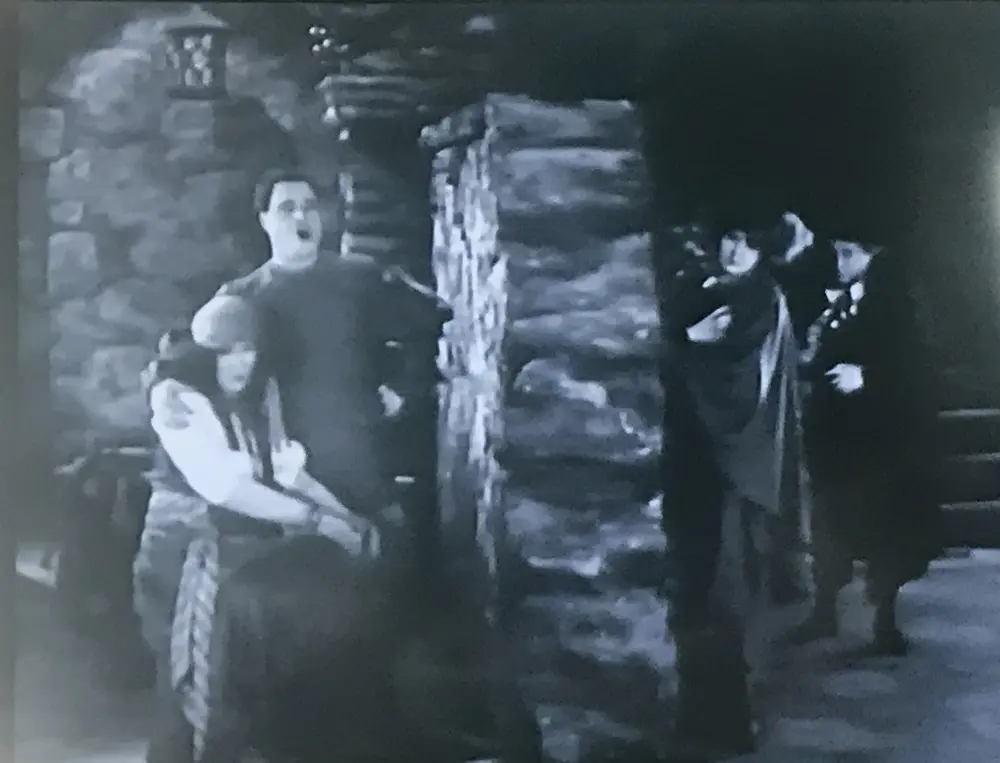
Alessandro Ricci's Rigoletto, the vengeful jester, is a figure of simmering rage and paternal despair. His hunched posture, his hand often clenching into a fist, and the dark intensity in his gaze speak volumes. He is the quiet storm, his silent fury a chilling promise of the tragedy to come. Sofia Mancini as Maddalena, the object of the Duke's fleeting affections, brings a coquettish playfulness that lightens the otherwise heavy atmosphere, providing a necessary contrast to Gilda’s innocence and Rigoletto’s brooding.
What's striking is how these four performers manage to create a sense of ensemble, even when the focus is often on individual reactions. The interplay of their gazes, their subtle shifts in posture, and their carefully choreographed movements create a visual 'quartet' that attempts to mimic the complex vocal harmonies of Verdi's original. It’s an imperfect, yet admirable, feat.
The cinematography in 'Quartette from 'Rigoletto'' is, as expected for its era, straightforward. The camera is static, often at a mid-range distance, capturing the full figures of the actors. Lighting is functional, designed to illuminate the scene rather than create mood, though the use of shadow for the exterior shots is an early, effective attempt at atmospheric design. There are no elaborate tracking shots or complex camera movements; the visual storytelling relies on the actors and the mise-en-scène.
Pacing is another area where modern viewers might find themselves challenged. The film unfolds deliberately, mirroring the unhurried progression of a live operatic performance. There are no rapid cuts or quick scene changes. Each emotional beat is allowed to linger, giving the viewer time to absorb the silent drama. For example, the extended shot of Gilda's face as she comprehends the Duke's treachery is crucial; it allows the audience to project their own understanding of her inner turmoil onto her expressive features. This slow pace, while authentic to the source and period, requires a different kind of engagement from the audience.
It's easy to dismiss this as simply 'slow,' but it's more accurate to see it as 'meditative.' The film asks you to sit with the emotions, to infer the music that would accompany them, and to appreciate the subtle shifts in performance. It works. But it’s flawed. The lack of intertitles to clarify the lyrics or specific plot points (beyond general understanding of the opera) can leave those unfamiliar with 'Rigoletto' feeling somewhat adrift. This is a film that assumes a certain level of cultural literacy from its audience, a common characteristic of early adaptations of well-known works.
The tone of 'Quartette from 'Rigoletto'' is one of earnest dramatic intent, tinged with the melancholic grandeur inherent in Verdi's work. Despite the absence of sound, the film manages to convey the opera's tragic undercurrent. The sense of foreboding, particularly in Rigoletto's silent intensity, is palpable. It's a serious film, devoid of comedic relief, focusing solely on the raw emotional core of betrayal and vengeance.
Its lasting impact is primarily historical. As an early example of adapting high art for the screen, it serves as a valuable document for understanding the evolution of film as an artistic medium. It demonstrates the early struggles and triumphs of cinematic storytelling, particularly in its attempt to convey complex narratives and emotional states without dialogue or synchronized sound. It paved the way for more sophisticated operatic adaptations, influencing how filmmakers would later approach the challenge of translating musical drama.
However, its impact on popular culture is minimal. Unlike some other early films that have retained a broad appeal, 'Quartette from 'Rigoletto'' remains largely a niche interest, primarily for academics and dedicated film historians. It's a foundational piece, but not one that typically features in popular retrospectives of early cinema.
'Quartette from 'Rigoletto'' exists in a fascinating period of cinematic experimentation, often alongside films that were either more purely theatrical or entirely focused on visual spectacle. Compared to a film like The Awakening, which might have explored more naturalistic drama, 'Quartette' leans heavily into its operatic roots. It shares a certain formal rigidity with early narrative shorts such as The Grip of Evil, where storytelling was still finding its unique voice beyond stage conventions. However, it stands apart from slapstick comedies like Dog Scents, which prioritized physical gags over emotional depth.
Its closest cousins are likely other operatic or dramatic adaptations of the era, which sought to bring high culture to the masses through the novel medium of film. While it lacks the groundbreaking visual effects of a Georges Méliès, its innovation lies in its attempt to translate the intangible power of music and voice into purely visual terms. It’s a testament to the early belief that cinema could encompass all forms of art, even those seemingly antithetical to its silent nature.
'Quartette from 'Rigoletto'' is not a film for everyone, nor is it a casual watch. It is a historical document, a fascinating experiment, and a testament to the early ambition of cinema. While its technical limitations and adherence to theatrical staging might make it a challenging experience for modern audiences, its value as an artifact of film and operatic history is undeniable. The raw, silent performances manage to convey the profound emotional weight of Verdi’s masterpiece, offering a unique, if incomplete, interpretation.
For those willing to engage with its historical context and appreciate its groundbreaking intent, it offers a rich, if quiet, reward. It’s a film that demands patience but delivers a rare glimpse into the formative years of an art form still finding its voice. It’s an acquired taste, certainly, but one that rewards the curious palate.
IMDb 6.9
1934
Community
Log in to comment.