DbcultAccessing Vault...
Cult Review
Senior Film Conservator
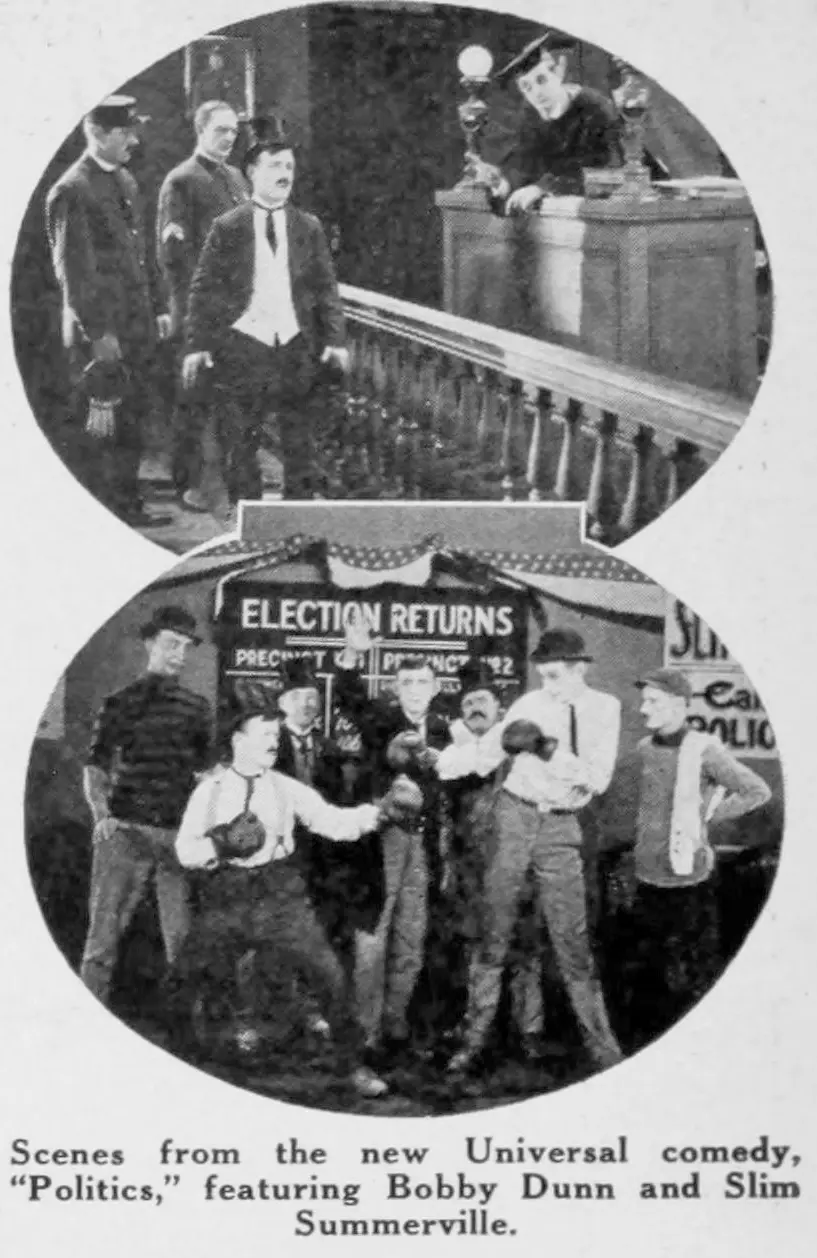
In the pantheon of silent era comedies, few sub-genres offer as much fertile ground for cynicism as the political farce. The 1926 short Politics, featuring the inimitable duo of Slim Summerville and Bobby Dunn, stands as a testament to the era's ability to lampoon the very foundations of civic order through the lens of pure, unadulterated slapstick. While modern audiences might view the concept of a 'police judge' as a quaint relic of a bygone legal system, the film treats this office as a holy grail of local influence, a position for which no tactic is too low and no deception too grand. In many ways, this film anticipates the more sophisticated political deconstructions seen in later works like The Catspaw, yet it retains a raw, visceral energy that is uniquely rooted in the vaudevillian traditions of its stars.
The core appeal of Politics lies in the visual and rhythmic contrast between its two leads. Slim Summerville, with his spindly limbs and hangdog expression, represents a sort of accidental menace. His movements are often languid, yet they carry a deceptive weight. Conversely, Bobby Dunn operates at a higher frequency, a ball of kinetic frustration that constantly threatens to boil over. This duality is essential to the film's success; the rivalry isn't just a clash of wills, but a clash of physical languages. When they vie for the office of police judge, it isn't a debate of policy—it is a choreography of chaos. They utilize 'fair means and foul' with a zeal that suggests the office itself is secondary to the joy of defeating the opponent. This echoes the thematic undercurrents of Squabs and Squabbles, where the pettiness of the conflict is directly proportional to the intensity of the performance.
The 'foul play' mentioned in the synopsis manifests in a series of meticulously timed set pieces. The filmmakers understand that in a silent comedy, the environment is just as much a character as the actors. The streets, the campaign posters, and the courtroom itself become weapons in the hands of Slim and Bobby. There is a specific sequence involving the sabotage of a public rally that rivals the maritime mishaps found in His Briny Romance for sheer inventive absurdity. The editing is sharp, cutting between the two candidates' escalating pranks with a tempo that builds toward a frenetic crescendo. It is this relentless pacing that prevents the film from feeling like a mere morality play. Instead, it becomes a celebration of the 'fair in love and war' philosophy, pushing the boundaries of what a 1920s audience would accept as 'fair' in a political context.
When we place Politics alongside its contemporaries, its unique flavor becomes even more apparent. While a film like What Happened to Jones relies on the comedy of mistaken identity and social embarrassment, Politics is much more direct in its aggression. There is no pretense of innocence here; both Slim and Bobby are fundamentally flawed, driven by an ego that transcends their actual qualifications for the bench. This lack of a traditional 'hero' makes the film surprisingly modern. It shares a certain dark DNA with The Sons of Satan, albeit filtered through a much lighter, comedic lens. Even the romantic subplots, often a staple of these shorts, are treated with a degree of skepticism, as if the characters are too busy sabotaging each other to truly commit to any other pursuit.
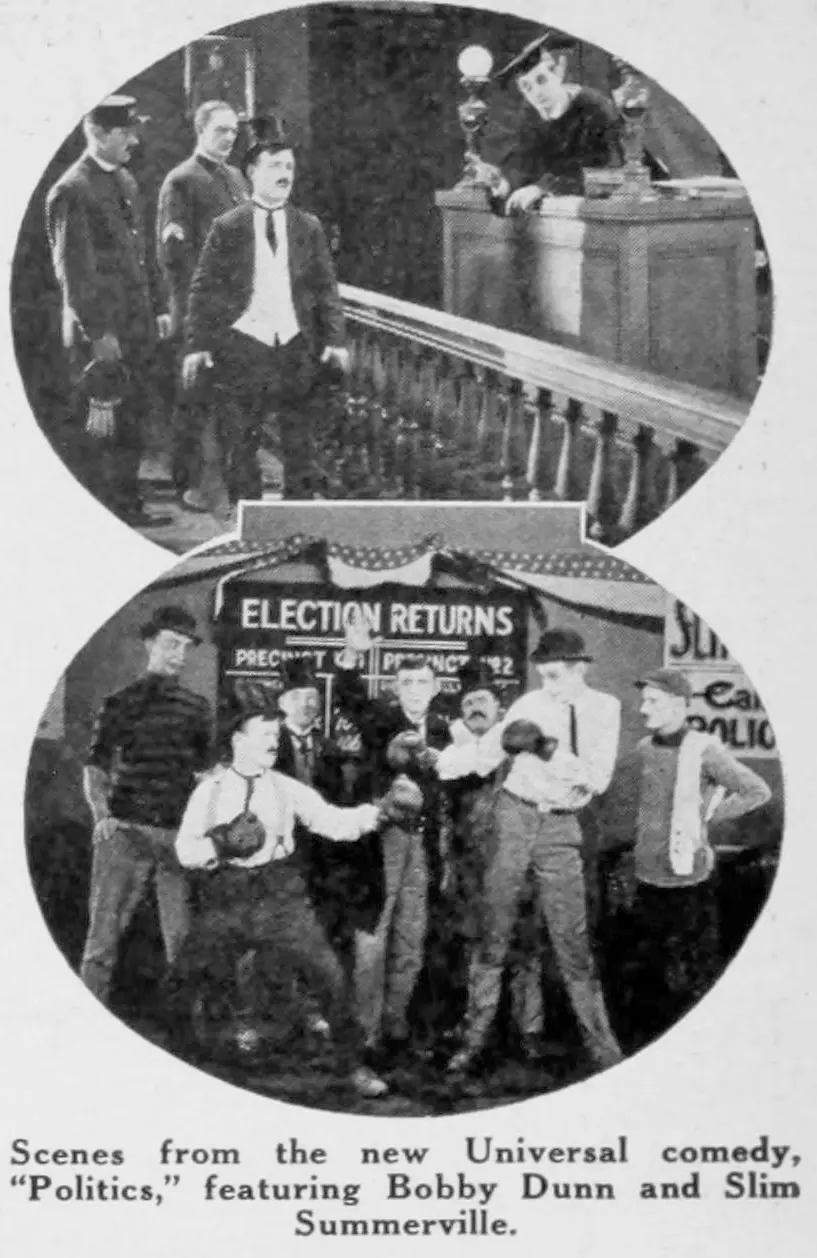
Visually, the film utilizes the medium-shot to capture the full range of Summerville's awkward gestures. There is a recurring motif of 'the look'—that moment when one candidate realizes the other has gained a temporary advantage. The lighting is functional, typical of the mid-20s studio style, but it effectively highlights the grime and grit of the small-town setting. The production design avoids the opulence seen in The Devil-Stone, opting instead for a grounded, almost mundane aesthetic that makes the subsequent slapstick even more jarring. By keeping the setting 'real,' the absurdity of the candidates' behavior is magnified. We see the same commitment to atmospheric groundedness in Sawdust, though applied to a different milieu entirely.
One might argue that the film subverts the 'underdog' trope popularized in films like The Pinch Hitter. In Politics, neither man is truly an underdog; they are both predators in their own right, circling the same piece of meat. This creates a fascinating tension where the audience's sympathy is constantly shifting. We root for Slim when Bobby pulls a particularly low trick, only to switch sides when Slim retaliates with even greater malice. This cycle of retribution is the film's engine. It lacks the melodrama of Az utolsó éjszaka or the haunting mystery of Le revenant au baiser mortel, but it replaces those high stakes with a relentless, low-stakes pettiness that is infinitely more relatable. The question isn't who is the better man, but who can survive the other's incompetence.
As we look back at Politics from a century's distance, its relevance is surprisingly intact. The methods of political warfare may have evolved—moving from physical sabotage to digital misinformation—but the underlying impulse remains the same. The film captures a moment in cinematic history where the grammar of comedy was being perfected. It doesn't have the grand scale of The Holy City or the serialized intrigue of The Phantom Fortune, but it doesn't need them. It is a lean, mean, comedic machine that understands the inherent hilarity of two men who think they are important enough to rule, yet are too foolish to lead. The inclusion of Bobby Dunn, an actor often overshadowed by the giants of the era, is a welcome reminder of the depth of talent available in the 1920s. His chemistry with Summerville is a masterclass in 'rivalry comedy,' a precursor to the great duos that would follow in the sound era.
Ultimately, Politics is a film that rewards the attentive viewer. Beyond the surface-level falls and spills, there is a sharp intelligence at work. It deconstructs the 'Great Man' theory of history by showing that local history is often made by small men with large grudges. Whether it's the subtle use of props or the expressive facial work of Summerville, the film remains a vibrant piece of our cinematic heritage. It may not possess the exotic allure of The Humming Bird or the romantic yearning of Nineteen and Phyllis, but it offers something perhaps more valuable: a mirror held up to our own competitive absurdities. In the world of Slim and Bobby, the only thing more dangerous than losing an election is winning one. For those looking to understand the evolution of the American screen comedy, Politics is an essential, albeit hilariously cynical, stop on the journey. It asks us to consider: who loved the office best? Much like the characters in Who Loved Him Best?, the answer is usually 'no one'—everyone just loves the fight.
IMDb —
1922
Community
Log in to comment.