DbcultAccessing Vault...
Cult Review
Senior Film Conservator
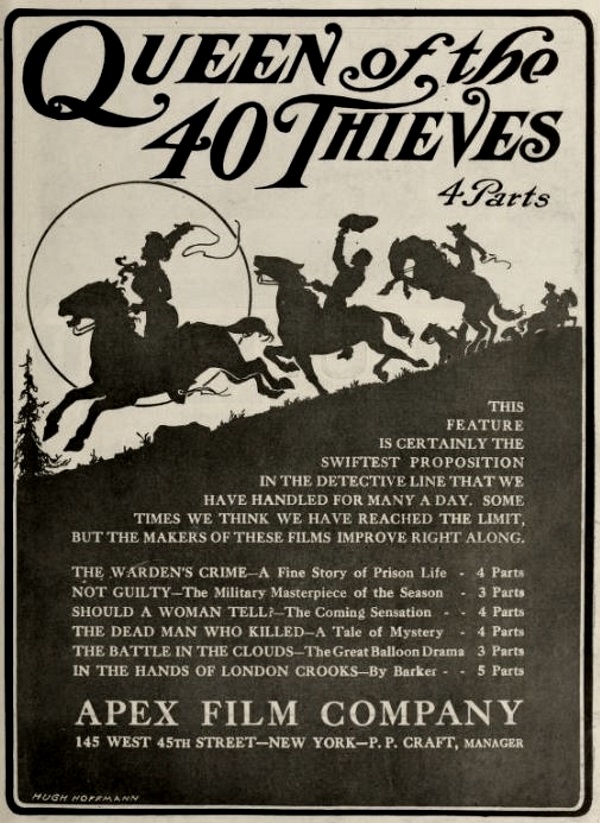
Imagine, if you will, the year 1914: Europe is a powder keg with a lit cigar resting on its fuse, while halfway across the Atlantic, American moviegoers are flocking to converted burlesque halls to gorge on one-reel wonders projected against bedsheet screens. In that crackling twilight of nickelodeon innocence, Queen of the Forty Thieves detonates like a Roman candle—an eight-reel barn-burner whose very length was a flex, a flex whose echo can still be heard in the multiplex sprawl of today.
What unfurls is less a plot than a kinetic oil painting: a Rockefeller-esque financier, jittery with premonitions, hires a detective so fresh-faced he could pass for a newsboy. The sleuth’s assignment? Slip inside the livery, curry the horses, and sniff out the conspiracy coiling around the millionaire’s flaxen-haired daughter. Cue the first of many switchbacks: a runaway carriage, thundering hooves, and a heroic interception that feels cribbed from a pulp cover—yet staged with such spatial gusto you half expect dust to spray from the projector beam.
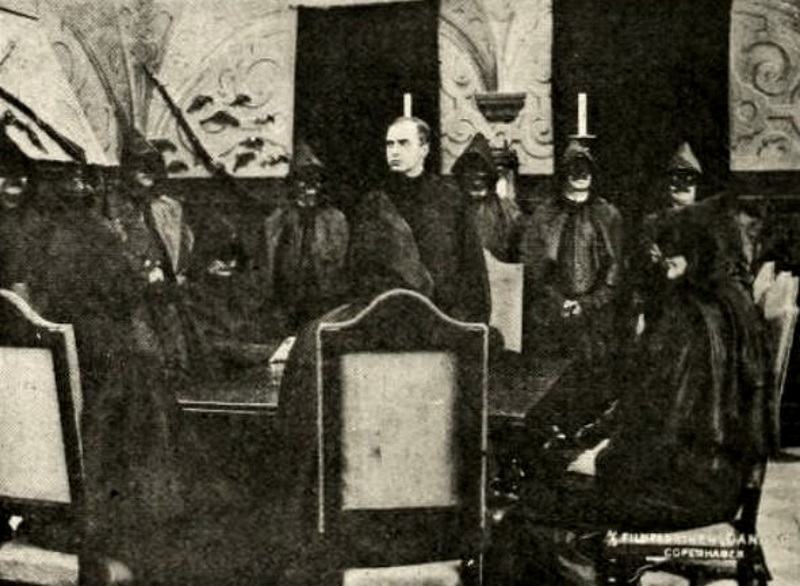
From there, narrative gravity tightens. The ousted coachman—soused, embittered—becomes putty in the hands of Jackson, a dandy whose silk cravat barely conceals the stench of larceny. Together they slink back to the estate, only to be outfoxed by Harris, whose lantern swings like a metronome across mahogany corridors. But triumph curdles: the millionaire, rattled by shadows, boots Harris from the premises, branding him charlatan. Our hero’s riposte? He scans the classifieds, answers a cryptic advert, and plummets head-first into the Forty Thieves’ candle-lit covenant—an initiation that plays like a satanic Rotary club.
Enter the Queen, draped in obsidian satin, eyes glittering with matriarchal malice. She rules her syndicate like Catherine the Great astride a warhorse of graft. Her agenda? Hijack the Parkers’ transcontinental escape, ransom the heiress, then vanish into the cavernous West. The screenplay, economical as a pickpocket, wastes zero breath on moral exposition: we intuit the Queen’s motives from the regal tilt of her chin, the languid way she toys with a pearl-handled stiletto while issuing edicts.
And now, the locomotive set-piece—a set-piece that, for 1914 audiences, must have felt like staring into the future. The gang, astride lathered mustangs, storms a moving train; clouds of alkali dust mingle with the ghostly plume of steam. Cinematographer John W. Brown (unaccredited, as was custom) cranks his hand-cranked camera at variable speeds, so the wheels churn with herky-jerky menace, while the sun flares off the polished rails like twin swords of Damocles.
Harris, tipped off by a purloined newspaper, gallops parallel to the iron horse, boards in disguise, and yanks Alice from the jaws of abduction—only for the gang to recapture them amid a juniper-stippled arroyo. It’s here the film pivots from swashbuckler to siege thriller. Back at the thieves’ adobe stronghold, the camera drinks in vertiginous depth: shadow-soaked corridors, cedar beams blackened by generations of smoke, an attic prison whose single window frames a crucible of stars.
Meanwhile, the cavalry—literal cavalry—gallops across the scrubland, sabers catching dawn like liquid mercury. Their assault is intercut with the Queen’s last-ditch arson: she torches her own empire rather than cede it. Flames lick the edges of the frame; nitrate crackles in the projector beam as though the medium itself blushes in empathy. The Queen, gut-shot, staggers through the inferno, frees Harris, and collapses—a monarch toppled not by law but by entropy.
What lingers is Harris’s ascent through the burning attic: he claws up a dangling hemp rope, shirt singed to ash, skin stippled with soot. He lowers Alice into the expectant blanket of soldiers below, the rope fraying fiber by fiber until—snap—they plummet, bodies slack, only to be buoyed by canvas and cheers. It’s a stunt sequence so visceral you can smell scorched jute, so tactile you feel the heat shimmer across a century of elapsed time.
Silent-era historians often dismiss pre-1920 features as stage-bound curios; Queen of the Forty Thieves spits on that thesis. Observe the camera mounted to the locomotive cow-catcher, the iris-in on Alice’s terror-widened eyes, the chiaroscuro as torchlight wrestles with celluloid grain. These flourishes prefigure not just the grammar of Dante’s Inferno (1924) but the kinetic sadism of 1970s New Hollywood. When Harris, framed against a wall of fire, hesitates for a single frame, we’re staring at a proto-Eastwood antihero—morally knotted, existentially alone.
Performances? The actors remain nameless ghosts, yet their physical lexicon is electric. The Queen communicates dominion via the languid arc of a cigarette; Harris, through a gait that alternates between hayseed shamble and panther coiling. Alice—no wilting daisy—spends half the film astride stallions, hair whipping like signal flags. She even rescues Harris in micro-beats, proving the film’s proto-feminist pulse, a pulse that reverberates later in Your Girl and Mine (1914).
Yet the film’s most subversive feat is tonal oscillation. One reel detonates with slapstick—drunken coachman chasing his top hat down a hillside—while the next plunges into Grand Guignol horror: charred corpses, vultures threading thermals above a massacre. That whiplash anticipates the genre gumbo of modern prestige TV, where laughter catches in the throat like fishhook barbs.
Of course, contemporary critics carped about the film’s “excess”—eight reels, intertitles that verge on dime-novel purple, a finale that milks the rescue for a teeth-grinding ten minutes. But excess is the point. In an era when most narratives wrapped at reel three, Queen of the Forty Thieves luxuriates in sprawl, like a railway baron ordering a second bottle of Montrachet simply because he can.
Restoration-wise, only fragments survive: a 35mm nitrate positive at the Library of Congress, battered but breathable; a Czech print with Czech intertitles that translate like drunken haiku; a 9.5mm Pathé baby reel missing every other frame, causing motion to stutter like a zoetrope mid-seizure. Even partial, the film crackles. Imagine reading a torn Dickens folio and still sobbing at Nancy’s death—such is the phantom charisma of this lost colossus.
So why resuscitate it now? Because the same oligarchic paranoia that haunts Parker haunts our Silicon Valley demigods. Because kidnapping-for-ransom has merely migrated to digital extortion. Because gendered power struggles still ricochet from boardrooms to Twitter brawls. Watching the Queen orchestrate her dominion, we glimpse every media magnate who ever mistook influence for immortality. Witnessing Harris’s self-immolating pursuit of justice, we recognize the investigative journalists who stake career, sanity, sometimes life on a byline.
And then there’s the final image—Harris, face blistered, accepting the millionaire’s handshake and the daughter’s hand in marriage. A conservative dénouement on paper, yet the actor’s eyes betray a thousand-yard stare: he has seen the void, smelled human fat sizzling, heard the Queen’s death-rattle echo off adobe walls. That thousand-yard stare is the birth of modern cinema—no longer mere entertainment, but a mirror hurled into the audience’s lap, reflecting our complicity, our hunger for myth, our terror of entropy.
If you scour archive.org, you might glimpse a 144-pixel, water-whispered rip. Seek it anyway. Crank the volume, let a minimalist synth score (I recommend Kreng) pulse beneath the flicker. Invite friends, pass bourbon, and when the attic burns, when the rope snaps, when the blanket balloons like a parachute, listen for the collective gasp—proof that a century-old ember can still scorch the present tense.
Queen of the Forty Thieves is not a museum relic; it is a stick of vintage dynamite. Light the fuse and brace for detonation.
IMDb 6.2
1925
Community
Log in to comment.