DbcultAccessing Vault...
Cult Review
Senior Film Conservator
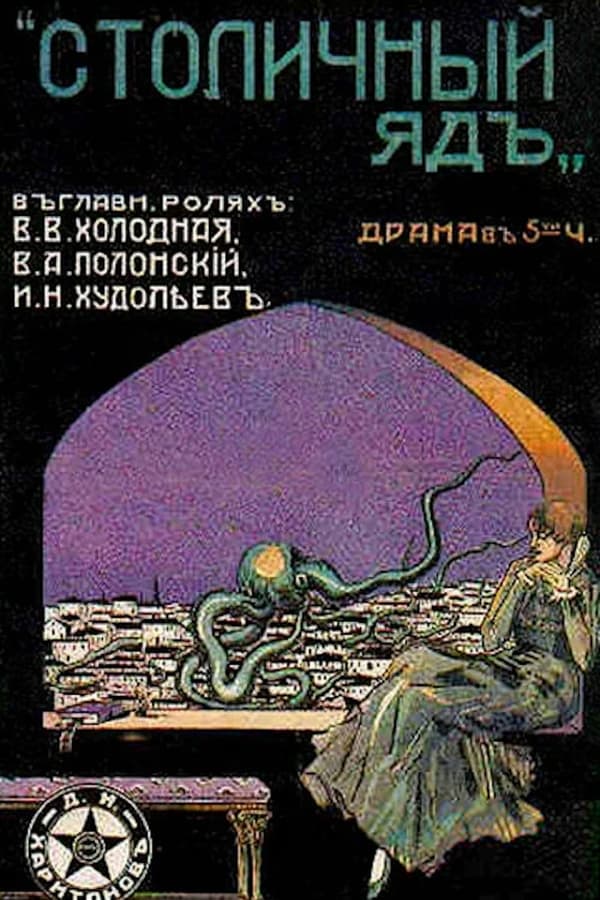
The first thing that strikes you is the frost. Even before the intertitles introduce Petrograd’s powdered aristocracy, the celluloid itself seems to exhale sub-zero vapor. Director Cheslav Sabinsky doesn’t merely photograph winter; he weaponizes it—every ballroom window drips with daggered icicles that mirror the crystalline malice of salon chatter. Vera Kholodnaya, lit like a devotional icon, drifts through this social tundra wrapped in white astrakhan, her eyes wide as Fabergé eggs, ready to be looted.
Silent cinema rarely traffics in subtle odor, yet Stolichnyi iad reeks of lilac water and gunpowder. The gossip that devours Liza is not conveyed via spoken slander but through a choreography of glances: a fan snaps shut like a guillotine, a dowager’s monocle catches the chandelier’s flare and refracts the accusation onto the next dancer. Sabinsky choreographs these cuts with Eisensteinian ferocity years before Eisenstein. The camera itself seems to participate, pushing in until Kholodnaya’s iris fills the frame—an abyss where rumor becomes destiny.
Scholars routinely cite A Fool There Was as the film that minted the vamp archetype, yet Kholodnaya’s Liza is something more terrifying: a virtuous girl executed by the collective erotic imagination of her peers. The picture’s true predator is not a monocled seducer but the semiotic slipstream of Petrograd’s idle class, a hive mind that metabolizes innocence into scandal the way a serf market converts flesh into rubles.
Look at the ball sequence, shot in a single sprawling tableau worthy of a 19th-century history painting. Sabinsky blocks his aristocrats in concentric circles: outer ring of gossiping matrons, middle ring of military officers trading smirks, inner sanctum where Liza waltzes with Prince Roman, oblivious that the orchestra’s pizzicato is the ticking of a social time-bomb. The camera begins to orbit, slowly at first, then with centrifugal violence, until the dancers blur into a maelstrom of cut-glass laughter. It’s a visual ancestor to the ballroom scene in The Flames of Johannis, yet predates it by seven years and feels infinitely more lethal.
The film’s most radical gambit arrives when Liza, now a pariah, visits the offices of The Northern Bee. Instead of a clacking newsroom, Sabinsky gives us a cavernous printshop where lead type is spoon-fed into presses like bullets into Maxim guns. A typesetter drops a single slug—the word “adulteress”—and we watch in macro as ink rolls, paper crushes, and tomorrow’s calumny is born. The sequence lasts maybe twelve seconds, but it compresses the entire epistemology of pre-revolutionary Russia: truth is whatever survives the mechanical reproduction.
Performances oscillate between Symbolist tableau and raw nerve. Kholodnaya’s face is a palimpsest: one instant the ingénue who believes goodness is hereditary, the next a hunted animal who realizes pedigree offers no prophylaxis against slander. Watch her eyes when she first hears the rumor—Sabinsky holds the shot for an eternity, denying us a cutaway. The pupils dilate not with shock but with recognition: she intuits that the story is more charismatic than her flesh ever was. It’s the same existential vertigo that haunts the protagonists of Envy and The Test of Womanhood, but Kholodnaya conveys it without a single subtitle.
Georgy Sarmatov’s Prince Roman is less a lover than a marble bookend, a man betrothed to dynastic ledger columns. His final close-up—after Liza’s corpse has been carried out of the winter palace—registers not grief but bureaucratic irritation, as though someone has spilled borscht on his service record. The true emotional counterweight comes from Vitold Polonsky as the scandal-sheet editor, a louche maestro who twirls a pince-nez while dictating headlines that will drive a woman to suicide. Polonsky underplays villainy into banality; he’s the ancestor of every Twitter algorithm that monetizes outrage.
Cinematographer Yakov Rossi lenses Petrograd as a necropolis of neoclassical facades. Note how he shoots the Anichkov Bridge at twilight: horse statues rear against a sky the color of bruised plums, their bronze flanks echoing the frozen muscles of gossiping humans. The city itself becomes a character, breathing through canals that glint like scalpels. Compare this urban fatalism to the pastoral fatalism of Blue Grass—both films understand landscape as moral verdict.
Fonvizin’s source novella, published in 1899, was already a caustic allegory of Russia’s addiction to reputation. Yet the screen adaptation amplifies the metaphysical horror. In the book, Liza retreats to a convent; in the film she stages her own extinction, descending that grand staircase like a fallen angel who has read the script and decided to improvise the ending. The gown—white silk dyed claret at the hem—turns her into a walking Russian flag soaked in blood, a premonition of 1917 delivered two years early.
The movie’s survival is itself a parable of rumor. Thought lost in the civil-war shelling of 1919, a nitrate print surfaced in 1968 inside the wall of a Vilnius townhouse, presumably hidden by a White émigré. Restoration required frame-by-frame bleaching to remove mold that had eaten Kholodnaya’s cheekbones into lunar craters. Thus the actress who once died from gossip now lives again through chemical resurrection, her ghost reconstituted by acetate and light.
Viewers weaned on post-modern pastiche may scoff at the film’s moral absolutism, yet its diagnosis feels algorithmically contemporary. Replace drawing-room whispers with retweet counts and Liza becomes any influencer canceled by viral montage. The picture understands that reputation is a form of capital whose value increases the more violently it fluctuates. In that sense, Stolichnyi iad is less a period piece than a prophecy written in frost and developed in darkness.
Watch it at 3 a.m. when insomnia makes your own apartment feel like Petrograd in winter. Let the tintypes of Kholodnaya’s face flicker across your retinas until you start to doubt your own digital footprint. Ask yourself: if a rumor about you trended for twelve hours, would you survive the thaw? The film offers no answer, only the echo of a ballroom orchestra playing a waltz whose tempo matches the heartbeat of a woman who has just discovered she no longer exists.
IMDb 5.5
1934
Community
Log in to comment.