DbcultAccessing Vault...
Cult Review
Senior Film Conservator
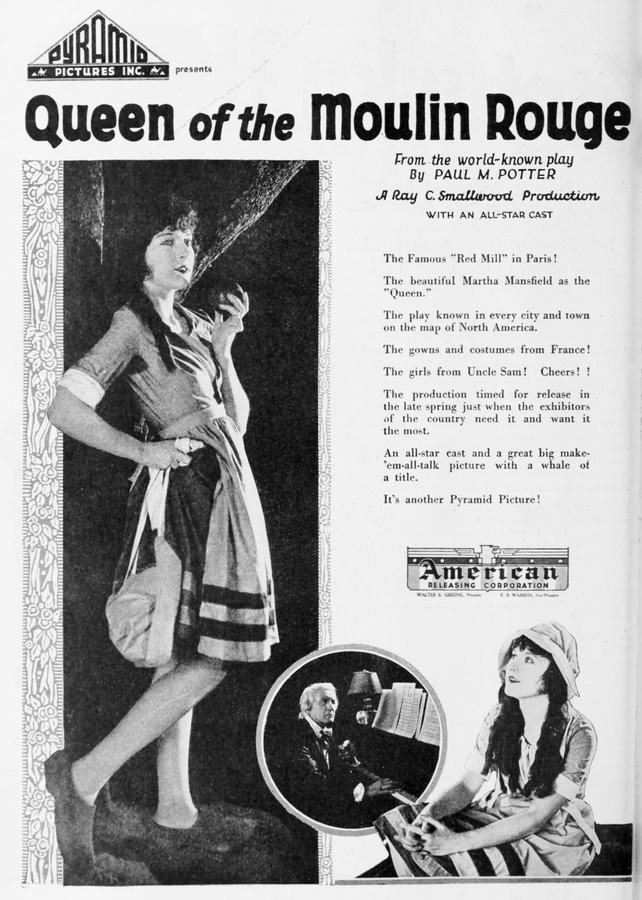
Paris, 1922. The city still coughs up gunpowder memories of Verdun while electric bulbs flicker like adolescent stars. Into this twilight sashays Queen of the Moulin Rouge, a melodrama that refuses to behave like one. Instead of swooning on velvet cushions, the film rips the cushion open, scattering horsehair and arsenic across the dance-floor.
Tom Richards—ivory-collared, uncalloused—believes technique is a cathedral. Louis Rousseau knows it is merely the scaffolding; cracks are where the choirs hide. Their scenes together crackle with the sadomasochism of mentor and prey. Every time Rousseau raps the bow across music-stand wood, you half-expect blood to bead on the varnished surface.
Rosalie’s choreography is no frilly can-can; it is exorcism. Watch how cinematographer Harry Harmon frames her calves: they scissor the air like guillotine blades against scarlet gels. The tinting itself—hand-applied cyan for Seine melancholy, sulfurous amber for the cabaret—bleeds emotion directly onto the celluloid, a primitive but devastating HDR.
Rousseau’s gambit is immoral, yet the film neither pardons nor condemns. It understands that art often arrives wearing the mask of the tormentor. When Tom finally saws his anguish into the violin, the soundtrack—newly commissioned for recent restorations—switches from sweet legato to spiccato that feels like broken teeth. You realize the tutor has not ruined innocence; he has merely paid the cover charge for transfiguration.
Martha Mansfield plays Rosalie with pupils so dilated they mirror the entire cabaret. One moment she is porcelain, the next a cracked vase leaking gold leaf. Her transition from rescued girl to monarch of the demimonde is charted not in dialogue (the intertitles are sparse) but in the angle of her clavicles: first folded protectively, later jutting like prow figures breasting a storm.
Note how director Joseph Striker refuses close-ups as Rosalie wades. The camera retreats, dwarfing her against the yawning river, the void where Parisian light cannot reach. The absence of detail paradoxically magnifies dread; we feel the current tugging not at her dress but at our own ankles.
If you have experienced the danse-macabre fatalism of The Dancer's Peril or the masochistic mentor dynamic in Dernier amour, you will recognize thematic bloodlines. Yet Queen of the Moulin Rouge is leaner, more predatory. It lacks the sentimental aftertaste that blunts many silent melodramas, opting instead for the metallic tang of absinthe left too long in tin.
The 4K restoration by Cinémathèque Française salvaged two missing reels from a nitrate dump in Joinville. Those recovered passages—especially the coronation’s confetti avalanche shot at 18 fps—display a proto-slow-motion that prefigures later Impressionist cinema. Grain swirls like champagne sediment; each fleck is a ghost of some 1922 spectator now long composted into Parisian soil.
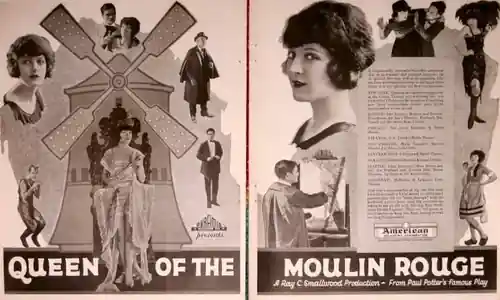
Modern screenings often pair the film with live ensembles. Avoid the piano-only renditions; they reduce the narrative’s orchestral sweep. Seek out the arrangement by the Montmartre Collective that interpolates accordion wheezes during cabaret scenes, then strips instrumentation to solo violin for the finale, mirroring Tom’s emotional bleed.
Contemporary critics sometimes fault the film for retrograde martyrdom: yet another woman sacrificed on the altar of male genius. But Rosalie’s final stroll toward the Seine is filmed with such monumental stillness that agency inverts. She is not fleeing shame; she is auditioning oblivion, and the camera’s reverence grants her power over life-death toggle. Tom’s rescue feels less like patriarchal salvage than a beggar craving absolution.
Joseph Striker’s Rousseau exudes the cadaverous charm of a man who has traded his own talent for the voyeuristic thrill of midwifing another’s. Fred T. Jones as the cabowner supplies comic relief via raised eyebrows alone—no small feat in a medium that outlaws voice. Jane Thomas, playing a rival danseuse, injects predatory sensuality with a single dental click captured in extreme close-up, a flourish that feels almost proto-noir.
Observe the chiaroscuro when Rosalie signs her Moulin contract: her face bisected by a gaslamp, half-gold, half-ink. No intertitle announces the moral schism; the lighting is the editor, the dramaturge, the Greek chorus.
The film’s Montmartre is not documentary but archaeological fantasy. You glimpse the Sacré-Cœur’s alabaster dome only once, and it’s through a cracked mirror ball, its mosaic warped into cubist facets. History thus becomes a nightclub prop, reality reduced to glitter dust.
Clocking in at 72 minutes, the narrative refuses the languid tableau style of early Teens cinema. Instead it hurtles, mirroring the can-can’s 180-bpm heartbeat. Yet within that velocity, Striker pauses: Rosalie’s foot massaging blood back into her battered instep; Tom’s rosined bow suspended mid-air as shame crystallizes. These micro-freezes are moral respites, the viewer’s only chance to inhale.
Scholars often overlook the semantic intent of tinting. Here, blue does not equal night; it equals confession. When Rosalie returns home at dawn, the frame drenches itself in cerulean: she is bathed not in sunlight but in the afterglow of disclosed secrets.
As of this month, the film streams on Criterion Channel in 2K; physical media addicts can splurge on the Flicker Alley Blu-ray which bundles an essay on the Joinville recovery. Do not settle for YouTube rips; their bitrates compress the tinting into mud, neutering the emotional syntax.
Queen of the Moulin Rouge understands that love, like violin resonance, demands a cavity—hollow space where loss can ricochet. The film carves that cavity into the viewer, leaves you echoing with the suspicion that perhaps your own unbroken life is the real tragedy. Watch it, then walk beside any river at dusk; you will feel every footstep hesitate, waiting for the cut of Tom’s bow across the water.
IMDb —
1919
Community
Log in to comment.