DbcultAccessing Vault...
Cult Review
Senior Film Conservator
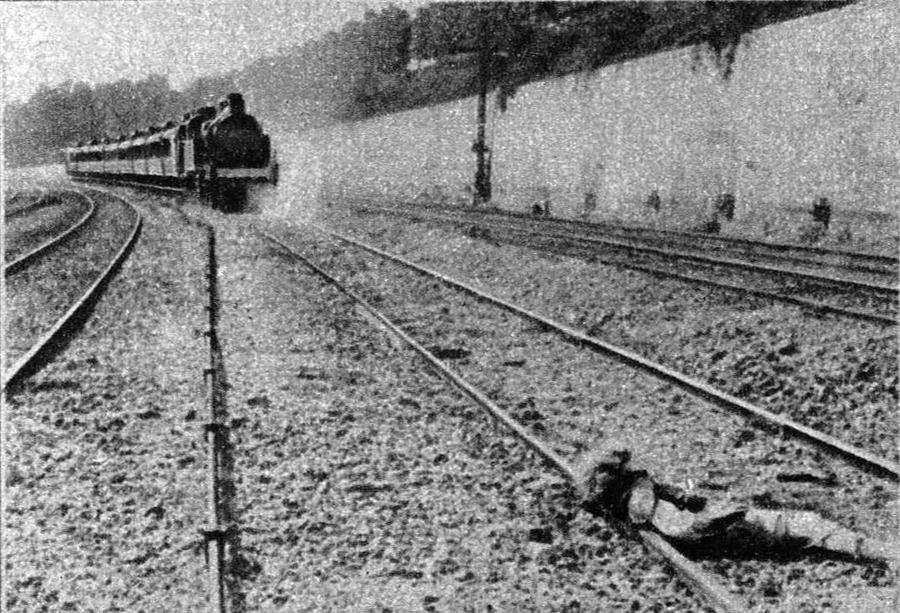
Paris, 1919. The armistice ink has dried but the blood in the gutters hasn’t yet oxidised. Into this half-lit fracture of Europe steps Rapax, a six-part serial that refuses to behave like one. Instead of tidy cliff-hangers, it offers wounds that reopen every time you blink. Director-writer duo Paul Garbagni and Jean Faber—names mostly erased by the nitrate fires of time—conceived a narrative organism that digests its own genre skin: part crime chronicle, part gnostic mass, part maternal hallucination.
Simone d’Argentières, incarnated by the regal yet tremulous Simone Vallier, first appears in an iris shot that refuses to open fully, as though the camera itself fears too much revelation. Her mourning attire is not the customary noir veil but a cascade of obsidian bugle beads that clatter like distant sabres whenever she exhales. The performance is calibrated at the threshold between operatic gesture and the micro-tremor of someone who hasn’t slept since the Marne. Silent-era historians keep comparing her to Musidora’s Irma Vep, yet Vallier’s Simone is less seductive anarch than matriarchal atom splitting: the moment she learns of Jean’s disappearance, her pupils seem to burn through the emulsion, a proto-special effect achieved by the cinematographer Lucien Cazalis simply by over-cranking and candlelight.

The kidnappers’ ransom note—delivered inside a communion wafer tin—demands not francs but a particular Venetian reliquary said to contain the index finger of Mary Magdalene. This MacGuffin, laughably baroque on paper, becomes the skeleton key to the serial’s meditation on touch: what maternal hands can and cannot hold. Every episode revisits the reliquary in a new context: a black-market antiques shop whose shelves also stock human horns, a boudoir where a demi-mondaine prices it by the gram against cocaine, finally a cathedral crypt where Simone claws open the reliquary only to find inside, instead of bone, a strip of 35 mm film showing her own wedding footage.
Jean, played with unsettling equanimity by child actor Luc Dartagnan, spends most of the narrative bound inside a wicker wheelchair pushed through corridors that echo Hands Up!’s mise-en-abyme of pursuit. Yet the camera prefers his POV: the kidnappers’ masks loom like papier-mâché planets, their breathing a Morse code that will reappear in the sound era’s first talkie thrillers. Dartagnan’s acting secret—revealed in a 1963 Cinémathèque interview—was that Garbagni fed him absinthe-dipped sugar between takes to maintain a state of lucid trance. The ethical chill of that anecdote colours every frame where Jean smiles at captivity as if it were merely another nursery rhyme.

Garbagni’s visual grammar pilfers equally from Catholic iconography and medical anatomy plates. Note the iris that closes on Simone’s scream in Episode III, shrinking to the shape of a human pelvis. Or the superimposition of a Stations-of-the-Cross lithograph over a chase through the Paris Metro, the crossbars aligning with the iron struts so that Christ’s burden becomes the city’s infrastructure. These are not empty stylistic flourishes; they argue that post-war Europe can no longer separate salvation from civic engineering, motherhood from state machinery.
Compare this to The Wolf, released the same year, where the city is merely a backdrop for individual sin. Rapax insists the city is sin’s circulatory system, and the serial’s editing—an average shot length of 3.4 seconds, unheard-of in 1919—renders that pulse tachycardic. French critics of the time dismissed the film as “Americanisme,” blind to how the rapid cuts externalise Simone’s cortisol-soaked perception, making the viewer complicit in her panic.

The supporting cast operates like a repertory of archetypes being flayed alive. Fernand Mailly’s police prefect begins as Javert-style pursuer, ends Episode V on his knees scrubbing Simone’s blood from cathedral tiles, the pigment of guilt literally staining his cuffs. Violette Jyl’s gossip columnist—imagine a Toulouse-Lautrec sketch given sentience—provides sardonic intertitles written in rhyming alexandrines, an innovation that makes exposition feel like decadent poetry. And Maurice de Canonge’s one-armed war veteran, reduced to photographing missing children for milk money, delivers the serial’s thesis in an intertitle that burns: “To search is to remember forward.”
Musically, the original 1919 screenings boasted a live score requiring two ondes Martenots, a barrel organ detuned to 432 Hz, and a soprano instructed to scream rather than sing during chase sequences. Most contemporary restorations substitute a generic piano vamp, so if your local cinematheque advertises “live accompaniment,” demand specifics; without the ondes, the beach-set finale—where dawn tide reclaims both kidnappers and kidnapped—loses its cosmic siren wail.

Gender politics in Rapax are a Gordian knot Simone hacks at with the same stiletto she hides in her parasol. The serial refuses to cast her as virginal madonna or femme fatale; instead she oscillates, sometimes within a single shot, between nursing the very henchman who pistol-whips her and bargaining her sexuality for information. When a male ally suggests she retreat to a convent, her response intertitle reads: “The cloister is just another rooms with doors.” That sly misspelling—“rooms” instead of “room”—implies plural prisons, linguistic and architectural.
Technically, the kidnapping sequence in Episode I is a master-class in negative space. The camera holds on an empty nursery: rocking horse mid-rock, steam still rising from warm milk. Cazalis lets the audience project Jean into the void, then cuts to a close-up of the ransom note’s serif typeface, letters quivering as if freshly inked with adrenaline. The absence-of-child here is more chilling than any actual restraint scene; one thinks of The Girl in the Web and realises how rarely cinema trusts emptiness to generate horror.

Comparative touchstones abound yet feel inadequate. The maternal anguish of A bánat asszonya is more folkloric, while Cleopatra’s epic pageantry lacks Rapax’s claustrophobia. Perhaps only The Folly of Sin shares its penchant for moral vertigo, but that film dilutes its poison with melodramatic redemption. Rapax offers no such salve; even the closing shot—Simone silhouetted against a sun that refuses to rise—implies cyclical damnation.
Restoration status: the original nitrate was thought lost in the 1937 Lubitsch warehouse fire until a 2K scan surfaced from a Portuguese monastery vault in 2018. The magenta layer had decayed, giving night scenes a bruised violet tint that, serendipitously, heightens the sickly aura. Current Blu-ray from Ciné-Lumière corrects colour but includes the decayed scan as alternate track—watch that version; the violet is history’s own commentary track.
Why does Rapax still detonate under the skin of anyone who discovers it? Because every era believes its own fractures are unprecedented, and this serial whispers back: the mothers of 1919 also stared into abysses that stared back. It weaponises nostalgia, not to comfort but to indict—every intertitle feels like a telegram from a civilisation that already knows it’s dying. To watch it is to hold a séance where your own century becomes the ghost.
Final tip: stream it during a thunderstorm, subtitles off, volume cranked so the ondes Martenot vibrates your ribcage like the war drums Simone hears in her head. When the iris closes on that final frame, count your heartbeats; if they sync with the fading flicker, congratulations—you’ve joined the kidnapped.
IMDb —
1916
Community
Log in to comment.