DbcultAccessing Vault...
Cult Review
Senior Film Conservator
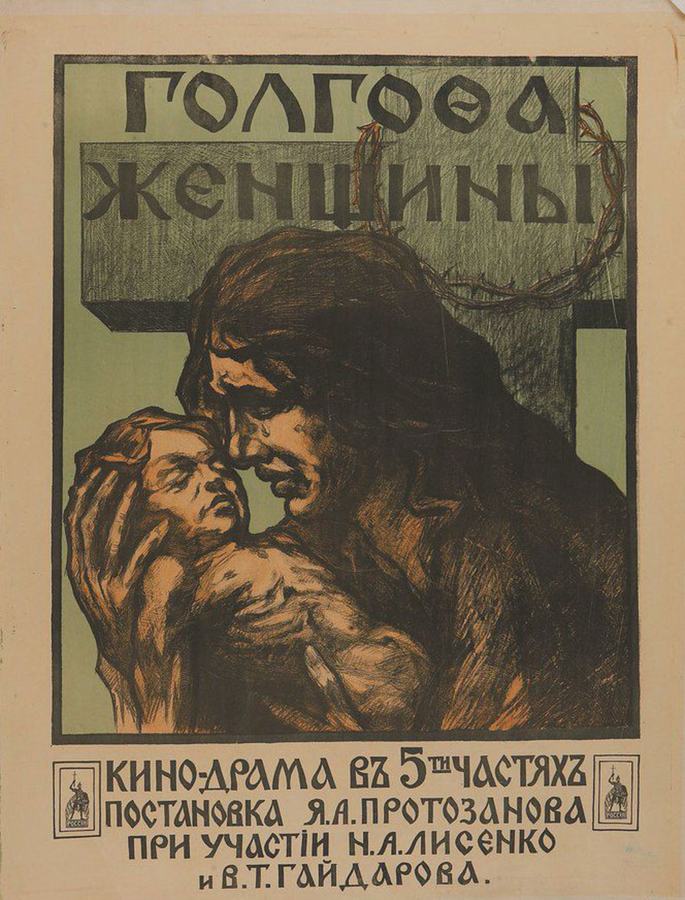
The silent era often evokes images of broad histrionics and simplistic moralities, yet Golgofa zhenshchiny stands as a defiant rebuttal to such reductions. This is not merely a film; it is a cinematic excavation of the soul. Watching Nathalie Lissenko navigate the treacherous waters of this narrative is akin to witnessing a slow-motion collision between human desire and the immovable wall of early 20th-century social stratification. Unlike the more commercial leanings of The House of Intrigue, which relies on the mechanics of suspense, this work finds its pulse in the agonizing stillness of its lead actress.
The visual language of the film is steeped in a heavy, almost oppressive chiaroscuro that mirrors the internal state of its characters. Every frame feels deliberate, a carefully composed tableau that emphasizes the isolation of the female experience. When we compare this to the thematic grit found in Prostitution, we see a shift from the external socio-economic struggle to a more metaphysical form of suffering. Lissenko does not merely act; she radiates a profound sense of weariness that transcends the screen. Her face becomes a map of the 'Calvary' referenced in the title, each flicker of her eyes a testament to a spirit being systematically broken by the expectations of her station.
Vladimir Gajdarov provides a performance of remarkable restraint. In many films of this period, the male counterpart is either a hero or a villain, but here, the lines are blurred. He represents the gravity of the situation—the weight that keeps the protagonist grounded in her misery. His presence is a constant reminder of the societal structures that make the 'Golgotha' inevitable. This isn't the whimsical growth seen in Little Miss Grown-Up; it is a stagnant, suffocating reality that offers no easy exits.
Technically, the film is a marvel of its time. The use of depth and shadow suggests an influence from the German Expressionists, yet it retains a uniquely Russian sense of fatalism. The pacing is intentionally slow, forcing the viewer to inhabit the protagonist's despair. This is a far cry from the energetic pacing of The Baseball Revue of 1917. Instead, it shares a certain DNA with the atmospheric dread of The Black Gate, where the environment itself feels like an antagonist.
The narrative arc is a downward spiral, yet it is executed with such grace that it never feels exploitative. There is a dignity in the suffering portrayed here that is often missing from contemporary attempts at tragedy. The film demands a high level of empathy, challenging the audience to look past the surface-level melodrama and engage with the existential questions at its core. How much of oneself can be sacrificed before the self ceases to exist? It is a question that resonates through the ages, making the film feel surprisingly modern despite its century-old vintage.
When examining the canon of 1920s cinema, Golgofa zhenshchiny occupies a unique space. It lacks the pastoral sentimentality of The Pines of Lorey or the overt moralizing of The Spark Divine. Instead, it offers a raw, unvarnished look at the consequences of a life lived for others. The protagonist’s journey is not one of redemption, but of endurance. In this way, it feels more closely aligned with the harsh realities explored in Unjustly Accused, where the system itself is the ultimate perpetrator of injustice.
The film also serves as a fascinating study of the Albatros studio's aesthetic. The collaboration between Russian exiles and French technicians created a hybrid style that was both intellectually rigorous and visually sumptuous. The costumes, the set design, and the lighting all work in harmony to create a sense of claustrophobia. Even in scenes set outdoors, there is a sense that the horizon is closing in. This is not the adventurous spirit of The Night Riders of Petersham; it is a world where there is nowhere left to run.
Nathalie Lissenko's performance is the undeniable heart of the film. She possesses a rare ability to convey complex internal monologues through minute physical shifts. In an era where many actors relied on grand gestures to communicate emotion, Lissenko's subtlety is revolutionary. Her portrayal of a woman on the brink of collapse is both terrifying and heartbreaking. It reminds us that the greatest dramas are often the ones that take place in the quietest moments, a sentiment echoed in the delicate character work of The Little Shoes.
The film’s conclusion is not a release, but a final, heavy seal on a life of struggle. It leaves the viewer with a sense of profound melancholy, a lingering ache that persists long after the screen goes dark. It does not offer the cathartic resolution of The Boomerang or the redemptive hope of The Little Samaritan. It is honest, perhaps brutally so, about the limits of human resilience when faced with an indifferent world.
To watch Golgofa zhenshchiny today is to engage with a piece of art that refuses to age. Its themes of gendered expectation, social isolation, and spiritual exhaustion are as relevant now as they were in 1924. It stands as a pinnacle of silent cinema, a work that utilizes the limitations of its medium to create something truly universal. While it may not have the pulp thrills of A Bid for Fortune or the historical sweep of The New South, it possesses an emotional depth that few films can match.
The film is a reminder that the 'inevitable'—a theme also explored in The Inevitable—is often a tragedy of our own making, constructed from the bricks of tradition and the mortar of pride. For any serious student of cinema, this is essential viewing. It is a haunting, beautiful, and ultimately devastating exploration of what it means to be a woman in a world that demands everything and gives nothing in return. Lissenko’s face, etched with the sorrows of a thousand lifetimes, remains one of the most powerful images in the history of the moving image.
In the end, Golgofa zhenshchiny is a masterclass in atmospheric storytelling. It proves that silence can be louder than any dialogue, and that a single teardrop can carry the weight of an entire civilization’s failures. It is a stark, shimmering jewel of the Albatros era, and its light continues to pierce through the darkness of a century past, illuminating the perennial struggle of the human spirit against the forces that seek to extinguish it.
IMDb —
1933
Community
Log in to comment.