DbcultAccessing Vault...
Cult Review
Senior Film Conservator
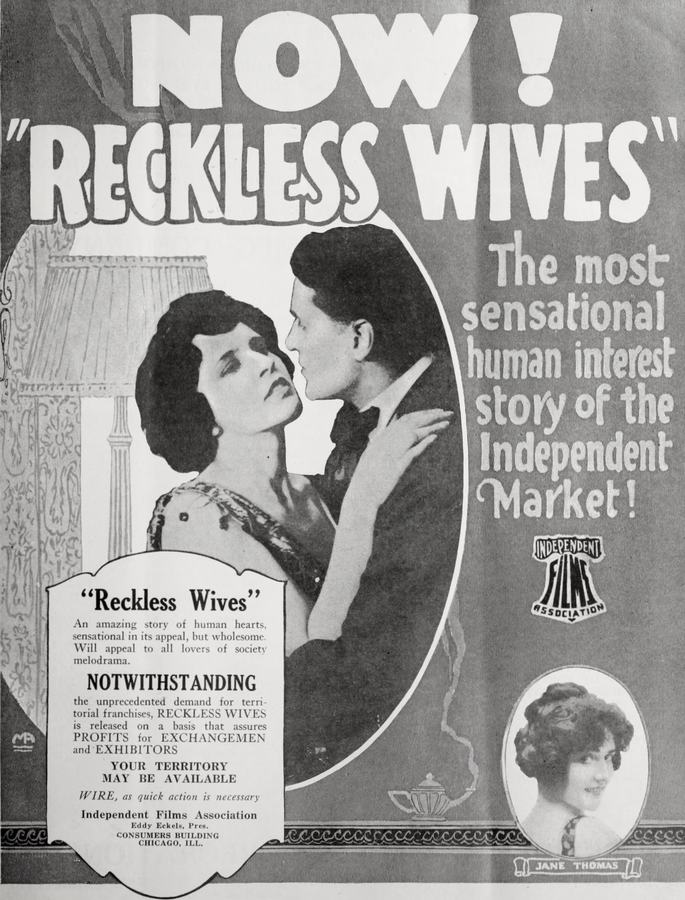
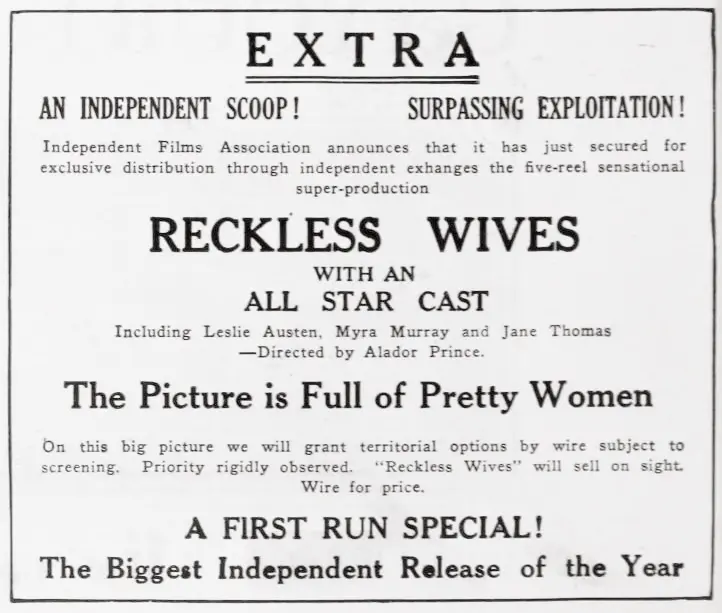
The first time we see Babette Corbin she is already framed like an auction lot: symmetrical, chandelier-lit, costlier than the Persian rug beneath her patent-leather heels. Director Roland Hadley holds the iris shot until the edges of the frame seem to chafe against her skin, as though even the screen itself wants something from her. It is 1925, the year when flasks were tucked inside silk garters and every close-up carried the hush of sin. Reckless Wives never announces itself as a morality play; instead it slips a monocle over the camera eye and invites us to ogle the very extravagance it will later flay.
The plot motor is almost insultingly slight—matron spies smoldering bohemian, pursues, purchases—but Hadley and scenarist Leah B. Sloane inflate that balloon until it hovers in the thin air of allegory. Babette’s first glimpse of George Cameron occurs via a rotogravure magazine left on a chaise: the page corners curl like beckoning fingers, the ink still damp from the press. In close-up, Helen McDonald allows her pupils to dilate exactly two millimeters—an eternity of silent cinema semaphore—and we understand that desire has already been commodified, stamped, and mailed to a rural postbox.
The film’s visual grammar is one of oppressive rectangles: window mullions, balcony rails, the severe neckline of Babette’s chemise. Against these grids Cameron drifts in smudged charcoal tweed, a man whose livelihood depends on smearing pigment into suggestible shapes. Their courtship plays out in counter-shot exchanges that feel like price haggling. When Babette finally lofts her offer—weekend house parties, a new Model T roadster, portrait commissions for his landscapes—Hadley cuts to an insert of Cameron’s paint-splattered shoes rocking back on the gravel, a miniature shrug that seals the contract.
Where Wildfire framed female yearning as volcanic and Madame Récamier draped it in Napoleonic gauze, Reckless Wives stages four distinct flavors of hunger. Florence, the husband’s niece, is famished for autonomy; she reads scandal sheets by flashlight and practices lip-prints on pillowcases, yet her rebellion never graduates beyond baby-doll pouts. Joy Ayres, meanwhile, starves for transcendence—every hymn she sings in the village chapel ascends an octave too high, cracking on a note that sounds suspiciously like sex. Cameron wants patronage without patronizing, Babette wants worship without work, and Corbin wants the continuance of his surname unstained by gossip. The narrative is a buffet where every dish devours the next.
Myra Murray plays Florence with a tremor that anticipates the neurotic heiresses of 1930s screwball; her eyebrows operate like two canaries desperate to flee their cage. When Cameron, half-drunk on dandelion wine, calls her a “kid sister,” the line lands with the thud of a slammed trunk. The ensuing suicide—an off-screen dissolve from rippling water to empty boat—remains one of silent cinema’s starkest elisions. No floating bouquet, no poignant locket on the pier; just the absence of a body where a body should be.
Richard Baker’s Cameron is less a lover than a start-up venture. His torso, frequently stripped for plein-air swimming scenes, is lean but not formidable—an body built by skipping meals rather than lifting iron. The camera lingers on the clavicle hollows that could cradle two copper pennies, underscoring the fiscal metaphor of seduction. When Babette drapes a silk robe over those shoulders, the gesture feels like a corporate takeover: hostile, inevitable, and scented with jasmine.
Hadley allows Cameron one moment of ungovernable lust—an insert of his thumb streaking crimson across an unfinished canvas after Florence’s death—but the film refuses to psychoanalyze him. Instead we watch the marketplace of masculinity recalibrate: the same villagers who once toadied to the artist now cross themselves when he passes, as though tragedy were contagious. Cameron’s final capitulation to Joy, sealed with a chaste kiss outside the country courthouse, registers less as romantic fulfillment than as a man accepting the only bid left on the table.
Though monochrome, the film’s tinting strategy amounts to a moral ledger. Interiors of the Corbin estate glow sulfurous amber, the shade of aged scotch and old invoices. Cameron’s studio scenes are bathed in slate-blue, as though the very air owes rent. The lake where Florence drowns is printed in pallid green—an absinthe echo that taints every subsequent reel. When Babette, back in town, dons a champagne organdy gown to attend a charity auction, the amber returns but now feels funereal, a reminder that coins and coffins share the same metallic sheen.
The surviving print, preserved by EYE Institut in Amsterdam, runs 74 minutes at 22 fps; its intertitles crackle with the brittle swagger of tabloid headlines. (“Love has a price—ask any cashier!”) The original score, now lost, survives only in a cue sheet calling for “saxophone blues, moderate tango, and tolling bell effect.” Contemporary festivals often substitute a doom-laden prepared-piano suite, but I prefer the scandal of accompanying it with nothing but projector whir—each mechanical stutter feels like a creditor knocking.
Viewers weaned on the kinetic flamboyance of Die Flammenfahrt des Pacific-Express may find Reckless Wives almost claustrophobic; its drama transpires in drawing rooms and dock planks rather than railway trestles. Yet the film’s containment strategy mirrors its thematic prison more concisely than the globetrotting catastrophes of The Strange Case of Mary Page. Meanwhile, the transactional eros on display here anticipates the venal matrimony of Stop That Wedding by a full decade, proving that the Jazz Age had already pawned its innocence before the Crash demanded receipts.
Helen McDonald, unjustly relegated to footnotes, wields the faint half-smile of a woman calculating interest on her own beauty. Watch the way her gloved hand trembles when she fastens a string of pearls around Florence’s neck—an act of charity that doubles as a yoke. Jane Thomas, as Joy, has the translucent skin and wide cheekbones of a Protestant chapel mural; her final acceptance of Cameron feels less like a victory than a reluctant merger, two bankrupt souls agreeing to share a single balance sheet.
Gerald C. Kaehn’s camera favors waist-up compositions, but when it does drop to floor level—most notably in the shot of Corbin’s polished boots pacing over Florence’s discarded love letters—the effect is surgical, a class dissection in real time.
The picture premiered at New York’s Rialto the same week as the Scopes Monkey Trial wrapped in Tennessee; newspapers yoked the two events under the rubric of “moral danger,” a marketing coup that fattened grosses but doomed the film to church-led censorship boards across the South. An alternate Catholic edit, preserved in an archive in Antwerp, excises the suicide entirely, substituting a title card that claims Florence “entered a convent beyond the river.” Such bowdlerization only amplifies the original’s bleak clarity: money can purchase flesh, but it cannot purchase narrative absolution.
Is Reckless Wives a feminist cautionary tale or a patriarchal revenge fantasy? The film shrugs off either label with the same nonchalance Cameron displays when discarding a squeezed-out tube of paint. Its achievement lies in capturing the instant when Roaring Twenties frivolity tips into existential vertigo. There are no heroines, no villains—only stakeholders negotiating the going rate for a human heart. Ninety-nine years after its release, that rate feels depressingly current; the Dow Jones of affection still rises and falls on the thinnest gossip, and every swipe-right carries the faint sulfurous waft of a contract signed in wet ink.
Watch it for McDonald’s micro-calibrated restraint, for Baker’s louche weariness, for the tint-shifted lake that swallows more than bodies. Watch it because the silents understood something we keep forgetting: desire is always in escrow, and the interest rate is murder.
IMDb 5.9
1927
Community
Log in to comment.