DbcultAccessing Vault...
Cult Review
Senior Film Conservator
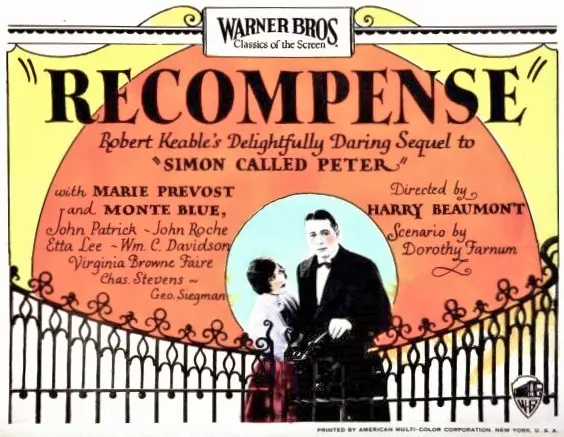
Recompense, a 1920s drama, weaves an intricate tale of duty, sacrifice, and personal growth through the lives of Julie Gmelyn, a spirited and determined Red Cross nurse, and Peter Graham, a clergyman who abandons his vocation to join the war. Director Robert Keable and screenwriters Dorothy Farnum and Robert Keable have crafted a film that delves into the complexities of human nature and the moral dilemmas faced by individuals in times of conflict.
The film's opening scene sets the tone with a serene yet ominous backdrop, featuring the lush landscapes of France, South Africa, and England. Julie, played with commendable zeal by Marie Prevost, navigates the challenges of her role as a nurse with unwavering resolve. Her character is a beacon of hope and resilience, embodying the spirit of those who tirelessly serve during wartime.
Concurrently, Peter Graham, portrayed by Monte Blue, stands at a crossroads. His decision to leave his chaplaincy and join the war is a testament to his personal and spiritual journey. The film explores the internal conflict faced by Graham as he grapples with leaving his congregation and the call to serve his country. Blue’s performance is nuanced, capturing the turmoil and eventual acceptance of his new role.
The narrative unfolds through a series of interconnected scenes that illustrate the challenges and triumphs of both characters. Julie's adventures in the war-torn regions are interspersed with Peter's experiences as a soldier. These segments are meticulously filmed, showcasing the grit and determination of those who led and served in the conflict.

The cinematography by George Siegmann is particularly commendable, with a rich palette of colors that evoke the stark contrasts of war and peace. The use of natural light and shadow enhances the emotional depth of the scenes, particularly during moments of intense conflict and quiet reflection.
Supporting characters, such as John Patrick, John Roche, and others, contribute to the film's tapestry. Their roles, though minor, are pivotal in highlighting the broader context of the war and its impact on the community. Virginia Brown Faire and William B. Davidson add layers of authenticity to the ensemble cast, further enriching the storytelling.
The script, penned by Dorothy Farnum and Robert Keable, is a masterclass in subtlety and depth. It avoids the pitfalls of melodrama, instead opting for a more nuanced exploration of the characters' inner lives. The dialogue is sharp and impactful, often serving as a poignant commentary on the futility of war and the strength found in human connection.
Recompense stands out among its contemporaries for its thoughtful approach to portraying the human condition. It does not shy away from the harsh realities of war but also celebrates the resilience of those who serve. The film’s ability to strike a balance between historical accuracy and emotional resonance is a testament to the skill of its creators.

Compared to other films of the era such as The Red Circle and Sally of the Sawdust, Recompense offers a more introspective and character-driven narrative. Unlike the more action-oriented films of the time, such as The Dumb-Bell and Common Ground, this drama delves into the personal stories and moral quandaries faced by its protagonists. It shares thematic similarities with Queen of the Sea and Bobby Bumps and the Hypnotic Eye, both of which explore the impact of external forces on individual lives.
The film's soundtrack, composed by an as-of-yet uncredited artist, complements the visual storytelling, enhancing the emotional impact of key scenes. The score is both evocative and understated, allowing the performances and cinematography to take center stage.
Recompense is a film that rewards close attention and repeated viewings. Its exploration of duty, sacrifice, and personal growth is both timeless and relevant. It stands as a testament to the enduring power of drama to illuminate the complexities of the human experience. In an era where the narratives of conflict are often simplified, Recompense offers a nuanced and deeply human perspective.
In conclusion, Recompense is a gem of early 1920s cinema, a film that resonates with its audience through its thoughtful portrayal of its characters and the broader themes it explores. It is a must-watch for anyone interested in the evolution of dramatic storytelling in film.

IMDb 7.2
1929
Community
Log in to comment.