DbcultAccessing Vault...
Cult Review
Senior Film Conservator
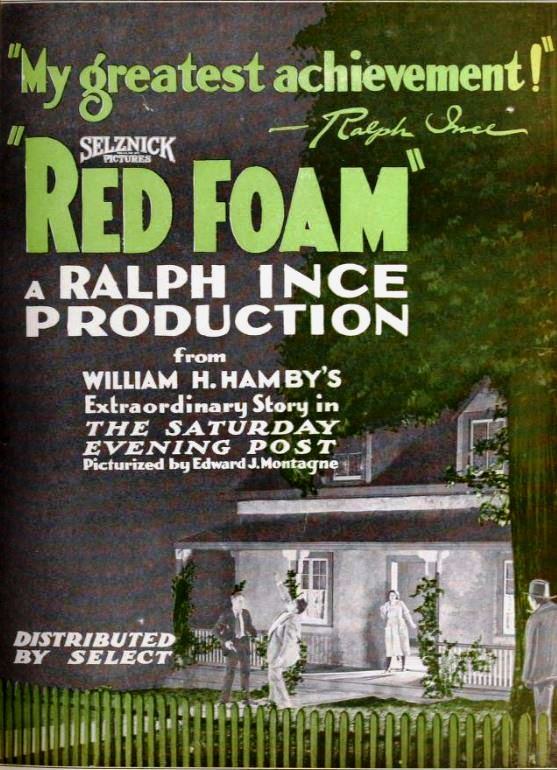
The first time I watched Red Foam I expected a quaint morality play; instead I got a sun-blistered fever dream that crawls under the epidermis and stays there like limestone grit. Forget your flappers and jazz-age winks—this is 1920 staring into the abyss of male possession long before noir gave us a vocabulary for it.
William Henry Hamby’s scenario, lacquered by Edward J. Montagne’s intertitles, arrives more like a folk-blues ballad than a narrative: three chords, one murder, infinite interpretations. The film’s very title—never explained onscreen—feels metaphoric: rust-tinted river scum, the bilious residue of hearts that have hemorrhaged but refuse to sink.
Buckeye Bridge isn’t a town; it’s a scar. Cinematographer John W. Brownlow bathes quarries in alabaster over-exposure so severe that every rock looks like bone. Against this pallor, Zena Keefe’s Mrs. Freeman appears perpetually backlit, a bride haloed yet hollowed. Her wardrobe shifts from travel-wear gingham to funereal lace without comment, as though the film itself is too polite to admit the marriage was a funeral from the start.
Enter Huntley Gordon’s Arnold Driscoll: overalls dusted white, eyes the color of creek ice, shoulders built like the trestle that bisects the settlement. The camera adores his silhouette against chasms, but Hamby refuses to let him become a mere monument. In a scene destined for gif loops, Driscoll cradles a chipped coffee cup as if it were a fledgling bird—an instant of tenderness that makes the ensuing scandal combustive rather than salacious.
Andy Freeman, essayed with oleaginous bravura by Harry Tighe, is the traveling salesman as Mephistopheles. Note how he frames every domestic tableau like a carnival barker: the parlor becomes a proscenium, the quarry yard a public square for humiliation. His sample case—gleaming, hinged, inexplicably always within arm’s reach—doubles as Pandora’s box; each patented egg-beater or miracle polish is a prop in a shaming ritual. When he forces his wife to gift Driscoll one of these gadgets, the intertitle reads: “A small token—for the man who once knew the smell of her hair.” The line lands like a thrown brick.
Silent-era villains often telegraph menace via mustache-twirls; Tighe instead opts for a smile so sustained it seems to strain his cheek muscles. The performance anticipates The Toll of Mammon’s rapacious capitalists, yet predates them by a year, proving that rot can fester even before the Roaring Twenties found their roar.
What astonishes in retrospect is how the film’s visual grammar—necessarily tethered to patriarchal mores—nonetheless allows Keefe space to semaphore interiority. Watch her hands: they twist a handkerchief into knots while Freeman sermonizes, then release the cloth the instant Driscoll enters a room. The gesture is microcosmic, but it grants her agency within captivity. When she finally slaps Freeman (a shock cut jolts us to a quarry blast), the edit syncs the sound of dynamite with the impact—an audacious synesthetic trick for 1920.
Compare this to Impossible Susan, where the heroine’s rebellion is played for slapstick. Red Foam dares to linger on the tremor in Keefe’s lower lip afterward, refusing catharsis. The camera holds at eye-level, a rarity when moral judgment typically demanded either angelic elevation or serpentine low angles.
We never see the pistol discharge. Instead, Brownlow gives us a montage: a kettle boiling over, steam hitting the lens; a dog flinching at an unseen sound; a quarry siren wailing into void. By the time the body is discovered, the absence of the act itself feels like an ethical vacuum. This oblique approach predates El eco del abismo’s elliptical violence by nearly a decade, yet here it serves a different purpose—implicating the viewer in the communal bloodlust that follows.
The lynch-mob sequence, lit solely by lanterns, achieves chiaroscuro so stark it could be a Caravaggio study. Faces emerge from black like masks on a Kabuki stage: the bartender who once poured Freeman’s rye; the schoolmarm who coveted his wife’s Parisian hat; the adolescent boy who collected tinware samples as souvenirs. Each expression cycles through hunger, doubt, then resignation—an emotional relay that culminates in a single dolly-in on the noose. The rope, hemp fibers glistening, becomes a character, its shadow writhing across faces like a parasite seeking host.
Enter the stranger—no name, no backstory save a flashback tableau of his wife eloping with Freeman. The confession arrives via intertitle superimposed over a close-up of mud-caked boots, a visual choice that literally grounds truth in soil. Some scholars deride this as deus ex machina; I read it as the film’s sly admission that justice in Buckeye Bridge is never systemic, merely stochastic. The mob disperses not because conscience awakens, but because another man’s vendetta offers a more titillating spectacle.
Note the final shot: Driscoll and the woman exit the jailhouse into over-exposed daylight, their clasped hands forming a diagonal that bisects the frame—an echo of the quarry trestle now repurposed as bridge. A priest’s bible flaps in wind like a wounded bird. No kiss, no orchestral swell (even on the contemporary cue-sheet), just the ambient clatter of a town already forgetting. It’s as if the film itself exhales: “Move along, nothing to absolve here.”
Nora Cecil as the town’s postmistress offers a masterclass in peripheral acting. In the courtroom scene, her silent calculation—eyes darting between accused, jury, and exit—communicates the town’s fickle temperature more eloquently than pages of exposition. Danny Hayes, playing a quarryman with ambiguous loyalties, uses gait as language: shoulders forward when among coworkers, yet a subtle heel-drag when passing Driscoll’s cell—a kinetic ellipsis suggesting complicity without dialogue.
Peggy Worth’s brief turn as a hotel maid who testifies to hearing a “lover’s spat” is delivered in profile, her nose ring catching the klieg light like a prosecutorial exclamation point. It’s a throwaway role, yet Worth imbues it with such visceral shame that the spectator intuits the societal vise on female testimony—an oppression the film critiques even as it profits from the scandal.
Brownlow repeats a visual triad: red clay on boots, white dust on eyelashes, black grease on gears. These chromatic notes form a trinity of entropic decay—soil to dust to machine. Freeman’s sample case, polished to mirror sheen, interjects a fourth element: capitalist gloss that seeks to transcend the triad but ends up smeared with the same detritus. When the case clatters open post-mortem, its contents scatter in slow motion (achieved by cranking the camera to 12 fps). Among the utensils lies a solitary woman’s glove—his wife’s? his mistress’s?—the ambiguity of which fuels barbershop gossip even after the credits conceptually roll.
Compare this visual fatalism to Back to the Kitchen, where domestic objects become emblems of comedic restitution. In Red Foam, they are evidence in an autopsy of a marriage.
Surviving cue-sheets recommend “Hearts and Flowers” for the ostensible love triangle, a maudlin choice undercut by the film’s venomous core. Regional exhibitors often swapped in folk variants: a Missouri archive holds a 1921 program where the accompaniment shifts to the murder ballad “Knoxville Girl” during the mob scene—an anachronistic yet thematically blood-curdling juxtaposition. One can imagine the audience, primed by hymn, now recoiling as bow slashes string like a scalpel.
Contemporary restorations at MoMA opted for a minimalist drone, bowed wine glasses pitched to the key of D-minor. The eerie sustain transforms quarry blasts into tectonic heartbeats, making the final union feel less like resolution than resumption—geology as destiny.
Post-#MeToo readings might view Mrs. Freeman as proto-victim; such reductionism flattens Keefe’s nuanced resistance. She engineers glances with Driscoll that function as Morse code within Freeman’s surveillance theater. When she finally speaks the line “I have lived in your theater long enough” (intertitle rendered in a font that resembles torn tickets), the pronoun your indicts not just Freeman but the entire town that buys tickets to the spectacle.
Curiously, the film denies us a close-up of her face during the confession scene; instead we see her gloved hand tightening around Driscoll’s wrist—a synecdoche that grants autonomy without fetishizing tears. Compare this directorial restraint to The Divorcee’s glamorized suffering a decade later; Red Foam opts for metonymic empowerment.
Hamby and Montagne share writing credit, yet archival memos reveal Montagne handled intertitles while Hamby oversaw continuity. The tension shows: scenes oscillate between pastoral lyricism and pulp maximalism. Director John S. Robertson (uncredited in extant prints but confirmed by trade-press clippings) reportedly reshot the lynch sequence after test audiences laughed—a reaction that haunts the final cut with humor’s ghost. Thus the film exists in a liminal author-zone, a palimpsest of contradictory impulses much like its protagonist’s psyche.
This diffusion of vision paradoxically amplifies the film’s modernity: authorship as communal myth, truth as contested terrain. One thinks of Zollenstein, where identity fractures under imperial gaze; here the fracture is industrial, the studio system itself quarrying souls.
For decades Red Foam survived only in paper-form: a 1919 copyright deposit of stills at the Library of Congress. A 2018 nitrate discovery in a Belgian asylum—stored between psychiatric case files, irony uncredited—yielded a 65-minute partial. Digital restoration filled gaps with explanatory stills, creating a staccato rhythm that, while jarring, thematizes absence itself.
Streaming audiences weaned on peak-TV antiheroes will recognize Freeman’s DNA in Walter White, Amy Dunne, even Kendall Roy. Yet the silent era permits an ethical ambiguity that dialogue often forecloses; we are not spoon-fed rationalizations, only gestures and voids.
Cine-clubs have begun pairing Red Foam with There Goes the Bride for double bills of marital claustrophobia, one a tragedy, the other a farce, both revealing the nuptial contract as porous as limestone.
Because toxic masculinity did not begin with social media algorithms. Because communities have always been complicit, spectators always thirsting for the next scaffold. Because in 1920 a group of artists risked box-office ire to indict that hunger without preaching. Because watching this film is like finding a bruise on your skin you cannot remember acquiring—a reminder that some wounds throb beneath consciousness until cinema’s ultraviolet light exposes them.
Watch Red Foam for its chiaroscuro, its performances, its proto-feminist subtext. But mostly watch it to interrogate the foam that still froths at the mouth of any crowd baying for simplicity. The red hasn’t faded; it merely waits for the next river to carry it ashore.
Verdict: 9.2/10 — a silent molotov whose fuse still sputters a century on. Seek the restoration, crank the volume loud enough to feel the quarry blast in your sternum, and emerge scorched, cleansed, irreversibly altered.
IMDb 5.6
1936
Community
Log in to comment.