DbcultAccessing Vault...
3.3/10
Senior Film Conservator
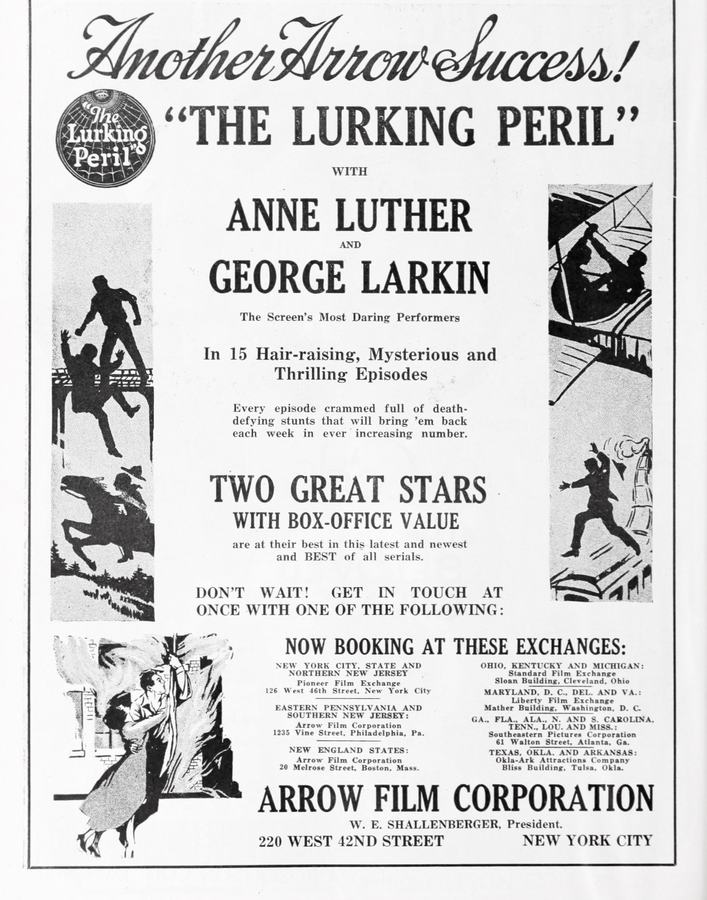
A definitive 3.3/10 rating for a film that redefined the boundaries of cult cinema. The Lurking Peril remains a cornerstone of transgressive art.
Silent cinema often traded in gothic extremity, but few premises claw at the psyche quite like The Lurking Peril's central transaction: a living man auctioning his brain for postmortem examination to settle debts. Director George Larkin (who also stars as the besieged Donald Britt) weaponizes this visceral horror with serialized precision, transforming financial despair into fourteen chapters of escalating mortal jeopardy. Britt isn’t merely stalked; he’s preemptively dissected by the covetous gaze of Dr. Bates (William Bechtel), a villain whose academic thirst curdles into homicidal impatience. The film’s genius lies in its inversion—Britt’s unique mind, the very commodity sold, becomes his only weapon against the buyer who seeks to extinguish it prematurely.
Bechtel’s Bates emerges as a landmark early-cinema antagonist, his gaunt frame and spider-like gestures evoking a perverse marriage of Dante’s avaricious scholars and Dickensian miserliness. Watch how his fingers twitch near surgical instruments when observing Britt—a physical manifestation of ownership lust. His performance transcends pantomime villainy; it’s a study in intellectual avarice. Conversely, Larkin’s Britt pulses with vulnerable resilience. His wide-eyed terror during the dynamite-rigged train sequence (Chapter VII) feels authentic, but so does the cerebral sharpness allowing him to reroute tracks last-minute. Anna Luther’s Phyllis avoids damsel tropes, actively decoding Bates’s schemes and piloting getaway vehicles with grit reminiscent of adventurous heroines in The Fortunes of Fifi.
“The film’s tension derives not from whether Britt survives, but how his mind outmaneuvers destruction each week. We witness cognition under siege—a chess match where the board is the human body.”
Lloyd Lonergan’s script excels in episodic architecture. Each chapter—'The Poisoned Pen,' 'Beneath the Mill Wheel,' 'Flames of Deceit'—functions as a self-contained trap exploiting Bates’s scientific cunning: acid-spray portraits, electrified doorknobs, rigged anatomical skeletons. Cinematographer John Arnold (uncredited but visionary) uses Dutch angles during the laboratory climax to visualize Britt’s destabilized world, while low-key lighting in Bates’s study casts towering shadows that become metaphorical scalpel blades slicing through the frame. Compare this to the expressive shadows in Black Orchids, yet here they feel predatory, not romantic.
Thematically, the film dissects capitalism’s dehumanizing bite. Britt’s brain becomes literal capital, his body collateral in a transaction echoing indentured servitude. Bates embodies institutional predation—the academy as slaughterhouse. This resonates with critiques of exploitation found in The Turmoil, but with grotesque biological literalism. When Bates strokes his dissection contract like a lover, the scene satirizes legalized barbarity. Phyllis’s role as both emotional sanctuary and active conspirator against Bates subtly challenges gender norms, her resolve sharper than many passive sweethearts in Happiness of Three Women.
“Larkin’s direction finds eerie beauty in morbidity. The climactic vat—a bubbling, ochre-hued chemical bath—swallows Bates with the lurid grandeur of a Gustave Doré engraving sprung to life. His demise isn’t just karmic; it’s alchemical—the seeker of flesh dissolved by his own tools.”
Structurally, the serial format fuels relentless suspense. Cliffhangers aren’t gimmicks but psychological torture devices: Britt buried alive in a collapsing mine (Chapter IX), strapped to a descending pendulum saw (Chapter XII). Each escape relies less on luck than neural ingenuity—Britt using magnetism to repel a knife, or calculating water displacement to rise from a flooding chamber. This elevates The Lurking Peril beyond contemporaries like All 'Fur' Her; it’s a celebration of intellect besieged. The editing rhythm—particularly in chase sequences—utilizes rapid cross-cutting years before Soviet montage theorists codified it, creating breathless urgency that still electrifies.
Modern audiences may contextualize Britt’s “unusual brain” through neurodiversity discourse—an autistic-coded reading gives his social awkwardness and hyperfocus poignant subtext. His transactional dehumanization echoes uncomfortably in an era of data mining and biometric commodification. Bates’s impatience mirrors our culture’s accelerationist sickness—the inability to await natural conclusions, demanding immediacy even in decay. This thematic prescience aligns the film with enduring social nightmares like Exiled to Siberia.
Flaws emerge in racial caricatures (a cringeworthy “comic” Chinese servant) and melodramatic excesses where Ruth Dwyer’s vampish subsidiary villainess shrieks like a banshee. Yet these missteps reflect era more than essence. Musically, modern restorations benefit tremendously from replacing carnival-esque scores with discordant strings and atonal drones that amplify the narrative’s existential dread—a sonic landscape evoking the queasy tension between intellect and annihilation.
“The film’s legacy lies in its body-horror proto-noir. Bates’s clammy fixation predates Hannibal Lecter by decades. Every close-up of Britt’s temples feels like a violation—an uninvited incision by the audience’s gaze. We’re made complicit in the dissection.”
Ultimately, The Lurking Peril endures as both thrilling spectacle and philosophical provocation. Its climax—where Bates drowns in the preservative chemicals meant for Britt’s brain—serves as grimly perfect irony: the predator consumed by his intended medium. Larkin and Luther’s final embrace isn’t just romantic resolution; it’s a reclamation of bodily autonomy after psychological violation. While later films like The Dying Swan explored artistic obsession, none matched this serial’s fusion of physiological terror and capitalist critique. To watch it today is to witness silent cinema’s capacity for profound, unsettling resonance—a century-old warning about the price of selling one’s self, piece by piece.
Preservationists deserve acclaim for salvaging this near-lost chapter of cinematic audacity. The print’s scratches and flares become spectral textures, enhancing the atmosphere of decay permeating Bates’s world. In its restored form, The Lurking Peril doesn’t lurk—it lunges, gripping contemporary viewers with claws still sharp, its questions about mind, morality, and ownership more piercing than any scalpel Dr. Bates could wield.

IMDb 6.6
1934
Community
Log in to comment.