DbcultAccessing Vault...
Cult Review
Senior Film Conservator
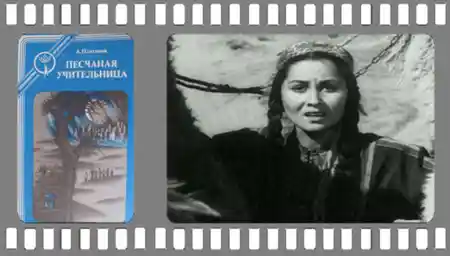
So, Revolt in the Desert. Is it worth your time today?
If you like old movies where people stare intensely at the horizon while sweating, then yes. If you want something fast or loud, you will probably hate this one. 🌵
Aina comes back from the big city university with big ideas. She’s a teacher now and wants to help her village kids learn more than just how to survive the heat.
But the timing is terrible. The whole village is fighting over collectivization, which is basically a big argument about who owns the land and the cows.
Her father, played by Aleksandr Oberyukhtin, is right in the middle of it. He’s a kulak—a rich farmer—but he’s also leading the village council.
It’s a massive conflict of interest. You can see the stress on his face in every close-up shot.
There is this one scene where Aina just looks at her father across a dinner table. The silence goes on for a long time, and it feels heavy, like the air right before a storm.
The desert setting isn't just a background. It feels like it’s trying to swallow the characters whole.
Everything looks dry and gritty. I honestly felt thirsty just watching them walk through the dunes.
You can tell the actors were actually hot and miserable. This wasn't filmed on a nice air-conditioned soundstage.
I noticed a stray dog in the background of one shot that looked very confused by all the shouting. 🐕 It’s a small thing, but it made the world feel lived-in.
The writing is by Andrey Platonov. If you like old books, that name might ring a bell.
He usually writes about people feeling small inside huge, complicated systems. You can definitely feel that vibe here.
It reminded me a little bit of the tension in The Big House, even though that’s a prison movie. Both films have that feeling of being trapped in a place where the rules are changing too fast.
Some of the editing is a bit jumpy, though. One minute they are talking in a room, and the next, someone is suddenly screaming in a field.
It feels like maybe some scenes were lost or cut out by a grumpy editor back in 1930. Or maybe that’s just how they did things back then.
Zana Zanoni plays Aina with these very expressive, sad eyes. She doesn't have to say much to show she's disappointed in her hometown.
The movie gets much better when it sticks to the family drama. When it tries to give big speeches about 'The Cause,' it gets a little stiff.
Like a shirt that has way too much starch in the collar. It’s hard to move naturally when you're trying to be a symbol.
I really liked the shots of the camels. They don't care about village councils or university degrees.
They just stand there looking bored while the humans ruin their own lives. It’s a nice bit of perspective.
It’s not a masterpiece, but it’s definitely interesting. It feels real in a way that polished modern movies usually don't.
The sweat on their foreheads is real sweat. The dirt under their fingernails is real dirt.
If you've seen Vzorvannye dni, you’ll recognize that specific 1930s Soviet energy. Lots of harsh shadows and people pointing at things very dramatically.
The ending feels like it happens about five minutes too fast. One second there’s a huge problem, and the next, it’s just... over?
I wasn't quite convinced by the resolution. It felt like the movie ran out of film or the sun went down and they had to go home.
Still, it’s a cool look at a part of history we don't see much. Just don't expect a happy-go-lucky time at the theater.
It’s a dusty, sweaty, political headache—but in a way that’s actually kind of memorable. 🎥
It’s a weird one, for sure. But if you're in the mood for something that feels like a time capsule, give it a go.
IMDb —
1923
Community
Log in to comment.