DbcultAccessing Vault...
Cult Review
Senior Film Conservator
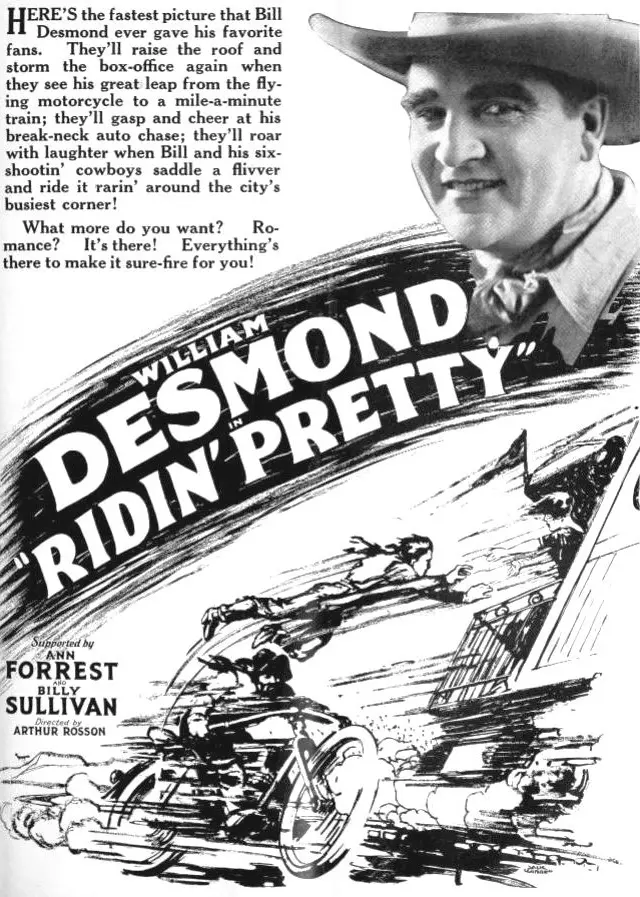
Is Ridin' Pretty worth watching today? Short answer: absolutely, if you approach it with the right historical lens and a genuine appreciation for the unvarnished charm of early 20th-century cinema. This film is a delightful curio for aficionados of silent-era Westerns and romantic comedies, offering a fascinating glimpse into the nascent tropes of both genres. However, it will undoubtedly test the patience of those accustomed to modern narrative conventions and rapid-fire pacing.
This film works because of its audacious genre blend and the sheer, unbridled energy of its lead, Billy Sullivan. It fails because its narrative contrivances, while common for the era, can feel rather simplistic and rushed by today's standards. You should watch it if you're keen to explore the roots of Hollywood storytelling, enjoy physical comedy, or have a particular fondness for the early silent film era.
Ridin' Pretty, a 1920 production, is a fascinating artifact that straddles the burgeoning genres of the Western and the romantic comedy. Directed with a clear eye for spectacle, it throws its audience headfirst into a culture clash that feels both utterly of its time and surprisingly resonant in its core themes of authenticity versus artifice. The premise itself is a goldmine for comedic potential: a rough-and-tumble Arizona cowboy, Sky Parker, inherits a fortune contingent on his ability to adapt to sophisticated San Francisco life for a year. This isn't just a fish-out-of-water story; it's a whole school of fish-out-of-water, as Sky brings his entire cowboy posse along for the ride.
The film’s opening act is a masterclass in establishing character through action. We don't just hear that Sky and his men are wild; we see them in glorious, chaotic detail. The sequence where they 'raise western hell' in San Francisco is the film's undeniable highlight, a whirlwind of slapstick and genuine, albeit anachronistic, cowboy bravado. Stealing Clydesdale horses from a brewery and using the mansion's gargoyles for target practice are not just plot points; they are declarations of intent, signaling that these men will not be tamed by city life, nor will they quietly conform. This early exhibition of pure, joyful anarchy sets a tone that is both irreverent and endearing, immediately drawing the audience into the cowboys' perspective.
At its core, Ridin' Pretty explores the enduring tension between the rugged individualism of the American West and the perceived sophistication of urban centers. Sky Parker, portrayed with a charming earnestness by Billy Sullivan, embodies the former. He is direct, honest, and utterly devoid of pretense. His world is one of open spaces and clear intentions. San Francisco, by contrast, is a labyrinth of inherited wealth, social maneuvering, and deceit, personified by his conniving cousin, Miller.
The introduction of Maize, played by Ann Forrest, complicates this dynamic beautifully. Initially a pawn in Miller’s scheme to defraud Sky of his inheritance, Maize is quickly caught between her mercenary task and a burgeoning genuine affection for Sky. This internal conflict is where the film finds its emotional anchor. Forrest's performance, particularly in the later scenes, manages to convey a depth of remorse and genuine feeling that transcends the broad strokes of silent film acting. Her transformation from an agent of deceit to a woman wrestling with her conscience is surprisingly effective, making her character the most compelling in the narrative.
The romance between Sky and Maize, while somewhat rushed by modern standards, unfolds with a certain innocent charm. Their connection feels less about grand declarations and more about a shared authenticity that develops despite their initial circumstances. Sky's unwavering trust, even in the face of Maize's initial duplicity, highlights his character's inherent goodness, making his eventual forgiveness all the more impactful. This is a love story built on a foundation of unlikely circumstances and the triumph of character over cunning.
The film's direction, credited to George Hively, is notable for its dynamic pacing and clear visual storytelling, particularly impressive for the era. Hively understands the importance of visual gags and physical comedy, especially in the absence of spoken dialogue. The early scenes of the cowboys' antics are choreographed with a delightful energy, showcasing a nascent understanding of comedic timing that would become a hallmark of Hollywood. The action sequences, particularly the climactic train chase, are executed with a surprising degree of tension and excitement. While not matching the elaborate stunts of a Buster Keaton or Harold Lloyd, the sequence of Sky chasing the train, crashing his car, and then commandeering a police motorcycle to board the speeding locomotive, is genuinely thrilling and speaks to a burgeoning mastery of action filmmaking.
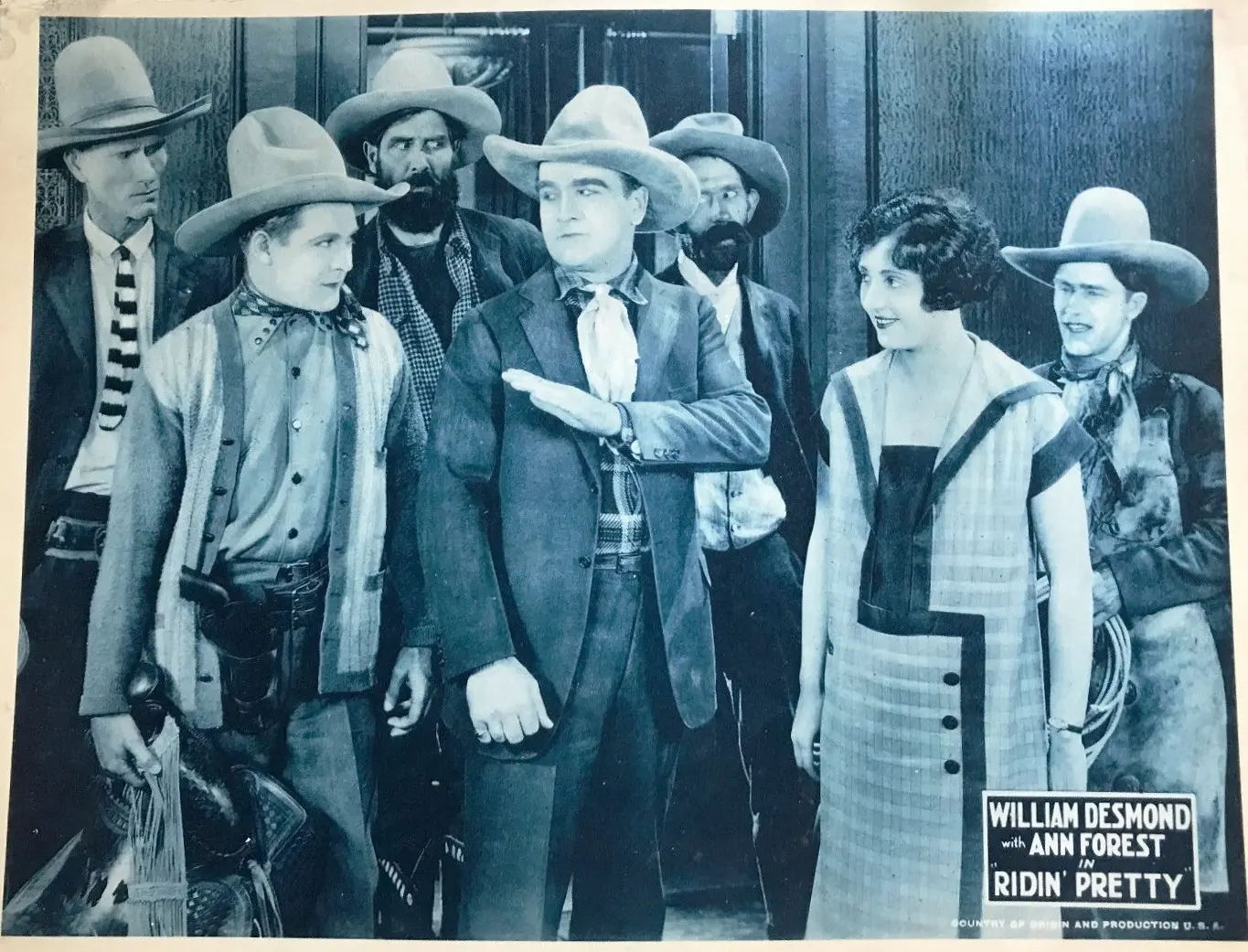
The narrative, penned by Isadore Bernstein, George Hively, and Raymond L. Schrock, adheres to many silent-era conventions. Plots are often straightforward, character motivations are clearly delineated (often with little nuance), and resolutions are typically neat and satisfying. While some might find the plot's simplicity a drawback, it allows for a focus on visual spectacle and character reactions, which are paramount in a silent film. The script efficiently sets up the central conflict, develops the romance, and delivers a clear resolution, all within a runtime that keeps the audience engaged without overstaying its welcome.
Billy Sullivan, as Sky Parker, is the heart of Ridin' Pretty. He exudes a natural, unforced charm that makes his character instantly likable. His physicality is well-suited to the role of a cowboy, whether he’s riding horses or engaging in comedic brawls. Sullivan’s expressive face carries much of the film’s emotional weight, particularly in moments of confusion or dawning realization. He embodies the 'ramrod' with a quiet strength and an inherent decency that makes his character's ultimate victory feel earned.
Ann Forrest, as Maize, delivers a performance that arguably elevates the material. Her initial portrayal of a mischievous, self-interested woman subtly shifts, revealing a character capable of genuine affection and profound guilt. The scene where she confesses her duplicity on the train is particularly poignant, relying solely on her facial expressions and body language to convey a torrent of emotion. It’s a testament to her skill that she makes Maize’s sudden change of heart believable and endearing. William Desmond, as the villainous Miller, plays his part with the appropriate degree of sneering menace, providing a clear antagonist against whom Sky's virtues can shine.
It works. But it’s flawed. This film is a testament to the raw, untamed spirit of early American cinema, a delightful blend that defies easy categorization. It’s a Western. It’s a comedy. It’s a romance. And it’s all wrapped up in the captivating silence of a bygone era.
The cinematography, while not groundbreaking by today's standards, is effective in capturing the contrasting environments of the Arizona desert (implied, though largely represented by Sky's demeanor) and the bustling San Francisco. The camera work is functional, focusing on clear compositions that allow the actors' performances and the physical comedy to take center stage. There's a particular joy in the wide shots that capture the cowboys' chaotic actions, allowing the viewer to take in the full scope of their 'western hell-raising.'
One unconventional observation is how effectively Ridin' Pretty, despite its age and silent format, manages to convey a palpable sense of sound. The clatter of horses' hooves, the cacophony of a city street, the huffing of a train – these are all implicitly communicated through the actors' movements, the pacing of the editing, and the sheer visual energy. It’s a testament to the power of silent film to engage the imagination, allowing the viewer to 'hear' the story unfold.
While not as widely remembered as some of its contemporaries, Ridin' Pretty holds a significant place in understanding the evolution of popular cinema. It demonstrates the early attempts to fuse genres, to tell stories that were both thrilling and humorous, and to develop archetypal characters that would populate screens for decades to come. It’s a film that reminds us that even in its nascent stages, cinema was already exploring complex human emotions and societal clashes through compelling narratives.
Absolutely. If you are a film historian, a student of early cinema, or simply someone who enjoys the unique charm of silent movies, Ridin' Pretty offers genuine rewards. It's a prime example of genre-bending before the term even existed. The blend of Western sensibilities with urban comedy and a dash of romance makes for a surprisingly engaging watch. It's not a 'masterpiece' in the conventional sense, but it is a valuable and enjoyable piece of cinematic history.
However, if you struggle with the slower pacing of silent films, or require constant dialogue to maintain engagement, then this might not be the ideal choice. The lack of a contemporary soundtrack (unless viewed with a modern score) can also be a barrier for some. It demands a certain level of patience and an openness to a different mode of storytelling. For those willing to make that leap, it's a delightful journey back in time.
Ridin' Pretty is more than just a historical curiosity; it's a vibrant, often hilarious, and surprisingly heartwarming piece of early American cinema. Its fusion of the rugged Western with the lighthearted romantic comedy makes it stand out, even amongst its contemporaries like The Marriage Maker or Up in the Air. While its plot might not boast the intricate twists and turns we expect from modern storytelling, its strengths lie in its raw energy, the charismatic performances of Billy Sullivan and Ann Forrest, and its audacious visual gags. It’s a film that demands a little patience but rewards it with genuine smiles and a fascinating glimpse into a bygone era of filmmaking. Don't expect a profound cinematic revelation, but do expect a delightful, unpretentious romp that reminds us of the sheer joy of early cinema. It’s a film that, despite its age, still rides pretty well.
IMDb 6.3
1935
Community
Log in to comment.