DbcultAccessing Vault...
Cult Review
Senior Film Conservator
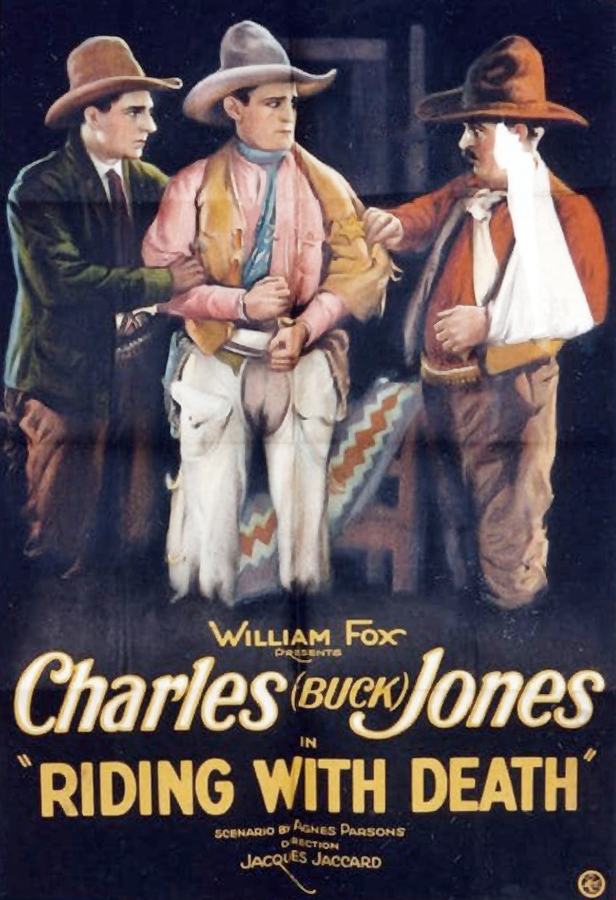
Few films from the 1930s marry the raw physicality of Westerns with the psychological nuance of a noir as deftly as Riding with Death. Buck Jones, in the role of Dynamite Steve Dorsey, embodies a hero who is as much a romantic as he is a vigilante, a duality that anchors the film’s emotional core. The narrative, penned by Jacques Jaccard and Agnes Parsons, unfolds with a deliberate, almost operatic pacing, allowing the audience to savor the tension between the law and lawlessness that defines the genre.
The film’s central conflict hinges on Sheriff Pat Garrity (J. Farrell MacDonald), a antagonist whose charisma is as lethal as his methods. Unlike the stock villains of lesser Westerns, Garrity is a man who understands the power of perception and manipulation. His plot to foreclose on Col. Lee Calhoun’s ranch is less a criminal act than a masterclass in exploiting legal loopholes, a nod to the systemic corruption that Westerns often mask as a backdrop. His coveting of Anita (Betty Francisco) is not driven by base desire but by a calculated desire to control the Calhoun legacy, a layer of ambition that makes him a far more dangerous adversary than a mere bandit.
Anita’s arc is the film’s emotional linchpin. Her relationship with Steve is fraught with unspoken tension, a dance of attraction and duty that mirrors the broader struggle between justice and vengeance. Betty Francisco’s performance is understated but piercing, her wide-eyed vulnerability contrasting sharply with the hardened world around her. When she finally admits her love for Steve, it is less a resolution than a catalyst, forcing him to confront the cost of his quest. This dynamic recalls the fraught romance in Taxi, though Riding with Death grounds its romance in a more visceral, earthy realism.
The film’s visual language is sparse but evocative. The Texas landscape is rendered in stark contrasts—sun-bleached ranches, shadowy jails, and the ever-present horizon that seems to mock the characters’ struggles. The use of deep focus in scenes where Steve is captured and interrogated by Garrity’s men amplifies the claustrophobia of the moment, a technique that feels ahead of its time. The editing, while rudimentary by modern standards, is effective in building suspense, particularly during the showdown sequence, which unfolds with the rhythm of a ticking clock.
Buck Jones brings a quiet intensity to Steve Dorsey, a departure from the bombastic archetypes common in Westerns. His physicality—every draw of the revolver, every glance at Anita—is deliberate, as if he is constantly weighing the moral implications of his actions. This restraint makes his eventual explosion of rage all the more cathartic. J. Farrell MacDonald, as Garrity, is a masterclass in restrained menace; his voice is smooth as silk, his gestures precise, and his presence a constant reminder of the corruption festering beneath the town’s surface. The supporting cast, including Jack Mower as Col. Calhoun and Artie Ortego as a loyal henchman, add texture without overshadowing the lead performances.
Riding with Death plays with Western tropes like a conductor with an orchestra, occasionally subverting expectations. The resolution—where Steve secures evidence to convict Garrity—avoids the cliché of a blood-soaked finale, instead opting for a bittersweet victory that feels more in line with the existential themes of Dangerous Waters. The film’s refusal to sanitize its world is both its strength and its flaw; while the ambiguity adds depth, it may leave some viewers craving a more definitive moral compass. Yet this ambiguity is precisely what makes the film resonate beyond its era, reflecting a timeless struggle between principle and pragmatism.
Though overshadowed by more flamboyant entries in the Western canon, Riding with Death holds a unique place in the genre’s evolution. Its exploration of institutional corruption prefigures the cynicism of later films like Pençe, while its focus on personal redemption echoes the introspective tone of Heiress for a Day. The film’s blend of action and introspection also owes a debt to Untamed Ladies, though it remains more grounded in its realism. For scholars of classic cinema, it is a fascinating artifact of a transitional period, where the Western was beginning to grapple with the complexities of modernity.
Riding with Death is a film that rewards patience and attention. It is not a popcorn spectacle but a meditation on the cost of justice in a world where the lines between hero and villain are often blurred. With its taut script, strong performances, and atmospheric direction, it stands as a testament to the genre’s capacity for both entertainment and introspection. For those willing to engage with its moral ambiguities, it offers a rich, if imperfect, cinematic experience that remains as compelling today as it was in 1937.
IMDb —
1914
Community
Log in to comment.