DbcultAccessing Vault...
Cult Review
Senior Film Conservator
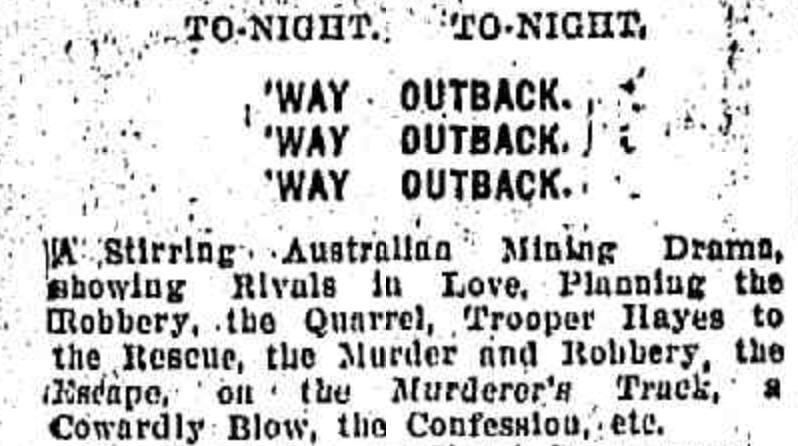
To understand the cinematic heritage of the southern hemisphere, one must grapple with the dusty, flickering frames of 1911. Way Outback stands as a monumental, if often overlooked, pillar of early Australian narrative filmmaking. While the global stage was becoming increasingly dominated by the sophisticated religious epics like The Life and Passion of Jesus Christ or the literary adaptations of Anna Karenina, the Australian film industry was forging a rugged, distinct identity rooted in the harsh realities of its own geography. Way Outback, featuring the stoic presence of Charles Villiers, is not merely a film; it is a historical artifact that captures the transition from stage-bound melodrama to the expansive, location-driven storytelling that would eventually define the 'bush' genre.
Charles Villiers brings a gravitas to the screen that was rare for the period. In an era where pantomime and exaggerated gestures were the standard—as seen in many European imports like Hamlet (1911)—Villiers adopts a more grounded, almost weary physicality. His performance reflects the exhaustion of the pioneer, a man whose primary dialogue is with the soil and the sky rather than his fellow man. This subtlety allows the film to transcend its simple plot, elevating it to a character study of resilience. Unlike the more action-oriented protagonists in The Story of the Kelly Gang, Villiers' character in Way Outback represents the 'squatter' ideal: the hard-working settler caught between the lawlessness of the bushranger and the uncaring hand of nature.
The narrative structure of Way Outback mirrors the episodic nature of frontier life. It lacks the cohesive, driving momentum of modern cinema, opting instead for a series of vignettes that build a cumulative sense of atmosphere. We see the mundane rituals of station life interrupted by the sudden, sharp threat of violence. This pacing is reminiscent of the early travelogues such as Canada: Nova Scotia to British Columbia, yet it is infused with a dramatic tension that suggests a maturing understanding of filmic suspense. The camera, while largely static, is positioned with an eye for the monumental, making the human figures appear small and precarious against the backdrop of the eucalyptus groves and rocky outcrops.
One cannot discuss Way Outback without addressing the cinematography. The Australian sun is a difficult mistress for early orthochromatic film stock, often blowing out the highlights and plunging the shadows into impenetrable ink. However, the filmmakers here utilize this high-contrast aesthetic to their advantage. The harsh light creates a sense of exposure—there is nowhere to hide in the outback. This visual vulnerability serves the plot perfectly, emphasizing the danger that comes with isolation. It is a far cry from the controlled, indoor lighting of contemporary American films like The Last of the Frontignacs. In Way Outback, the environment is the primary antagonist.
The use of location is what separates this work from the stage plays of the time. While the influence of the Victorian proscenium is still visible in the framing of certain interior scenes, the outdoor sequences breathe with an authenticity that stagecraft could never replicate. The rustle of the dry grass, the dust kicked up by horses, and the genuine sweat on the actors' brows contribute to a sense of verisimilitude. It shares a thematic kinship with The Squatter's Daughter, but Way Outback feels more intimate, focusing on the domestic sphere within the wilderness rather than the grand political machinations of land ownership.
By 1911, the Australian public had a voracious appetite for tales of the bush. The 'bushranger' film had already become a controversial subgenre, leading to bans in various states due to the perceived glorification of outlaws. Way Outback navigates this precarious cultural landscape by shifting the focus toward the 'squatter'—the legitimate farmer. This shift was a strategic move by filmmakers to maintain respectability while still providing the thrills of the frontier. It paved the way for later explorations of the genre like Robbery Under Arms and The Girl from Outback.
The film's depiction of conflict is rooted in the concept of 'frontier justice.' When the legal systems of the city are hundreds of miles away, the individual must become the law. This moral ambiguity is a recurring theme in early Australian cinema. We see echoes of this in The Life and Adventures of John Vane, the Australian Bushranger, but Way Outback grounds this conflict in the protection of the home. The home, in this context, is a fragile construct, a small box of wood and tin in an ocean of scrub. The defense of this space is treated with a sacred intensity, mirroring the moral weight found in religious cinema like The Life of Moses, albeit in a secular, gritty context.
There is a certain beauty in the technical constraints of 1911. The absence of synchronized sound forces the viewer to focus on the visual language—the tilt of a hat, the speed of a horse’s gallop, the lingering shots of an empty horizon. In Way Outback, the silence is not an absence, but a presence. It represents the oppressive quiet of the bush, a silence that can drive men to madness. This use of atmosphere is far more effective than the more frenetic editing seen in urban comedies or shorts like A Record Hustle Through Foggy London. Where the London film celebrates the chaotic energy of the crowd, Way Outback celebrates the terrifying majesty of the void.
The editing, handled with a primitive but effective 'cut-in' technique, allows for moments of heightened emotion. When a threat is perceived, the camera moves closer, breaking the objective distance and pulling the audience into the protagonist's anxiety. This nascent understanding of film grammar shows that the creators of Way Outback were looking beyond the mere recording of events—as seen in the early 'actualities' like 69th Regiment Passing in Review—and were instead attempting to manipulate the viewer's psychological state. It is the beginning of the 'thriller' as we know it in an Australian context.
To view Way Outback today is to witness a nation trying to see itself for the first time. In 1911, Australia was a young federation, still grappling with its identity as a former penal colony and a new member of the global community. Cinema was the tool used to construct this identity. The film reinforces the 'pioneer myth'—the idea of the white settler conquering a 'vacant' land. While modern audiences will rightly note the problematic erasure of Indigenous perspectives—a commonality in films of this era like A Victim of the Mormons which also focused on narrow 'othering'—it is essential to view Way Outback as a product of its time. It reflects the anxieties and aspirations of the colonial project with startling clarity.
The film also serves as a testament to the robustness of the early Australian film industry. Before the 'Hollywood invasion' of the 1920s, Australia was a world leader in feature-film production. Way Outback was part of a wave of creativity that included works like The Fatal Wedding and A Ticket in Tatts. These films were culturally specific, yet they spoke to universal themes of family, justice, and survival. They were exported to London and New York, proving that the Australian experience had a global resonance.
The iconography established in Way Outback remains influential to this day. The wide shot of a lone rider against a sunset, the close-up of a weathered hand on a fence post, the flickering light of a campfire—these are the building blocks of the Australian cinematic aesthetic. We see their descendants in the 'Ozploitation' films of the 70s and the prestige dramas of the 90s. The film teaches us that the landscape is not just a setting, but a character that demands respect. This is a lesson that European filmmakers, accustomed to the tamed forests of the continent as seen in Krybskytten, often failed to grasp.
In the final analysis, Way Outback is a triumph of grit over polish. It lacks the sophisticated optical effects of The Fairylogue and Radio-Plays, and it doesn't possess the historical scale of Defense of Sevastopol. What it does have is a raw, unvarnished honesty. It is a film that smells of eucalyptus and horse sweat. It is a film that understands the weight of the sun. Charles Villiers, with his quiet intensity, provides the human anchor for this exploration of the infinite. For any serious student of cinema, Way Outback is essential viewing—a reminder that the most powerful stories are often found in the most desolate places.
As we look back from a century's distance, the flickering images of Way Outback remind us of the ephemeral nature of the medium. Many films from 1911, such as The Mummy or The Bells, have been lost to time or nitrate decay. That we can still witness Villiers' journey into the heart of the Australian wilderness is a miracle of preservation. It is a cinematic bridge to a world that no longer exists, yet whose echoes still define the Australian identity. The film's legacy is not found in its box office receipts, but in the way it taught a nation how to look at itself through a lens.
IMDb 7
1933
Community
Log in to comment.