DbcultAccessing Vault...
6.6/10
Senior Film Conservator
A definitive 6.6/10 rating for a film that redefined the boundaries of cult cinema. Roaring Lions at Home remains a cornerstone of transgressive art.
In the pantheon of silent-era comedy, few motifs elicit as much visceral anxiety and comedic potential as the introduction of a wild predator into a sanitized domestic sphere. Roaring Lions at Home stands as a testament to the sheer audacity of early 20th-century filmmaking, a period where health and safety regulations were secondary to the pursuit of a genuine, heart-stopping gag. Unlike the calculated, often sterile environments of modern digital effects, this 1924 short utilizes the palpable, muscular presence of actual lions to create a friction that is both terrifying and hilarious.
The narrative architecture is deceptively simple, yet it serves as a robust framework for the physical genius of its cast. When a young girl visits the circus, the loss of her dog triggers a sequence of events that feels like a fever dream of suburban paranoia. The accidental substitution of a lion cub for a pet dog is the inciting incident that propels the film into a masterclass of situational irony. While the family remains blissfully unaware of the apex predator in their midst, the audience is treated to a high-stakes game of hide-and-seek that predates the sophisticated suspense of later decades.
Long before he became the quintessential straight man to Stan Laurel’s whimsical fool, Oliver Hardy was a formidable presence in the silent shorts of the 1920s. In this production, his physicality is on full display. Hardy possessed a unique ability to convey a sense of refined dignity even when faced with the most absurd circumstances. His reactions to the unfolding chaos—the subtle eye flutters, the adjustment of his tie, the way he occupies space—provide a grounding element to the film's more kinetic moments.
Hardy’s performance here offers a fascinating contrast to his work in more dramatic or somber pieces of the era. If one examines the tonal gravity of The Black Stork, the lightness of Hardy’s touch in Roaring Lions at Home becomes even more impressive. He isn't merely a clown; he is a technician of timing. Alongside him, Heinie Conklin provides the necessary frantic energy that balances Hardy’s more measured comedic beats. Together, they navigate a house that has effectively become a cage without bars.
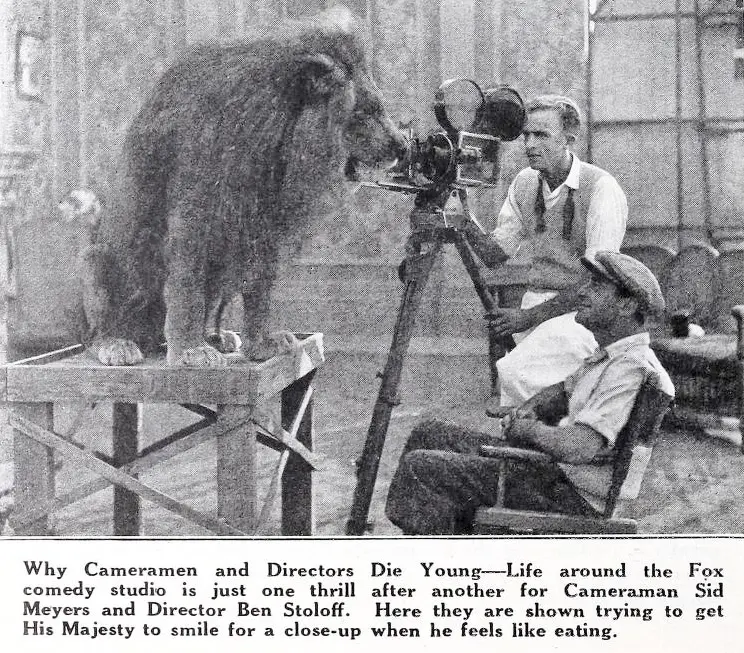
There is a raw, unvarnished quality to the animal interactions in this film that modern cinema simply cannot replicate. The lioness trailing her cub into the home isn't a puppet or a CGI construct; she is a half-ton of feline instinct. The way the camera captures her padding through doorways and sniffing around furniture creates a genuine sense of dread. It’s a thematic cousin to the high-stakes tension found in On the Night Stage, though redirected through a comedic lens.
The film excels in its use of deep space. Often, we see a character in the foreground engaged in mundane activity while the lioness looms in the background, a shadow of the wild encroaching on civilization. This visual storytelling is far more sophisticated than the film’s status as a "slapstick short" might suggest. It mirrors the tension found in dramas like The Law Decides, where the consequences of one's actions catch up with them in the most unexpected ways.
To truly appreciate Roaring Lions at Home, one must view it within the broader landscape of 1924 cinema. This was a year of immense variety. While this film was providing thrills through animal antics, others were exploring historical romance, such as The Courtship of Myles Standish, or diving into the social complexities of The Auction Block.
The pacing of the film is relentless, reminiscent of the high-octane energy found in The Speed Maniac. However, where that film relied on mechanical velocity, Roaring Lions at Home relies on biological unpredictability. The stakes feel higher because the "villain" is an irrational force of nature. This isn't the calculated malice of The Price They Pay; it is the simple, powerful drive of a mother seeking her child.
Even when compared to the more avant-garde European offerings like Fasching or the eerie atmosphere of Die Gespensterstunde, this short holds its own by leaning into the universal language of fear and laughter. It captures a specific American zeitgeist—a fascination with the exotic and a burgeoning middle-class domesticity that was ripe for parody.
The film’s brilliance lies in its escalation. It begins with the subtle movement of a "dog" that doesn't bark, moving into the discovery of large paw prints, and culminating in a full-scale feline occupation of the kitchen. This structure is a precursor to the "house-wrecking" comedies that would become a staple of the Laurel and Hardy era. The way the domestic space is systematically dismantled by the presence of the lioness is a metaphor for the fragility of human order.
Consider the film Turning the Tables. In that narrative, the power dynamics are shifted through social maneuvering. In Roaring Lions at Home, the tables are turned by raw power. No amount of social standing or politeness can negotiate with a lioness. This creates a comedic vacuum where the characters must revert to their most primal instincts—running, hiding, and climbing—to survive. It is slapstick in its purest, most essential form.
The technical execution, including the editing by the uncredited writers and directors, is surprisingly sharp. The cross-cutting between the mother lioness’s progress through the neighborhood and the family’s oblivious interactions with the cub builds a rhythmic tension. It’s the same kind of rhythmic editing that made The Winning Stroke so effective in its sports sequences, though here it is used to heighten the absurdity of the situation.
Heinie Conklin, often overshadowed by the larger-than-life presence of Hardy, deserves significant credit for the film's success. His rubbery face and frantic movements provide the perfect visual counterpoint to the lioness’s sleek, lethal grace. While Hardy plays the "Everyman" trying to maintain his composure, Conklin is the audience's surrogate, reacting with the appropriate level of terror to the presence of a predator in the parlor.
This dynamic is a staple of the era, seen in various forms in films like Cupid Camouflaged or the socially pointed The Girl and the Judge. However, the stakes in Roaring Lions at Home feel more immediate. There is no courtroom drama or romantic misunderstanding that can’t be solved by a quick exit through a window when a lion is involved.
The film also touches upon the theme of maternal instinct, albeit in a broad, comedic way. The lioness is not portrayed as a monster, but as a mother. This gives her actions a logic that contrasts with the human characters' confusion. It’s a nuanced touch that elevates the film above mere animal exploitation. One might see echoes of this thematic depth in The Loves of Letty or the psychological undercurrents of Scratch My Back, where underlying desires drive the plot forward.
Ultimately, Roaring Lions at Home is a vibrant artifact of a time when cinema was still discovering its boundaries. It combines the thrill of the circus with the comfort of the home, then proceeds to set fire to that comfort. The presence of Oliver Hardy gives it historical weight, but the film’s energy is entirely its own. It reminds us that at the heart of all great comedy is a seed of danger—a realization that the world is far less predictable than we like to believe.
As we look back at the silent era, it is easy to dismiss these shorts as mere trifles. Yet, the craftsmanship required to coordinate live animals, physical comedy, and coherent storytelling without the aid of dialogue is immense. This film remains a roaring success, a piece of cinematic history that still manages to elicit a gasp and a laugh in equal measure. It is a wild ride through the suburban jungle, guided by the steady, comedic hand of one of the medium’s true masters.

IMDb 6.4
1935
Community
Log in to comment.