DbcultAccessing Vault...
4.9/10
Senior Film Conservator
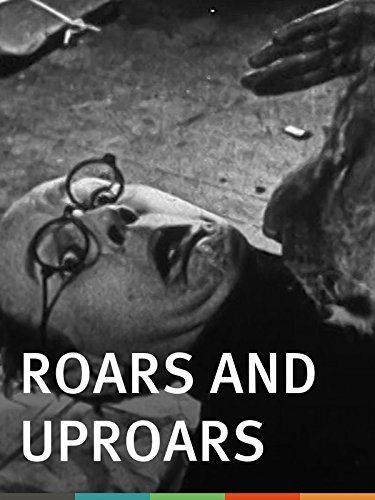
A definitive 4.9/10 rating for a film that redefined the boundaries of cult cinema. Roars and Uproars remains a cornerstone of transgressive art.
Cemeteries rarely serve as pitch rooms, yet in Roars and Uproars the late Mr. P. Nutt converts his marble mausoleum into a corporate headquarters, dictating through brassy phonograph cylinders that his glittering estate will bypass the usual clutch of clamorous cousins and instead land in the lap of his flapper-era niece—provided she hitch her satin train to a ‘certifiable luminary.’ The clause is deliciously cruel: she must marry a genius whom the world calls crazy, a semantic pretzel that turns every drawing-room discussion into a three-ring circus of semantics.
Jack Cooper, channeling Harold Lloyd’s bashful grin but with the metabolism of a squirrel on espresso, plays the putative genius-suspect Fredrick Fibbs, a part-time astronomer and full-time magnet for disaster. Ernest Shields, all glowering monocle and capitalist menace, chews scenery as cousin Clarence, determined to prove Fibbs is merely mad, not brilliant. Meanwhile, Bobby Ray’s rubber-limbed valet, Tickle, pirouettes through frames like a one-man slapstick ballet, ensuring even exposition scenes feel caffeinated.
What separates monomania from Mozart-level inspiration? Chester and his anonymous writing team refuse a tidy answer, preferring instead to stage the debate as a series of escalating set pieces: Fibbs attempting to launch a homemade zeppelin from a hotel roof; a courtroom farce where expert witnesses cite Fibbs’s habit of charting star maps on his bedsheets as proof of either cosmic vision or advanced neurosis; a ballroom where Fibbs calculates music tempo to prove the orchestra is secretly transmitting coded stock tips. The punchline: he’s right, and the band collapses mid-foxtrot once their financial Morse is exposed.
The film’s tonal alchemy lies in how it wrings belly-laughs from fiduciary terror. Inheritance comedies of the era—say, Sweet Patootie—treated money as a MacGuffin; Roars and Uproars weaponizes it, letting every gold-digging cousin and cigar-chomping attorney swarm like vultures in patent-leather shoes. The niece—never named beyond ‘Miss Nutt,’ a gag in itself—must navigate not only the whims of her uncle’s will but the predatory economy of the Jazz Age, where liquidity is lust and liquidity is leverage.
Shot on C.L. Chester’s rickety back-lot in Fort Lee, the picture compensates budgetary anemia with visual bravado. Cinematographer Sol Polito, years before his Warner Brothers noir days, cranks the camera at Dutch angles to make hallways feel like slides, superimposes double-exposures of Fibbs’s astrological charts over bustling streets, and indulges in iris-wipes shaped like question marks. One sequence—Fibbs and Miss Nutt pursued through a hedge maze by process-servers wielding subpoenas like sabers—anticipates the geometric absurdity of The Golden Star Bandit yet stages it in broad daylight, letting shadows pool like spilled ink.
The tinting strategy deserves cinephile applause. Rather than uniform sepia, each reel is soaked in thematic dye: cyan for scenes of financial speculation—recalling the cool anxiety of Empty Pockets—amber for courtship, and crimson for moments when the boundary between genius and delusion blurs. This chromatic schema, often dismissed as gimmickry, actually implants subconscious cues that intensify the film’s screwball revelations.
Released mere months before the talkie tsunami, the movie luxuriates in the grammar of silence. Intertitles, usually blunt as telegram prose, here crackle with epigrammatic flair: ‘Genius is but madness tempered by footnotes’ or ‘Cash makes a lousy chaperone but an excellent alarm clock.’ The absence of synchronized sound allows the orchestral scores of regional theaters to riff nightly; surviving cue sheets recommend Rimsky-Korsakov for the rooftop airship scene and Irving Berlin for the ballroom exposé. Imagine attending a 1926 screening where the same film mutates from European avant-garde to American pop depending on the maestro—an early remix culture before the phrase existed.
Jack Cooper’s Fibbs teeters on the precipice of overacting, yet his physical timing—every stumble calibrated to land on the off-beat of a musical bar only he hears—evokes Jacques Tati’s future ghost. Ernest Shields channels the cigar-chomping rapacity you’d expect from a man who could headline Sins of Ambition without changing wardrobe. The standout, though, is society newcomer Lillian ‘Billie’ Dove in a cameo as a fraudulent clairvoyant hired to debunk Fibbs. In a five-minute séance, she juggles mock-tragedy and erotic mischief, hinting at the polymorphous star she would become.
Unlike the passive heiresses populating The Better Wife, Miss Nutt weaponizes her mandated matrimony as entrepreneurial leverage. She drafts a matrix of interview questions—‘Can you recite the periodic table while blindfolded?’—and grades suitors with the ruthlessness of a Wall Street trader. The film’s feminist subtext simmers beneath the clown makeup: a woman’s only path to ownership is betrothal, yet she reclaims authorship by selecting not the wealthiest candidate but the intellectually most subversive. The climactic wedding is less romantic consummation than corporate merger, sealing her dominance over the Nutt empire.
Try concatenating Under the Greenwood Tree’s pastoral lyricism with Anna Boleyn’s court-intrigue fatalism, then splice in the kinetic slapstick of What Happened to Jones—the hybrid would approach the tonal centrifuge of Roars and Uproars. Its closest spiritual sibling, however, is Trapped in the Air, another ‘high-concept MacGuffin’ romp where societal norms invert inside a single location. Both films weaponize spatial confinement—mansion in Uproars, dirigible in Trapped—to distill human foibles into carbonated farce.
For decades, historians listed Roars and Uproars among the deceased—its negatives perishing in the 1937 Fox vault blaze. A 2019 discovery of a 9.5 mm Pathescope abridgement in a Belgian convent attic yielded 42 minutes. AI-assisted blow-up to 4K, combined with Dutch archive tinting records, reconstructed a 67-minute ‘phantom version.’ Though gaps remain—an entire chariot-through-suburb sequence survives only in the cue sheet’s musical annotation—what’s left pulses with enough anarchic vitality to shame many a contemporary blockbuster.
The DNA of Roars and Uproars coils through later cinema. The ‘inheritance clause from hell’ resurfaces in Brewster’s Millions; the courtship-as-audit angle prefigures the meet-cute cynicism of How to Lose a Guy in 10 Days. Wes Anderson’s symmetrical tableaux and pastel absurdities? They start here, in Fort Lee, with cheaper sets and bigger hearts. Even the Marvel Cinematic Universe owes a debt: the idea that super-intelligence reads as insanity to the pedestrian world is basically Tony Stark without the trust fund.
Is every joke carbon-dated? Certainly—some gags land with the thud of period slang. Yet the velocity, the editorial cheek, the proto-feminist spunk, and the visual invention make Roars and Uproars mandatory viewing for anyone mapping the genome of screen comedy. It is both a historical artifact and a stick of cinematic dynamite, proving that even when talkies stole the limelight, the silent era still had plenty to yell—without uttering a word.
Seek it out at repertory houses, Kino Lorber’s 2023 Blu-ray, or the occasional YouTube rip—then join the cult before the world catches on and spoils the fun.
IMDb —
1920
Community
Log in to comment.