DbcultAccessing Vault...
Cult Review
Senior Film Conservator
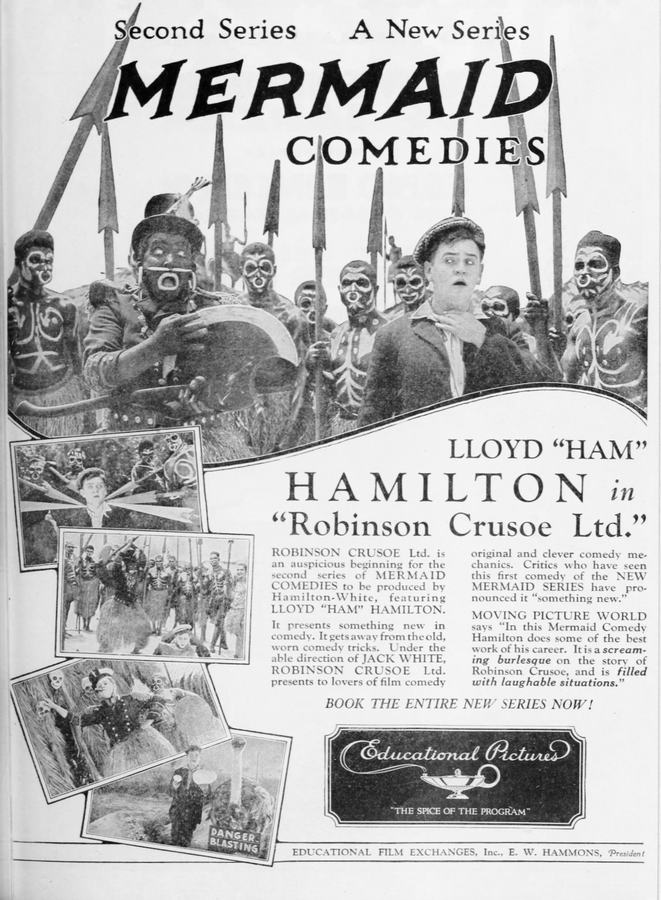
There are films that merely screen, and then there are films that rupture the celluloid and start nesting in your cortex like phosphorescent tapeworms. Robinson Crusoe Ltd. is the latter, a 1923 gauntlet of celluloid dementia that stitches Edwardian pluck to Bolshevik slapstick and then sprinkles gun-cotton yolk on top.
Imagine, if your synapses still fire in monochrome, the scent of salt-bloated ledger books when the millionaire’s gilded schooner belly-flops onto coral. Archie Mayo’s script—yes, the same Archie who later marinated Bogart in noir—here juggles tropes like a caffeinated prestidigitator: the shipwreck yarn, the colonial guilt fantasia, the bedroom-farce triangle, and the Looney-Tunes physics lecture. The result is a fevered auction where human capital is the only currency and an ostrich plays both bull and bear.
Irene Dalton’s ward trembles on the precipice of caricature, a flapper ingénue whose eyes hold the same bewildered liquidity you’ll spot in Joan of Arc when the pyre crackles. Yet Dalton undercuts naiveté with micro-smiles—those half-second smirks that whisper ‘I’m selling shares in your doom’. Meanwhile Lloyd Hamilton, rubber-limbed veteran of two-reel chaos, plays the tycoon as if Charlie Chaplin’s Tramp had swallowed J.P. Morgan’s portfolio and now suffers the indigestion of ethics.
Watch Hamilton attempt to light a Havana while waist-deep in quicksand; the cigar becomes a metronome for imperial decline—each failed puff a quarterly report of moral bankruptcy. The gag lasts seventeen seconds but etches itself into the fossil record of silent-era satire, outlasting even the pyrotechnics of the ostrich’s ordnance.
Technically sepia, the film bleeds hallucinations of other palettes. When the explosive egg glows cobalt on the nitrate, your retina insists it sees sea-blue even though no tinting is present. Mayo understood that absence can be a pigment; he withholds color until the mind riots and invents its own hues—an anarchist’s inversion of The Pearl of Paradise’s hand-painted opulence.
Economists prattle about fiat currency; Mayo gifts us flightless currency. The ostrich, unnamed and unashamed, trots onto the scene like a Wall Street courier who’s misplaced his trousers. Each egg is a bond backed by gunpowder; when it hatches, the resulting blast rewrites property deeds, redistributes bamboo equity, and launches coconut futures into the stratosphere. Marx would have chortled his beard off; Keynes would have tried to purchase the bird.
Note the symmetry: early Hollywood was itself a speculative bubble, studio stocks bloated on Floridian real-estate swampland. By letting an ostrich crater the island marketplace, Mayo mocks the very financiers who bankrolled his picture. Satire, savage yet giddy, struts around in clawed feet.
Frank B. Good’s camera chews through magnesium flares as though it fears the dark. Day-for-night scenes swim in silver nitrate shadows, while close-ups of coral resemble petrified brain coral—an apt metaphor for capital ossified into reef. The editing rhythm apes the staccato of ticker tape: 6-frame flashes of warriors’ eyes, 4-frame insert of a ticking egg, then 24 frames of Hamilton’s eyebrow ascending into his hairline. You can almost hear the Kino-apparatus hyperventilating.
Silence is never silent. In the auditorium, the projector’s rattle becomes the island’s surf; the audience’s gasp when the first egg explodes registers as a phantom chord. Contemporary critics compared it to Number, Please? for its clockwork suspense, yet Mayo’s timing is more sadistic, stretching the pregnant pause until viewers squirm like ants under a magnifying glass.
Post-war audiences, still gagging on mustard gas headlines, recognized the island as Europe’s scarred psyche. The painted “savages” sport kilt-like fronds that mimic Scottish regiments; their war chant syncopates to ragtime, hinting that imperial drums always return as nightclub percussion. Mayo, himself a child of Brooklyn immigrants, refuses both demonization and absolution; instead he stages a circus where colonizer and colonized swap masks mid-pirouette.
The maid—billed only as Miss DuVerney—carries the film’s moral ballast. While the tycoon barters cufflinks and the ward practices pouts, she stitches a quilt from sailcloth scraps, each square embroidered with the date of another mutiny against patriarchal logic. Her final act: she pockets an unexploded eggshell, tucks it into the tycoon’s Gladstone, and boards the rescue freighter. Off-camera, we sense a future detonation in a New York salon—an anticipation of feminist sabotage decades ahead of its fuse.
Where Going Straight moralizes about rehabilitation, Robinson Crusoe Ltd. laughs until the laugh detonates. Where Mary Moreland seeks pastoral redemption, Mayo’s island offers only the redemption of boom and bust. And while Pagan Love exoticizes the tropics, here the tropics flip the bird—feathered, long-necked, and incendiary.
Only two incomplete 35 mm prints survive: one in the Cinémathèque française (missing reel 3), another in a private San Fernando vault (worm-gnawed but complete). Restoration attempts stall because the ostrich’s explosive eggs were hand-tinted with a dye that modern solvents dissolve. Thus the film exists in a quantum state—half-seen, half-imagined—like capital itself.
Variety 1923 dismissed it as “a menagerie in delirium.” Photoplay accused Mayo of “feeding the public gunpowder under the guise of guffaws.” Yet in Leningrad, young Eisenstein scribbled feverish notes: “explosive ostrich = proletariat detonation?” History doesn’t confirm if he ever screened it, but the montage DNA is unmistakable.
Fast-forward a century: NFTs hawk pixelated eggs, SPACs promise island paradises, and every startup claims to be the next ostrich. Mayo anticipated the absurdity of value conjured from thin air—or rather, from the cloaca of a megafauna. The film is a prophecy disguised as a prank, a prospectus scrawled in sand just before the tide of progress rolls in.
By the time the rescue steamer belches coal-smoke on the horizon, the island’s economy has cratered, its gods have moulted, and the concept of rescue itself feels like a genteel swindle. The tycoon tips his tattered top-hat to the ostrich, who responds by laying one last cobalt egg—unfertilized, inert, yet humming with potential. Fade-out. No end title. Just the whirr of the projector begging for a rewind that nitrate cannot survive.
If you hunt for certainties, sail elsewhere. If you crave a film that explodes its own balance sheet, Robinson Crusoe Ltd. is trading over-the-counter in the twilight between reels.
IMDb —
1915
Community
Log in to comment.