DbcultAccessing Vault...
5.9/10
Senior Film Conservator
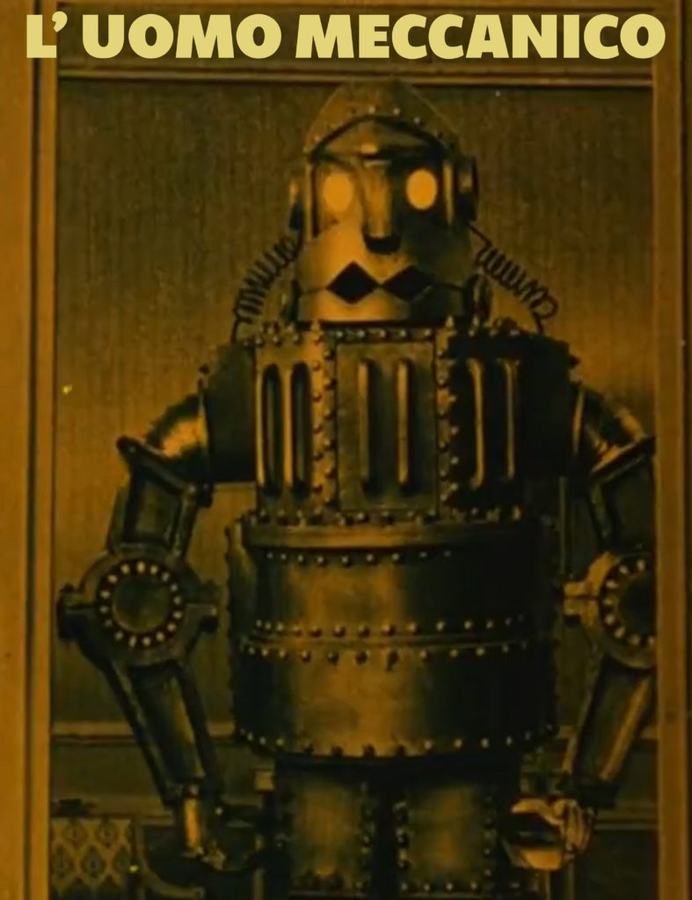
A definitive 5.9/10 rating for a film that redefined the boundaries of cult cinema. The Mechanical Man remains a cornerstone of transgressive art.
A copper colossus stalks the baroque arcades of Turin, its joints exhaling steam like a dragon on a diet of tram wires and moonlight.
That image—half folklore, half industrial premonition—cements The Mechanical Man as the phantom hinge between Victorian gothic and Futurist roar. Shot in 1921 but largely unseen outside back-street cinematoteche, André Deed’s hallucinatory one-reeler distills the anxiety of an electrifying century: terror that the body might be usurped by levers, that the soul itself is nothing more than a current you can switch on or off.
Deed, better known for the slapstick Boireau series, here trades custard-pie chaos for uncanny minimalism, anticipating Lang’s Metropolis without the safety-net of UFA riches. The result is a film that feels exhumed rather than projected, nitrate fever dream rather than entertainment.
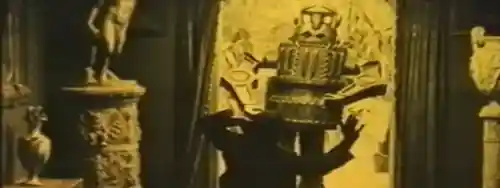
Forget genteile laboratories; Silvestri’s workspace is an abattoir of bric-a-brac: birdcages, bird skulls, bird-like women who watch from spiral staircases. The montage is staccato—iris-in, iris-out—each cut a Morse code throb. A Tesla coil blooms violet behind the inventor’s head, haloing him as both Promethean saint and garage tinkerer. The birth of the automaton is not a triumphant Frankensteinian crescendo but a sputter: gears refuse to bite, a piston jams, the creature’s left arm droops like a wilted petal. Imperfection becomes the film’s heartbeat.
What chills is not size or strength but obedience at a distance. The scientist twirls a Bakelite dial; blocks away the metal man pirouettes, crushing a rose beneath his heel. The city’s onlookers laugh—until laughter recoils into silence. Deed weaponizes perspective: the camera adopts the automaton’s height, so we hover at shoulder level, seeing human scalps like moving crop circles. Spatial estrangement breeds moral vertigo. Suddenly the viewer is complicit, joystick in hand.
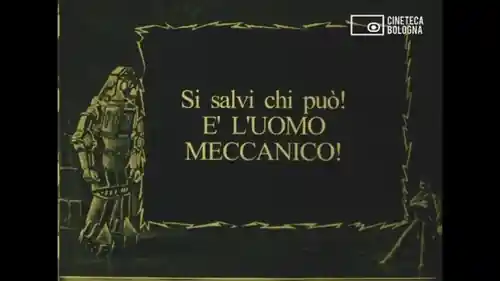
Notice how intertitles shrink as the machine learns: words evacuate, leaving only the thud of metal on stone, as if language itself were a fleshy inconvenience the automaton has optimized away.
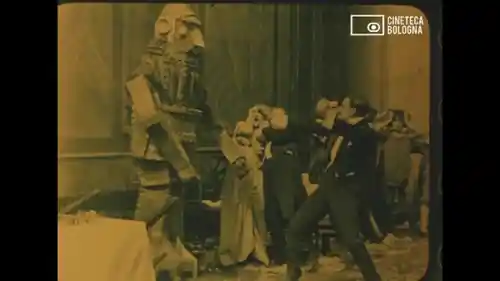
Mid-film, the narrative folds like a Möbius strip. During the masked ball—shot in a single smoky long take that rivals Ophüls—Giulia Costa’s dazzling showgirl glides in a harlequin suit. Reflections ricochet off a hall of mirrors, so when the automaton enters wearing identical garb, the eye cannot adjudicate carbon from tin. Identity becomes a masquerade you can unscrew with an Allen key. The scientist, desperate, yanks the control lever; the robot responds by waltzing with the woman, dipping her so low her cigarette kisses a champagne puddle and ignites. Flames crawl up the hem of her gown—yet she keeps smiling, assuming the heat is part of the pageant. It’s a moment so cruel it circles back to camp, then back again to tragedy.
Valentina Frascaroli’s character—billed only as “The Bride” in studio notes—occupies the liminal zone between trophy and saboteur. She lounges in peacock-feather negligee, reading forbidden pulp sci-fi, dreaming of electric paramours more constant than flesh. When she finally kisses the automaton, the close-up reveals her pupils dilated not with lust but recognition: here is a lover who cannot renege, whose heart is literally a dial she can wind. Deed slyly critiques the transactional romances seen in concurrent melodramas like Old Wives for New or An International Marriage. Yet the film refuses didacticism; her fate—strangled by the very cables she caressed—renders the critique as cold as the automaton’s kiss.
Cinematographer Giuseppe Biana had one arc lamp, a crate of orange gel, and a roll of tungsten stock expired since 1917. From these scraps he conjures chiaroscuro worthy of Der Graf von Cagliostro. Shadows stretch like spilled ink across alley walls; moonlight pools in the automaton’s rivets, turning each screw-head into a miniature planet. Superimpositions are achieved in-camera—cranking back the film, exposing anew—so that at times the robot appears to walk through its own ghost. Silent-era aficionados will spot the nascent “Schüfftan-lite” technique: mirrors angled to reflect miniature sets, allowing a colossal automaton to loom over rooftops without costly glass shots.
Archival records show that some prints toured with a live trio: violin, trap-drum, and a hand-cranked siren. Contemporary festivals often commission new scores, yet the most piercing accompaniment remains the projector’s own clatter—metronomic, insectile. The absence of orchestral sentimentality sharpens the film’s ethical barbs. Each creak of the sprockets feels like the automaton’s vertebrae aligning.
Listen closely and you’ll hear history’s rehearsal for the mechanical heartbeat of The Mainspring or the marital automatism dissected in Why Divorce?—films that, despite talkie technology, never matched the sheer tactility of noiseless torque.
André Deed casts himself as the scientist, a sly meta-wink: the silent clown now pulling cosmic strings. His face—rubbery, Chaplinesque—undergoes a sinister inversion. Where once his eyebrows leapt like startled crows, here they droop into the resigned arcs of a man realizing omnipotence is a form of servitude. Opposite him, Gabriel Moreau’s automaton is a masterclass in negative acting. Encased in plated long-johns painted gun-metal, Moreau relies on posture: spine ramrod, arms swinging forward from the shoulder like pendulums. The performance is so eerily precise that when the robot attempts to smile—a hinge unhooking a steel jaw—the audience gasps at the uncanny valley suddenly yawning beneath 1921 feet.
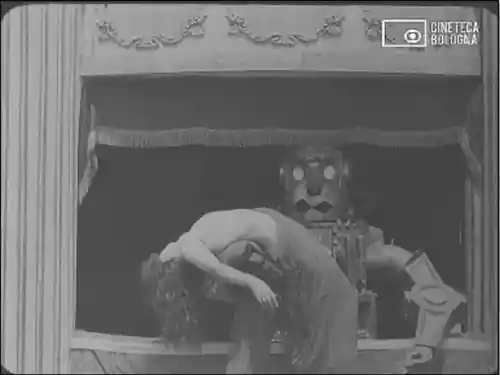
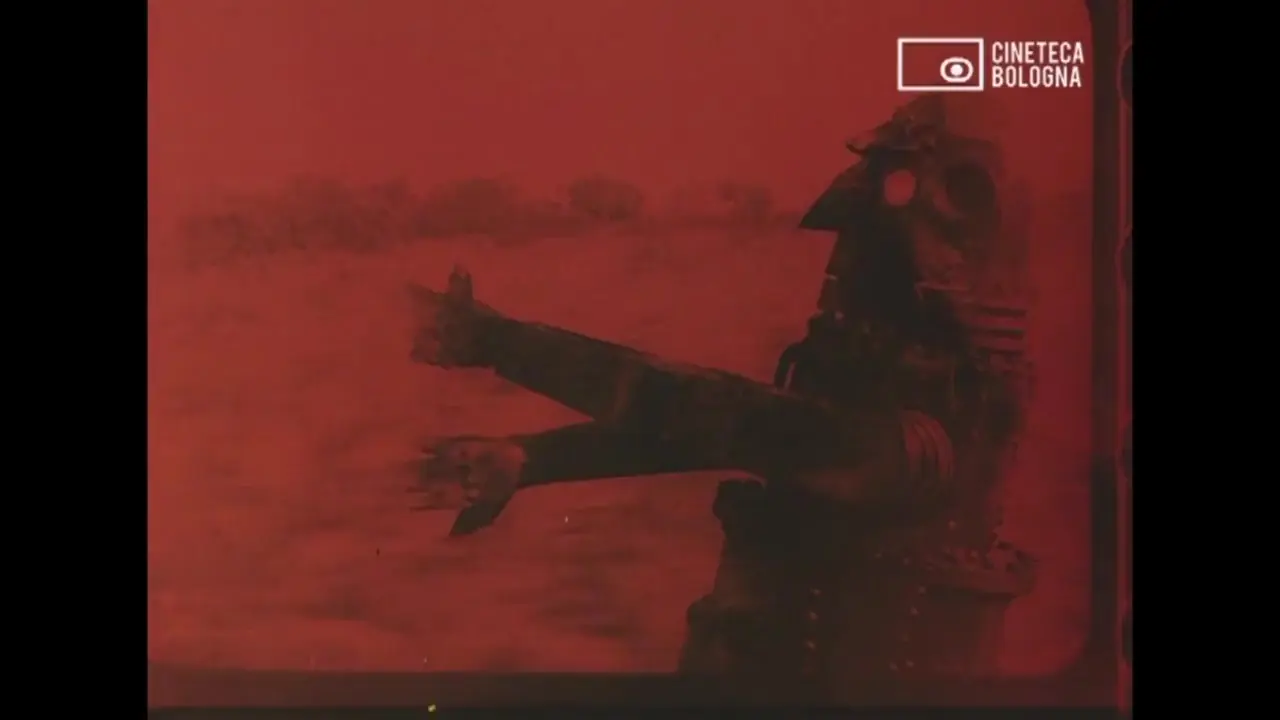
Only 42 of the original 65 minutes survive. Nitrate decay, vault floods, and a WWII bombing raid claimed the rest. Rather than hobble the film, these lacunae intensify its mystique. The missing reel—believed to contain the automaton’s rampage through a textile mill—exists now only in production stills: the robot wreathed in cotton drifts like dandelion seeds, workers frozen mid-scream. Cine-sleuths posit Deed intended a cyclical ending: the scientist, dismantled and reassembled into a breathing marionette by his own creation. Evidence? The final extant shot: a close-up of the automaton’s hand resting atop a human scalp, stroking hair with the tentative curiosity of a child petting a dead sparrow. Ambiguity triumphs over closure.
Post-WWI Italy, riven by worker strikes and the rise of Fordist worship, seeps into every frame. When the automaton lifts a crate labeled “IMPORTED COAL,” the subtext is clear: foreign industry, remote-controlled by capital, crushes local flesh. Yet Deed, ever the anarchic jester, refuses partisan bromides. The same automaton later topples a fascio symbol, hinting that mechanized tyranny transcends ideology. In an era when other films flaunt nationalist kitsch—see The Spirit of '17—this silent cyborg fable feels refreshingly unaligned, a cautionary tale for any society eager to trade marrow for piston.
Contemporary discourse fixates on AI ethics, neural implants, deep-fake doppelgängers. Viewing The Mechanical Man today is like finding a blueprint signed by tomorrow. The film anticipates not just technological displacement but ontological vertigo: if your double can waltz into your bedroom and no one blinks, what exactly is the irreducible core of “you”? Streaming-era viewers, blase about CG spectacles, may snicker at cardboard rivets—until they notice how the automaton’s gait matches the algorithmic cadences of Boston Dynamics videos. History, it seems, plagiarizes itself.
Where Tangled Hearts domesticates technology into romantic farce, and Hinton's Double plays identity mix-up for laughs, The Mechanical Man refuses the safety of genre. It straddles the liminal ridge between The Scarlet Sin’s moral didacticism and The Temple of Dusk’s decadent mysticism. In its DNA you can trace the lineage to By Proxy’s surveillance paranoia and the marital commodity fetish of Sunshine and Shadows. Yet none of these siblings glow with quite the same radioactive whimsy.
The 2022 4K restoration by Museo Nazionale del Cinema utilized AI interpolation to reconstruct missing frames, yet purists will cheer that the algorithmic sheen stops short of smoothing the hand-cranked cadence. Arrow Films’ Blu-ray pairs the film with a scholarly commentary, while Criterion’s forthcoming Silent Apocalypse box set promises a newly commissioned score by electro-cellist Zoë Keating—her looping ostinati promise to braid silicon with gut-string, a sonic mirror for the film’s man-machine dialectic. Streamers can rent it on Kino Cult, but nothing rivals a 16 mm theatrical screening where projector flicker becomes part of the mise-en-scène.
Great cinema does not merely tell a story; it rewires your synesthetic alphabet. After The Mechanical Man you may hear every elevator door sigh like an iron lung, may feel the smartphone in your palm warm into a beating heart you can hold at arm’s length. Deed’s flicker-book prophecy endures because it stages the primal fear that we are all remote-operated, that somewhere a deranged scientist—perhaps our future self—twirls a dial and our arms rise in salute. The film offers no redemption, only a dare: cut the wires, embrace the vertigo, and discover whether you fall or fly.
—Projected in the cathedral of your skull, the automaton still walks.

IMDb 5.6
1930
Community
Log in to comment.