DbcultAccessing Vault...
Cult Review
Senior Film Conservator
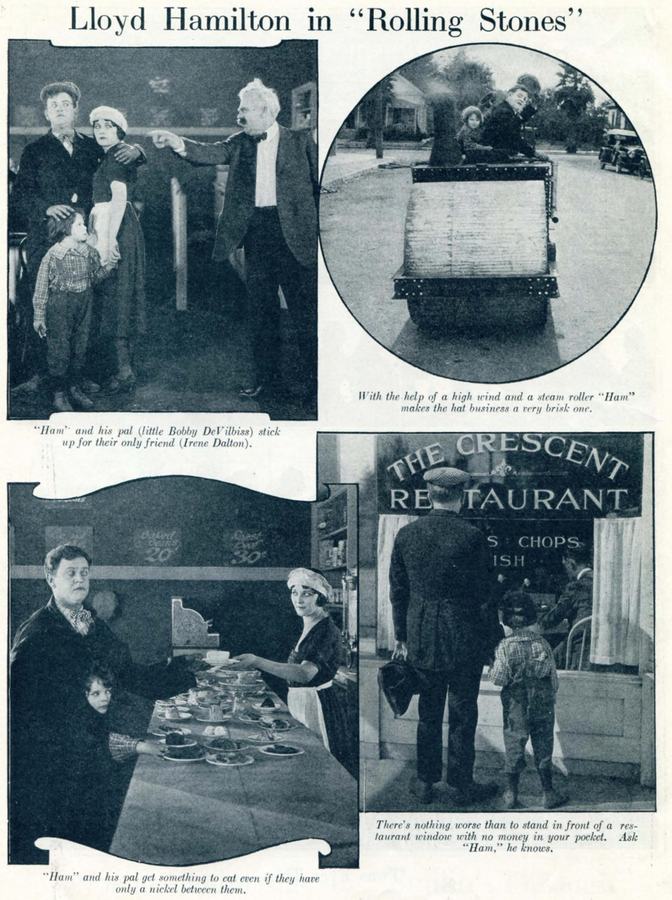
The year 1922 stands as a peculiar monolith in the history of cinema, a time when the visual language of comedy was shedding its primitive skin and evolving into something far more sophisticated and structurally sound. Within this milieu, Rolling Stones emerges not merely as a relic of the silent era, but as a vibrant testament to the subversive genius of Lloyd Hamilton and the directorial precision of Archie Mayo. While many contemporary audiences might gravitate toward the more widely canonized works of the era, such as Camille, there is an earthy, tactile brilliance in Hamilton’s 'Ham' persona that demands a closer, more scholarly inspection.
Lloyd Hamilton remains one of the most underrated titans of the silent screen. Unlike the acrobatic athleticism of Keaton or the balletic pathos of Chaplin, Hamilton’s comedy is rooted in a specific type of lugubrious momentum. In 'Rolling Stones,' his interaction with the steamroller is nothing short of operatic. He doesn't just operate machinery; he exists in a state of precarious harmony with it. The steamroller, a symbol of industrial progress and crushing finality, becomes an extension of his own awkward physicality. When he flattens a gentleman's hat, it isn't a mere gag; it is a profound statement on the fragility of social status in the face of mindless industrial force.
Comparing this to his work in Seeing Stars, one can observe a maturation in how Hamilton utilizes negative space. In 'Rolling Stones,' the street is a stage, and the steamroller is the primary antagonist. The timing required to synchronize the kid’s hat-tossing with the steamroller’s inexorable advance reveals a level of technical mastery that Archie Mayo would later refine in his more dramatic endeavors. Mayo, who would go on to direct heavyweights, shows here a penchant for the rhythmic editing that makes slapstick transcend into the realm of visual poetry.
The plot’s central conceit—destroying the old to necessitate the new—is a biting critique of the 'broken window' fallacy. By having the child throw hats into the street, the film highlights a desperate, almost predatory form of capitalism. Irene Dalton and Juanita Archer provide the necessary grounding for this farce, representing the 'civilized' face of the hat store that benefits from this clandestine vandalism. Their performances offer a sharp contrast to the blue-collar clumsiness of Hamilton and Otto Fries. It is a social microcosm where the survival of the boutique depends on the destruction of the street.
In many ways, this thematic depth mirrors the underlying tensions found in The Whistle, though 'Rolling Stones' opts for levity over melodrama. The film avoids the didacticism often present in social-conscious films like Samson, choosing instead to let the absurdity of the situation speak for itself. The sight of a steamroller methodically pancaking a row of expensive headwear is a visceral image that lingers long after the credits roll, a precursor to the mechanical deconstructions we would later see in the works of Laurel and Hardy.
Archie Mayo’s direction in 'Rolling Stones' is remarkably modern for 1922. He utilizes deep focus to keep the millinery shop in the background while the destruction occurs in the foreground, creating a sense of simultaneous narrative threads. This technique is far more advanced than the flat, stage-like presentations seen in earlier shorts like The Chicken Parade. The cinematography captures the textures of the era—the heavy wool of the suits, the polished brass of the steamroller, and the delicate lace of the hats—with a clarity that honors the craft of the period.
Furthermore, the inclusion of Robert DeVilbiss as 'the kid' adds a layer of mischievous energy that prevents the film from becoming too bogged down in Hamilton’s slower comedic beats. DeVilbiss possesses a screen presence that rivals the more famous child stars of the time, such as those found in Oh, Baby!. His chemistry with Hamilton is the engine that drives the film's second act, providing a bridge between the innocent play of childhood and the destructive consequences of the adult world.
To fully appreciate 'Rolling Stones,' one must view it through the lens of its contemporaries. While Fireman, Save My Gal! relied heavily on the frantic energy of emergency services, 'Rolling Stones' finds its humor in the slow, inevitable crawl of the steamroller. It is a comedy of anticipation rather than a comedy of reaction. Similarly, while Solomon in Society explored the nuances of class through dialogue and social maneuvering, Mayo’s film does so through the literal crushing of class symbols—the hat being the ultimate signifier of a man’s station in the 1920s.
Even when compared to the exoticism of The Jungle Goddess or the intrigue of The Secret Code, 'Rolling Stones' feels more grounded and, ironically, more daring. It takes a mundane urban setting and transforms it into a surrealist landscape of flattened felt. It lacks the pretension of Ce qu'on voit but possesses a raw, unadulterated cinematic joy that is often lost in more 'artistic' pursuits.
The final sequences of the film, where the shop is flooded with disgruntled, hatless men, serves as a masterclass in ensemble blocking. Otto Fries and Jack Lloyd navigate the burgeoning chaos with a frantic energy that perfectly complements Hamilton’s stoicism. The resolution of the film, while adhering to the expected tropes of the era, leaves the viewer with a lingering sense of the cyclical nature of destruction and rebirth. In the world of 'Rolling Stones,' nothing is permanent, especially not a man's dignity when faced with a five-ton piece of machinery.
As a piece of film history, this work stands alongside The Pride of the Firm as an essential study of early workplace comedy. It captures a moment before the Hays Code, before the homogenization of studio humor, when a director could find the sublime in a flattened hat. It is a film that rewards multiple viewings, as each frame is packed with the incidental details of a bygone Los Angeles, from the cobblestones to the specific typography on the shop windows.
In the grand tapestry of 1920s cinema, 'Rolling Stones' is a bright, orange thread—vibrant, slightly abrasive, and utterly essential. It lacks the melodrama of The Unapproachable Woman or the moralizing of Hit-the-Trail Holliday, and it is all the better for it. It is a pure distillation of the 'Ham' magic, a mechanical ballet that proves that sometimes, to build something up, you have to flatten everything in your path. For anyone seeking to understand the DNA of modern physical comedy, look no further than this steamrolling success.
Reviewer Note: The archival quality of 'Rolling Stones' allows us to appreciate the subtle facial expressions of Lloyd Hamilton, whose 'deadpan' was a precursor to the stoic greats of the talkie era. A must-watch for silent film aficionados and students of cinematic structure alike.
IMDb 5.7
1936
Community
Log in to comment.