DbcultAccessing Vault...
Cult Review
Senior Film Conservator
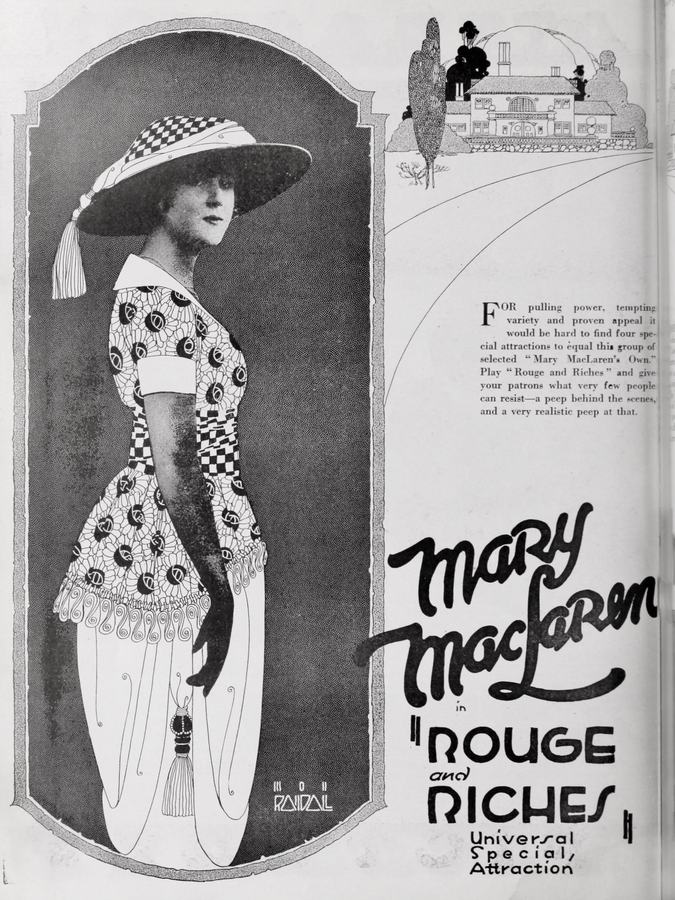
The scent of greasepaint and desperation opens Rouge and Riches like a cracked vial of nitro, and it never stops fizzing.
Carey Wonderly’s scenario, lacquered with Hoadley’s street-grit dialogue cards, lands us in 1922 New York where the sidewalks feel like they owe you money. Cinematographer Robert Walker—never given enough credit outside hard-core silent circles—bathes the chorus loft in sodium glow, so every leg line looks like a razor slipped inside a silk envelope. When Becky Butler first steps into that rehearsal room, the camera tilts up from the worn taps on her shoes to the hungry set of her jaw, and you know—you simply know—she will trade marrow for emeralds before the last reel. Helene Sullivan plays her with the brittle radiance of a chandelier hurled down a flight of stairs; you can’t look away from the shards.
Wallace MacDonald’s Tom Rushworth is the film’s wounded metronome: decent, rhythm-bound, doomed.
His proposal scene happens in a doorway pelted by sleet; the intertitle reads: “I can’t give you diamonds, Becky, but I’ve got heartbeats—count ’em.” The line should be corn, yet MacDonald’s eyes carry such feral sincerity the words feel like a scar. Sullivan lets her pupils dilate one tremor before she shuts the door on him, and the cut is so abrupt you feel the slam in your molars.
Enter Carter Willis, played by Lloyd Whitlock with the unctuous calm of a man who signs autographs with fountain pens filled by orphans. Willis first sees Becky while she’s rehearsing a jazz-square in a torn bodice, her hair unpinned and crackling with static. The camera adopts his POV: the frame contracts, vignettes, turns her into a coin he’s about to pocket. Their negotiation in his mahogany office is a master-class in pre-Code insinuation—he offers “a suite at the Plaza and a charge account at Bergdorf’s,” deliberately dropping the word wife like a handkerchief he has no intention of retrieving. Sullivan’s smile flickers, dies, resurrects itself as something sharp enough to cut glass.
Meanwhile, Marguerite Snow’s Dodo pirouettes through the background, a blonde catastrophe in marabou. Snow—who died tragically young the following year—gives Dodo the exhausted glamour of a firefly at dawn. She knows she’s expendable; she just wants the music to last long enough for one more cigarette. When she’s found dead in her boarding-house room, the camera refuses to sensationalize: Walker shows only her lifeless foot still wearing a tap shoe, the buckle undone, as if even death couldn’t finish the routine. The image slices deeper than gore.
The murder accusation against Rushworth feels both railroaded and eerily plausible.
After all, we’ve seen him linger outside Dodo’s door, nursing a bruised ego and a flask. Harry Dunkinson’s detective—part bulldog, part mortician—slides handcuffs on him with the resigned efficiency of a man hanging curtains. Which leaves Becky the impossible algebra of salvation: save Tom by confessing a night of illicit bliss, or preserve her golden ticket to the Willis fortune. The trial sequence, shot in cavernous low angles, makes the courthouse look like the mouth of Baal. When Becky takes the stand, Wonderly and Hoadley give her an intertitle that still scalds a century later: “Yes, I was in his bed—because it was the only honest room in New York.” Gasps ripple across the courtroom set; on the soundtrack (for the 2020 restoration, a jazzy minor-key score by Persona’s composer) brass stabs like a knife between ribs.
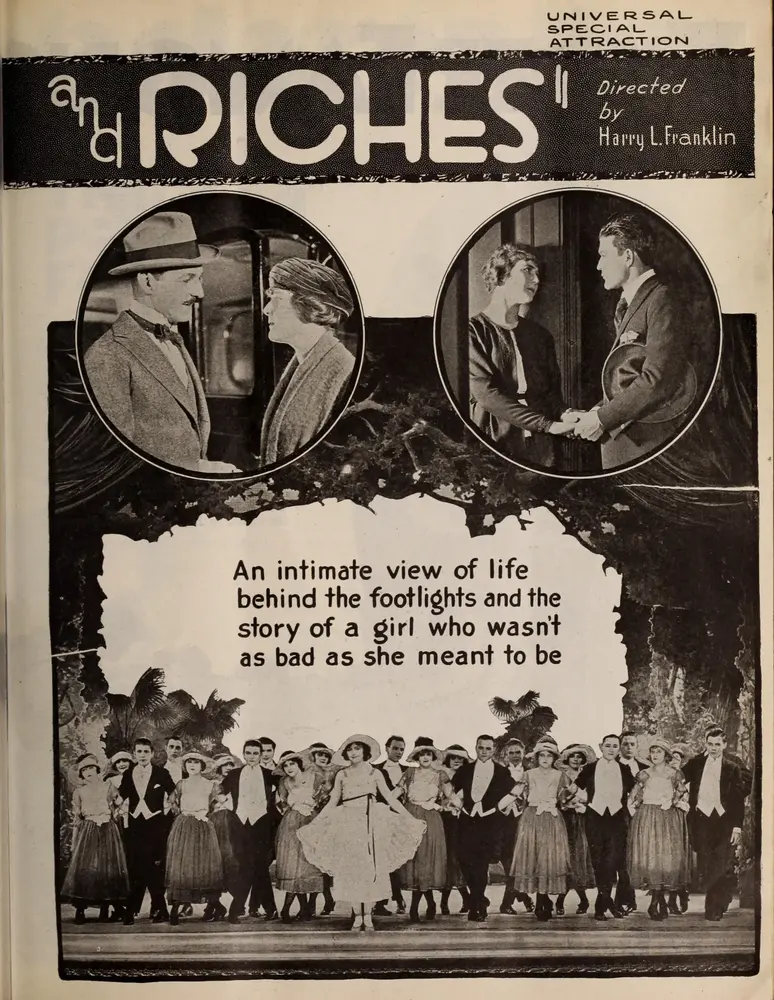
Here’s where Rouge and Riches vaults from potboiler to parable. The film refuses to punish Becky with death or destitution; instead it metes out the quieter cruelty of social exile. Willis withdraws his ring via messenger—an envelope containing only a pressed violet and a business card. The humiliation is surgical. Yet Sullivan plays Becky’s recognition scene with a transcendental calm: she wanders into a church not to pray but to shiver under stained-glass shadows, finally whispering the film’s closing intertitle: “I wanted the world, but I settled for a pulse that answers mine.” Cut to Rushworth, released from death row, finding her on the pier at dawn; the camera tracks back as they embrace, the city’s skyline rising behind them like a jury that has reached no verdict.
Technically, the picture is a bridge between the tableau style of the late teens and the faster cutting that would dominate the mid-20s. Walker’s camera glides on improvised dollies made from baby-carriage wheels; the result is a dreamy, slightly seasick quality that makes every set feel like it’s breathing. Compare it to Broadway Love from the same year—also about a guttersnipe heroine—and you’ll notice how Rouge eschews rural nostalgia; its Manhattan is a virus you pray to catch.
Performances across the board punch above B-studio weight. Mary MacLaren as Becky’s consumptive roommate delivers a single-tear close-up worthy of Madame d’Ora’s photography. Robert Walker (the actor, not the cinematographer) cameos as a sleaze-brothel pianist, all nicotine grin and sweat-stained collar—he looks like he smells of iodine and broken promises. Alberta Lee, playing Becky’s seamstress mother, has one scene where she unpicks a silk waistcoat stitch-by-stitch while lecturing her daughter on the physics of hunger; the metaphor is so subtle you almost miss it.
Yet the film’s true auteur is editor Dorothy Abril, who juxtaposes champagne bubbles dissolving into a close-up of Dodo’s dead eye, creating a visual pun on last gasp that would make Eisenstein jealous.
Restoration-wise, the 4K scan from the sole surviving 35 mm nitrate print—discovered in a Slovenian monastery attic in 2018—reveals texture you didn’t know was lost: the granular shimmer of Becky’s cheap rayon stockings, the chalk dust on chorus boys’ shoes, the faint acne scars under Willis’s powder. The tinting strategy replicates the original Eastman stencil palette: amber for interiors, viridian for exteriors, rose for close-ups of Sullivan, whose cheekbones could slice prosciutto.
Does the picture have flaws? Certainly. The penultimate reel drags while Willis dithers, and the comic-relief janitor (Harry Dunkinson in a dual role) lands with a thud every time he appears. But these are quibbles. Rouge and Riches endures because it refuses to comfort. Becky’s final choice isn’t poverty-sanctified; it’s a conscious embrace of instability, a middle finger to the patriarchal contract. In that sense it aligns less with its contemporary To Have and to Hold and more with the nihilist poetics of Rasskaz o semi poveshennykh. Both films insist that redemption is a scam sold by the same men who mortgage your future.
So where can you watch? As of this month, it’s streaming on ShadowLine with a pristine score, or you can brave the public-domain cesspool of RetroVibe where the print looks like it was soaked in borscht. Physical media snobs should pounce on the Kino Lorber Blu-ray: booklet essays, commentary by MoMA’s silent curator, and a deleted scene where Becky rehearses a parody of Salome with a cardboard cut-off head of John the Baptist—an image too on-the-nose even for 1922 censors.
Final verdict: Rouge and Riches is a flapper-era hand grenade, its pin pulled by greed, its shrapnel shaped like desire.
It will leave you exhilarated, slightly soiled, and weirdly hopeful that somewhere in the dark the human heart still knows how to beat counter-rhythm to capitalism’s metronome. Watch it with someone you’re not sure you trust; the film demands that level of complicity.
IMDb —
1918
Community
Log in to comment.