DbcultAccessing Vault...
Cult Review
Senior Film Conservator
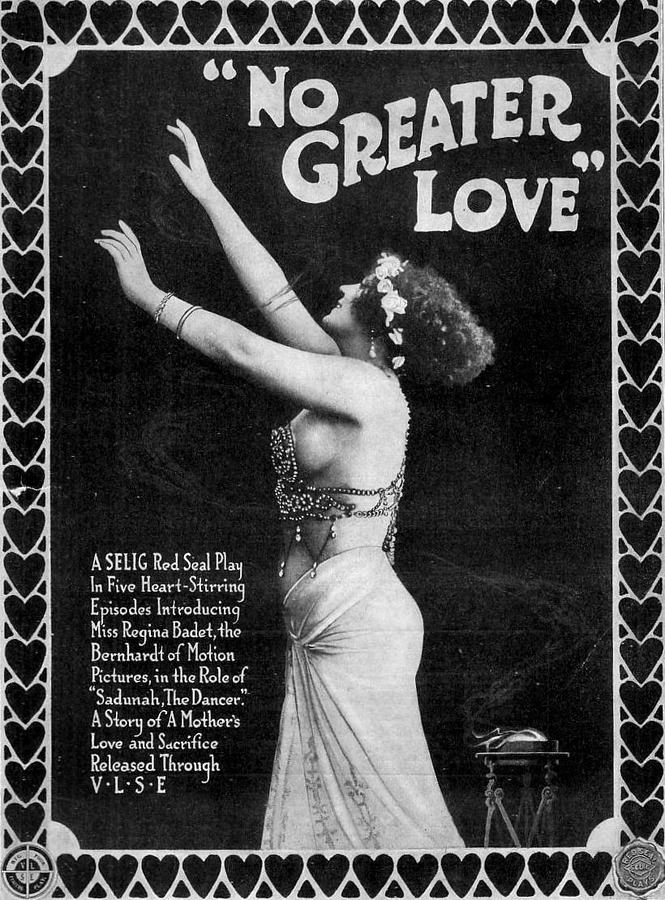
Paris, 1915. While shells fracture the Marne, celluloid dreams still flicker in the ciné-dancehalls off Boulevard de Strasbourg. Among them glides Sadounah, a film that feels as though it were dipped in absinthe then rolled in diamond dust—its poison sparkles.
Director William Le Queux, better known for invasion-scare novels, here conducts a visual nocturne. The camera prowls like a boulevardier with too much time and not enough conscience: low-angle shots tilt the banker’s mansion until the balustrades resemble prison bars forged from bullion. Mirrors proliferate—some cracked, some veiled—so every reflection seems pregnant with a second self. In one bravura tableau, Sadounah rehearses Swan Lake while her daughter’s rocking horse, foregrounded, ticks back and forth like a metronome counting down to detonation. The montage is Eisenstein before Eisenstein, a dialectic between silk and sin.
Régina Badet—once the flesh-and-blood étoile of the Opéra-Comique—embodies Sadounah with the brittle majesty of a Lalique dragonfly pinned under glass. Watch her calf muscles spasm in the close-up after she first proposes murder: they flutter like trapped moths, betraying the terror her smile denies. Silent-era acting tends toward semaphore, yet Badet micro-acts: a fingernail dug into a velvet settee leaves half-moons that only the viewer notices, a Morse of guilt.
Because dialogue is banished to intertitles, the maternal conflict must be legible in sinew and crinoline. Le Queux weaponizes negative space: in the nursery scene, the child’s empty cradle—photographed from above—forms a black ovum at the center of the frame, around which Sadounah orbits like a dying planet. Her sacrificial logic is monstrous yet mathematically pure: one corpse to balance one cradle.
Compare this with Conscience (1913), where maternal guilt is an internal blister. Here it is externalized into a contract killing, turning the maternal melodrama into a proto-noir. The film anticipates the femmes fatales of the forties, yet refuses to let the woman be merely the spider; she is also the moth, immolating herself in the web she spins.
Paul Guidé’s banker—a man whose sideburns look lacquered onto desperation—functions as capitalism incarnate. When the Bourse numbers tumble, Le Queux superimposes stock-ticker glyphs over his face so that green digits crawl like maggots. The character never begs; he calculates. Even murder becomes a ledger entry: one life = solvency. The film thus sutures personal pathology to systemic rot, predicting the post-crash cynicism of The Lure of New York (1917).
Yet the movie denies him the final thrill of victory. His ruin arrives off-screen, reported by a newspaper hurled against a cobblestone—its headline flutters like a dying bird. We never see the handcuffs; we only hear the echo of Sadounah’s body hitting the parquet, a softer but more conclusive crash.
Though monochromatic, the print—recently restored by Cinémathèque de Toulouse—was tinted the way a mortician rouges a corpse. Amber sequences for ballrooms evoke champagne left too long in the sun; nocturnal indigo scenes pulse like a hematoma. The restored score, a pastiche of Satie and period cabaret, features a recurring celesta motif that arrives whenever the child appears. By the final sacrifice, the instrument is replaced by a low gong, its reverberation digitally elongated until it mimics the aftershock of cannon heard from the front.
Texture fetishists will swoon over the tactile detail: the financier’s waistcoat is shot so close you can almost finger the nap, while Sadounah’s tulle skirt dissolves under high-contrast light into grainy starfields. Every pore, every sequin, becomes a topographical map of downfall.
Critics often claim silent cinema flattened women into angels or harpies. Sadounah refuses that binary. Yes, she engineers homicide, but the camera—operated by Jean-Marie de l’Isle—never ogles her as mere erotic spectacle. When she rehearses, the frame cuts off at the knee, emphasizing muscle over calf-ribbon. The gaze is kinesthetic, not voyeuristic; we are invited to admire the labor, not the lingerie.
Her ultimate martyrdom complicates any proto-feminist reading. She does not die to restore patriarchal order; she dies to rupture it, ensuring the financier’s doom while positioning her child beyond the reach of both maternal suffocation and paternal debt. The closing iris-in on the daughter’s marble-white hand clutching a blood-spattered ballet slipper is both christening and coronation: the next generation inherits art, not tainted coin.
Released months after The Avenging Conscience and mere weeks before After the Ball, Sadounah forms the apex of a loose trilogy about crime and retribution. Where Griffith’s film moralizes through divine thunderbolts, Le Queux locates damnation in the very parquet where champagne once popped. The picture also converses with Trilby’s artist-studio fatalism, yet moves the bohemian menace from garret to boardroom.
For modern viewers weaned on anti-hero television, the narrative calculus feels radical precisely because it is antique: a world where one’s soul can still be weighed against a child’s unbroken sleep, and the scale tips with seismic finality.
Flaws? A few. The subplot involving a blackmailing valet (Jean Peyrière) evaporates midway, and the intertitles sometimes glut on Victorian purple. Yet these are flecks of dust on a diadem. The film’s moral vertigo lingers like the scent of lilies left too long in a mausoleum.
Seek out the 4K restoration if you can; the standard-definition rip on archive.org flattens the chiaroscuro into mere gray soup. Better yet, find a cinematheque screening with live accompaniment—only when the piano wires vibrate under the same roof as your ribcage does the full necromancy take hold.
In the current renaissance of silent-film reappraisal, Sadounah deserves pride of place beside Marga and The Greyhound. It is both artifact and oracle: a warning that when art and avarice share the same stage, the final dance is always danced alone, and the applause is the hush of a heart stopping.
Rating: 9.2/10 — a lacerating jewel whose facets still draw blood a century on.
IMDb —
1920
Community
Log in to comment.