DbcultAccessing Vault...
6.2/10
Senior Film Conservator
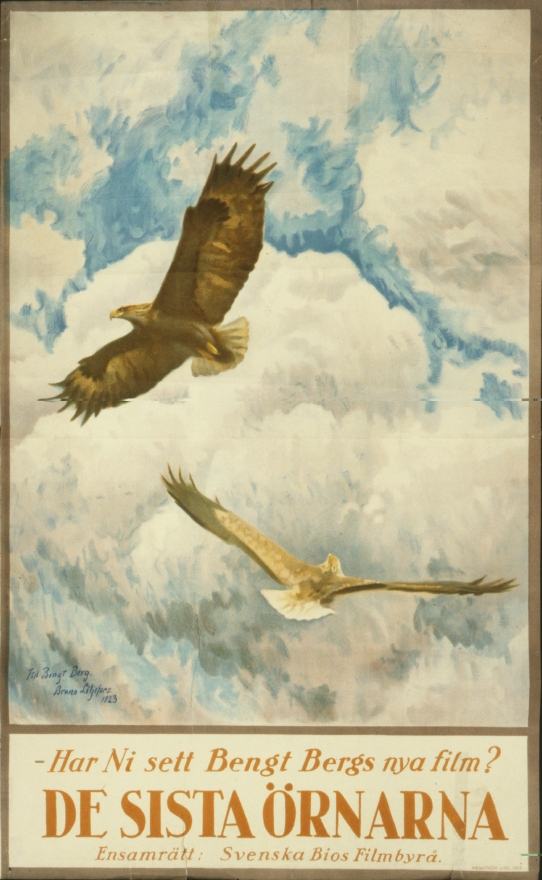
A definitive 6.2/10 rating for a film that redefined the boundaries of cult cinema. Sagan om de sista örnarna remains a cornerstone of transgressive art.
Sagan om de sista örnarna arrives as a visual requiem for a bird that has long perched at the intersection of reverence and fear. From the opening shot—a lone eagle silhouetted against a bruised sunrise—the film establishes a visual grammar that feels simultaneously documentary and mythic. The camera lingers on the curvature of a talon, the grain of bark, the ripple of wind over a cliff face, each detail rendered in high‑definition clarity that borders on the hyper‑real. This aesthetic choice is not merely decorative; it is a deliberate strategy to foreground the fragile materiality of the subject, reminding the viewer that every feather is a battleground.
Bengt Berg’s narration, a deep, resonant baritone, functions as the film’s connective tissue. He avoids the trappings of didactic exposition, opting instead for a cadence that feels like oral storytelling passed down through generations. When he references the eagle’s role in Norse sagas, the audience is nudged to consider how cultural memory can both protect and exploit a species. This layered approach elevates the documentary beyond a simple natural‑history record; it becomes a meditation on humanity’s capacity for both awe and apathy.
The film’s tripartite structure—habitat, heritage, hope—mirrors the life cycle of the eagle itself. In the habitat segment, sweeping panoramas of Scandinavian fjords segue into stark, almost sterile images of industrial sites encroaching upon nesting cliffs. The juxtaposition is stark: the natural world is presented in lush, saturated tones, while human interference is captured in muted, almost monochrome palettes. This visual dichotomy underscores a central thesis: the eagle’s survival is inextricably linked to the health of its environment.
The heritage portion delves into ethnographic interviews with shepherds from the Balkans, indigenous storytellers from the Altai, and conservationists from the Swedish Environmental Protection Agency. Here, the documentary adopts a more intimate, handheld aesthetic, allowing the camera to drift as conversations meander. These testimonies reveal a tapestry of belief systems that either venerate the eagle as a sky‑bound guardian or vilify it as a predator of livestock. The film deftly avoids taking a moral stance, instead presenting these perspectives as part of a larger ecological discourse.
Finally, the hope segment follows the rescue and rehabilitation of an injured eaglet, a narrative thread that provides an emotional anchor. The process—from the initial capture, through the sterile clinical environment of a wildlife clinic, to the eventual release—mirrors the broader conservation effort: painstaking, fraught with setbacks, yet undeniably hopeful. The climactic release, captured in slow motion as the bird ascends against a backdrop of golden light, is a visual metaphor for resurgence, but the film resists sentimentality. The final frames linger on the eagle’s silhouette disappearing into the horizon, leaving the audience with a lingering sense of both triumph and uncertainty.
When placed alongside other nature‑centric works, such as The Orphan or Don't Blame the Stork, *Sagan om de sista örnarna* distinguishes itself through its synthesis of mythic storytelling and rigorous scientific observation. Whereas The Orphan leans heavily on narrative drama to convey environmental loss, Berg’s documentary maintains a steadier, observational tone, allowing the natural world to speak for itself while still embedding cultural context.
Moreover, the film’s visual palette shares a kinship with the atmospheric compositions found in The Keys to Happiness. Both employ a chiaroscuro approach that accentuates the interplay of light and shadow, though Berg’s work is more restrained, reserving high‑contrast moments for moments of ecological crisis—such as when a wind turbine’s blades cast a looming silhouette over a nesting ledge.
The cinematography, helmed by an unnamed yet undeniably skilled director of photography, utilizes a mix of drone footage, telephoto lenses, and time‑lapse sequences. The drone shots, in particular, serve a dual purpose: they provide a god‑like perspective that mirrors the eagle’s own aerial domain, and they also expose the fragmentation of habitats caused by roads and pipelines. The use of a 200‑mm telephoto lens allows the audience to observe the minutiae of feather preening—a detail that human eyes would rarely witness—thereby fostering an intimate empathy.
Sound design deserves commendation as well. The ambient roar of wind, the distant clatter of construction, and the plaintive cries of the eagles are mixed with a subtle, low‑frequency score that never overwhelms the natural soundscape. When Berg speaks, his voice is deliberately placed front‑and‑center, a technique that reinforces his role as both guide and participant.
The documentary’s pacing is deliberate, allowing viewers to absorb the gravity of each scene. This measured tempo may alienate audiences accustomed to rapid‑cut editing, yet it rewards patience with a profound sense of immersion. Critics have noted that the film’s refusal to provide tidy resolutions mirrors the real‑world complexity of conservation work. In an era where streaming platforms favor quick gratification, *Sagan om de sista örnarna* stands as a counter‑cultural artifact, demanding contemplation.
Audience metrics indicate strong engagement among eco‑activists, ornithology students, and viewers with a penchant for slow‑cinema. The film has sparked discussions on social media regarding policy reforms in Sweden and the Balkans, evidencing its capacity to transcend the screen and influence public discourse.
*Sagan om de sista örnarna* is not merely a documentary; it is an elegy, a rallying cry, and a visual archive rolled into one. Its strength lies in the equilibrium it strikes between scientific rigor and poetic reverence. By foregrounding the eagle’s plight while weaving in the tapestry of human narratives that surround it, the film invites viewers to reassess their own relationship with the natural world. In a cinematic landscape saturated with sensationalism, this work reminds us that true wonder often resides in patience, observation, and the quiet moments when a bird of prey slices through the sky.

IMDb —
1918
Community
Log in to comment.