DbcultAccessing Vault...
Cult Review
Senior Film Conservator
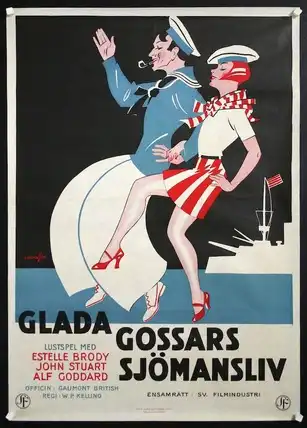
If you have a high tolerance for the specific kind of polite, slightly stiff British humor that defined the late 1920s, you might get a kick out of Sailors Don't Care. It’s a movie that feels like it was made by people who really respected the Navy but didn't quite know how to make a joke land without a five-second pause. If you’re looking for a gripping war drama, this isn't it. But if you want to see John Stuart looking incredibly uncomfortable in a common sailor’s uniform, you’re in the right place.
The whole premise is ridiculous in that way only silent movies can get away with. Sir Henry (played by John Stuart) joins his son’s ship as an ordinary rating. He’s a knight. He’s supposed to be rich and refined, but here he is, pretending to be a 'salt of the earth' type. The funny thing is, Stuart doesn’t really change his acting style at all. He still stands like he’s waiting for someone to hand him a brandy, which actually makes the scenes where he’s trying to blend in with the other sailors accidentally hilarious. There’s a moment early on where he’s handling a mop, and he looks at it like it’s a strange, alien artifact.
Estelle Brody shows up, and as usual, she’s the most energetic person on screen. She had this way of moving that felt much more modern than the rest of the British cast at the time. While everyone else is posing, she’s actually reacting. I noticed in the scenes she shares with Stuart, she’s doing a lot of the heavy lifting with her eyes just to keep the energy from flatlining. It reminded me a bit of the chemistry in The Glorious Adventure, where the spectacle sometimes threatens to swallow the actors whole.
The pacing is… let’s call it relaxed. There is a long stretch in the middle where they are just hanging out on the ship, and the 'comedy' consists of people falling over or looking confused. It drags. You can almost feel the director, Roy William Neill, waiting for the final act so he can finally get to the U-boat stuff. Some of the shots of the crew in the mess hall feel weirdly empty, like they only had enough extras to fill half the benches, so they just hoped we wouldn't notice the gaps.
Speaking of the U-boat, the shift in tone is jarring. We go from 'silly dad in a sailor suit' to a fairly tense Q-ship encounter. A Q-ship is basically a merchant vessel with hidden guns, meant to lure submarines to the surface. When the movie finally stops trying to be a sitcom, it gets much better. The way the hidden gun flaps fall away is actually a great bit of practical filmmaking. It’s one of those moments that unexpectedly works because it feels grounded in actual naval tactics rather than stagey slapstick.
There’s a weird edit during the battle where a German sailor is seen looking through a periscope, and then it cuts to a shot of the British ship that looks like it was filmed on a completely different day with different lighting. It’s one of those tiny visual observations that pulls you out for a second. The water in the 'sea' shots also looks suspiciously like a very large tank in a few frames, especially when the depth charges go off. The splashes are just a bit too small for the scale they’re aiming for.
I found myself focusing on the background details of the ship more than the plot. The costumes are surprisingly lived-in—except for Stuart’s, which looks like it came straight from the dry cleaners every morning. The contrast between his pristine whites and the grimy faces of the engine room crew is probably intentional to show his character's fish-out-of-water status, but it just makes him look like he’s in a different movie than everyone else.
Mary Brough has a few scenes that are clearly meant to be the comic relief highlight, and she’s great in a 'pantomime dame' sort of way, but her energy is so high it almost knocks the rest of the scene over. It’s that broad, theatrical style that was already starting to feel a bit dated by 1928. It’s a far cry from the more naturalistic stuff you’d see in something like The Talk of the Town (granted, that’s much later, but you can see the seeds of the transition here).
Is it a masterpiece? No. It’s a bit of propaganda, a bit of a family comedy, and a bit of a naval thriller. It doesn’t do any of those things perfectly. But there’s a charm to its clumsiness. The scene where the son finally realizes his dad is on the ship is played with such a weird lack of urgency that I had to rewind it to make sure I didn't miss a title card. They just sort of look at each other, nod, and move on. It’s very British, I suppose.
If you like seeing how 1920s cinema handled the transition into more complex action sequences, the final twenty minutes are worth the price of admission. The rest of it is just a pleasant, if slightly boring, excuse to see some silent stars in naval gear. It’s the kind of movie you watch on a Sunday afternoon when you don’t want to think too hard about 'the human condition' and just want to see a fake submarine get what’s coming to it.
IMDb —
1924
Community
Log in to comment.