DbcultAccessing Vault...
6.6/10
Senior Film Conservator
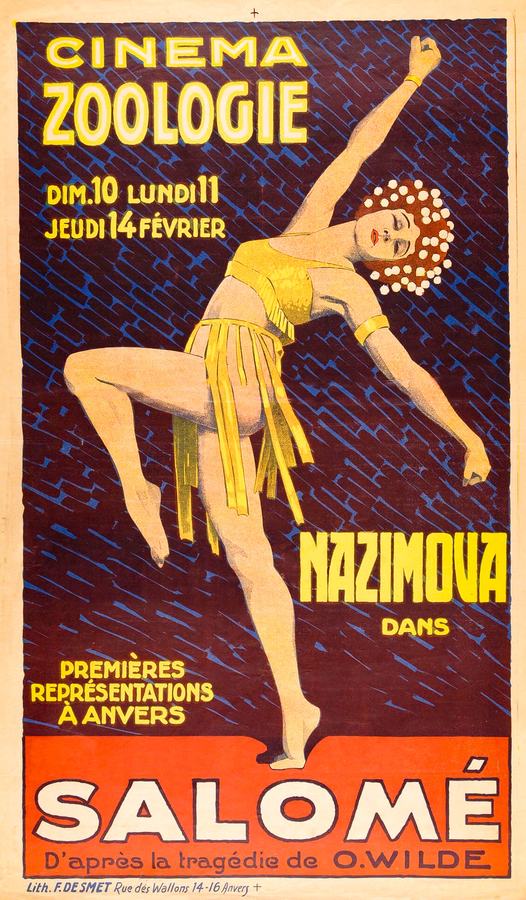
A definitive 6.6/10 rating for a film that redefined the boundaries of cult cinema. Salomé remains a cornerstone of transgressive art.
The celluloid itself seems soaked in mercury and opium; each intertitle arrives like a tattoo needle etching copperplate curses onto the viewer’s cornea. Salomé—not merely adapted but alchemically transubstantiated by Nazimova and Natacha Rambova—jettisons narrative decorum the way a cobra sloughs skin. What remains is a 72-minute hallucination where geometry, flesh, and scripture collide inside a mirrored sarcophagus.
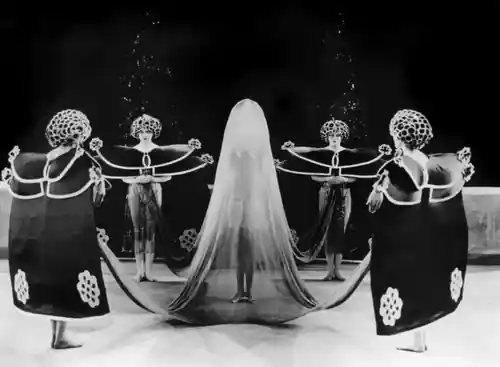
Nazimova’s dance refuses the shimmy-and-jiggle burlesque one might expect from 1922; instead she articulates a hieroglyphic alphabet of desire—pelvic oscillations mutate into stigmata, arms splice into lunar crescents, feet sketch labyrinths on the onyx floor. The camera, shackled by early two-strip Technicolor limitations, instead becomes a chiaroscuro scalpel, carving negative space until the screen itself appears to breathe through gill-slits.
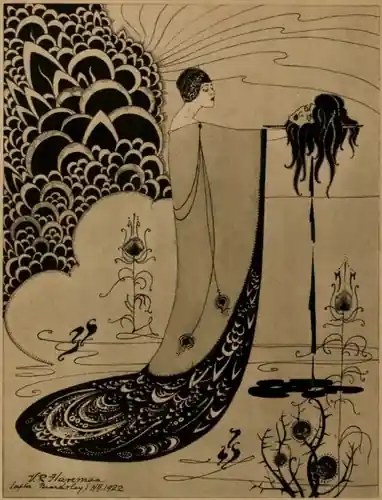
Beneath the biblical drapery squirms a triumphant sapphic insurgency. Rambova’s costumes—metallic scallops, nipple-armor of cloisonné beads—turn the female form into a Byzantine reliquary. Meanwhile, the male courtiers wear lamé tunics so sheer their pubic hair creates restless Morse code against silk. The film’s production mythology whispers that every actor was homosexual, hired to irradiate the set with authentic lavender vibrations; whether apocrypha or PR wizardry, the celluloid queerness vibrates like a tuning fork struck by moonlight.
Where Wilde’s play drips with epigrammatic arsenic, Nazimova opts for ophthalmic silence—close-ups linger until dialogue becomes epidermal. The prophet’s curse is delivered not via subtitle but through a lens that slowly tilts from his blistered ankles to the sky, as if Heaven itself were complicit in the voyeuristic contract. Dialogue intertitles arrive sparingly, lettered in a stylized uncial font that resembles semen crystallizing on parchment.
Louis Dumar’s tetrarch behaves like a gouty Saturn, devouring his own ringed moons of self-restraint. His throne room—an origami nightmare of acute angles—compresses power into acute sadistic spasms. Watch how he fondles the emerald ring that promises Salomé’s wish: the gesture loops, stutters, reverses, a zoetrope of royal debauch echoing backward into the proto-cinema of Emperors Caligula and Elagabalus.
Nigel De Brulier’s ascetic lumbers from the cistern with cheekbones sharp enough to slice theological veils. His matted hair drips algae and apocalypse; his eyes, however, blaze with a monastic OnlyFans energy. The actor, famous for earlier villainous eccentrics, here channels both object and obstacle—his torso becomes the cartographic center onto which every character projects their unspoken cartography of lust.
Rambova’s veils alternate between gossamer and cuirass: first a coral membrane that evokes dissected sea anemones; second a saffron cataract; third a malachite net heavy as court intrigue; fourth a vermilion so saturated it bleeds onto the lens; fifth a tinfoil lamé that screeches like feedback; sixth a bruise-purple organza; seventh a mercury lamination that, once shed, leaves Salomé as baldly luminous as a Pre-Raphaelite tuberculosis patient. Each discard cues a jump-cut to the moon, implying astronomical complicity.
When the head finally arrives—no dripping gore, but a burnished Byzantine oval—Herodias (Rose Dione) lifts it like a censer, swinging the relic through clouds of myrrh. The camera’s iris closes until only the head’s lips remain, mouthing a final, silent anathema that metastasizes into the film’s closing shot: a superimposition of Salomé’s eyes over the lunar disc, two syphilitic moons eclipsing any possibility of moral sunrise.
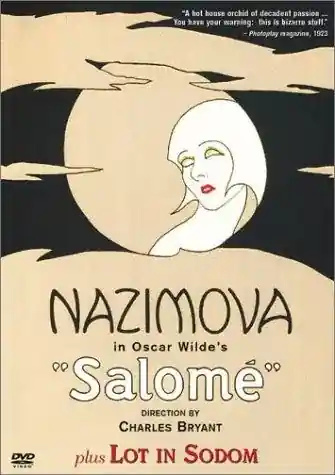
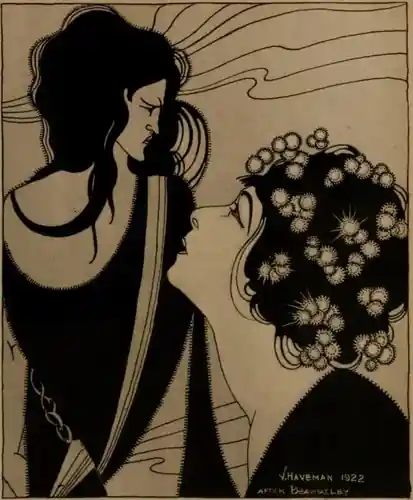
The film’s Art-Nouveau DNA—Aubrey Beardsley’s ink-ribbed eroticism filtered through a lesbian gaze—prefigures everything from Dorian Gray’s narcissistic decay to Madonna’s Vogue crucifix. Watch for the moment Salomé’s shadow detaches from her body and performs a separate pirouette: an early special effect achieved by double-exposure, predating German expressionist silhouettes by mere months yet feeling centuries ahead in occult audacity.
Modern screenings often pair the film with new scores—ritualistic doom-drone, Sephardic ululations, even glitch-hop—but the original 1922 premieres relied on a single oud and a tam-tam struck off-screen, the reverberations synchronized so that each thud coincided with a cut to Salomé’s bare instep. The absence of canonical audio invites viewers to project their own interior cacophony: mine tastes of copper pennies balanced on the tongue during fever.
Contemporary critics dismissed the picture as “orientalist excreta,” yet Variety’s 1922 capsule oddly praised Nazimova’s “kinetic hieroglyphs.” Today, queer cine-clubs resurrect it as a proto-riot-grrl anthem; art historians parse its Persian miniatures meets Bauhaus negative space; TikTok teens sample the dance into three-second loops, severing context the way Herod’s executioner severs necks. Criterion’s 4K restoration reveals hairline cracks in the silver emulsion that resemble the Shroud of Turin—proof that the film continues to sweat stigmata a century on.
Unlike Little School Ma’am’s prairie rectitude or Man Behind the Curtain’s Prohibition sleaze, Salomé refuses redemptive catharsis. Its kinship lies closer to Fires of Rebellion’s anarchic fever yet surpasses even that incendiary tract in formal nihilism. Where Mother Earth sentimentalizes agrarian cycles, Nazimowa’s Judea is a salt-encrusted wasteland where soil refuses to accept blood, forcing decapitated heads to roll like marble bowling balls across eternity.
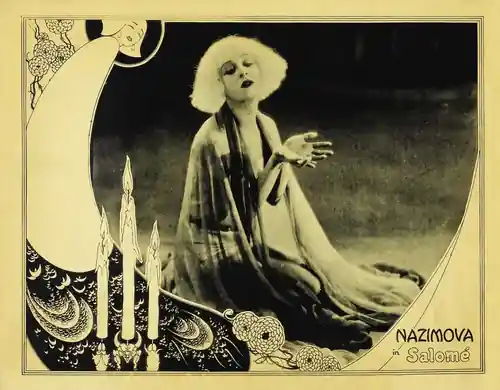
Original 1922 lobby cards—printed on linen rather than paper—surface sporadically on eBay, often misattributed as outtakes from Rainbow Girl. A mint-condition card auctioned in 2023 for $8,700, the illustration depicting Salomé cradling the Baptist’s head against her breast, eyelids studded with actual glass micro-beads that catch projector light like cat eyes. Owning one feels less like possessing memorabilia than hosting a cursed relic; my own copy arrived wrapped in pages torn from a 1919 Syriac Bible, the passage underlined: “I will make mine arrows drunk with blood.”
To watch Salomé is to consent to a century-old infection: the silver nitrate enters via retina, incubates in the hypothalamus, erupts weeks later as dreams of lunar blood and mirrored corridors. Nazimova never again directed; some say the film exhausted her life-force, others that Hollywood’s Hays moralists branded her a decadent witch. Whatever the truth, each fresh viewing shears another sliver from the soul, leaving audiences like Herod—haunted, titillated, and forever bargaining with shadows for one more glimpse of the dance.
IMDb 6.7
1926
Community
Log in to comment.