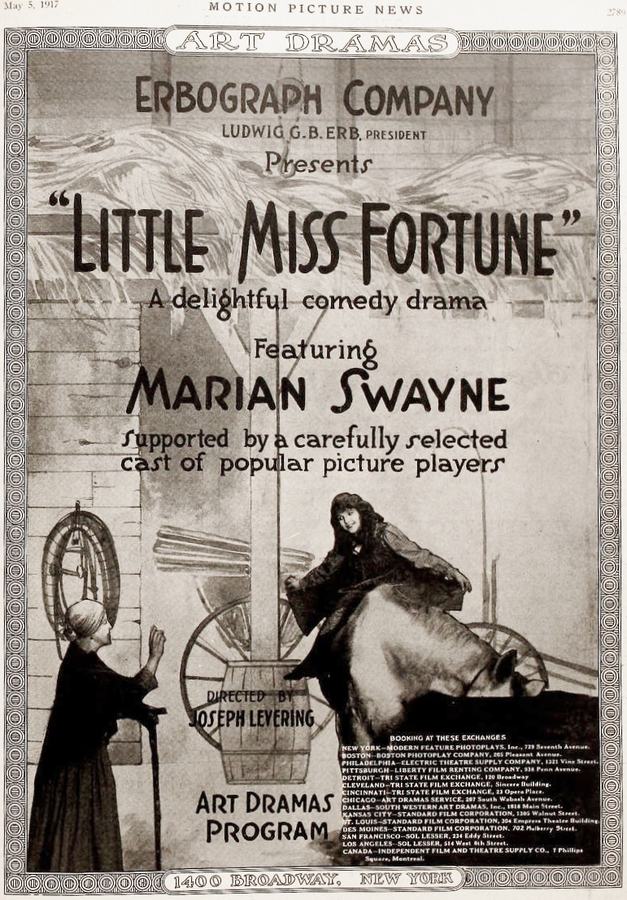
There is a moment—roughly two-thirds through Clarence J. Harris’s brisk, fifty-five-minute celluloid valentine—when Sis (Marian Swayne) lifts her soot-smudged gaze toward the limelight and the frame itself seems to inhale. Nitrate grain glimmers like frost on a windowpane; the iris-in contracts until her corona of hope fills the screen. It is 1923, but the film feels older, almost antediluvian in its conviction that art can ransom a life. That Sis’s redemption arrives not through marriage but through performance is the picture’s quiet revolution.
Scholars routinely lionize the gargantuan canvases of Napoleon or the proto-feminist swagger of Daphne and the Pirate, yet this modest chamber piece—shot largely on a single boardinghouse set that wobbles if you squint—radiates an intimacy those epics seldom risk. Harris, a scenarist better known for potboilers, here channels the fervid romanticism of a country kid who once pressed his nose against tent-flap canvas yearning for the magic inside. Every dissolve feels like a sigh; every intertitle is laconic poetry carved from corncob vernacular.
Swayne, barely twenty during production, carries the film on clavicles sharp enough to slice fog. She has the pneumatic gauntness of someone who has eaten more dreams than dinners, yet when Jim (Hugh Thompson) prompts her to «imagine the audience naked,» her grin snaps open like a broken locket revealing a secret photograph. Watch her hands: they flutter from apron hem to heart to mouth, a semaphore of insecurity transmuting into audacity. It is a performance calibrated for silence—no theatrical semaphore, no widened eyes begging for pity—just a tremulous confidence that swells until we believe, as Jim does, that boards can be a throne.
Thompson, saddled with the thankless «leading man» archetype, sidesteps narcissism by playing Jim as a man terrified of obsolescence. His eyes linger on Sis not with predatory hunger but with the desperation of someone clinging to driftwood in a shipwreck. The chemistry between them crackles because it is mentorship first, erotics second; the courtship occurs in the margins of scripts, in the hush between footlights. When he finally declares affection, the subtitle card—white letters on black—reads simply, «You’ve made my old songs new again.» Corn? Maybe. Yet in context the line lands like a psalm.
The film’s visual grammar is thrift-store Expressionism: low-key lighting pools under doors, hallways stretch into Pirandello infinity, and city exteriors are rendered via back-projected smoke so thick you could butter it. Cinematographer Charles L. MacDonald relapses occasionally into the standard medium-wide two-shot, but when he inches the camera closer, the world tilts. During Sis’s impromptu stage debut, the lens hovers just below proscenium height, turning spectators into a ravenous hydra of shadows. Each cutaway to Flossie (Lucile Dorrington) in her sickbed feels like a guilty conscience—lace curtains breathing, a mirror reflecting nothing because the soul has stepped out.
Dorrington has perhaps the trickiest task: embodying the ingenue whose fragility is both weapon and wound. She totters between malice and marrow-deep fear that her replacement will eclipse her. In one chiaroscuro close-up, she claws at her own reflection, smearing cold cream like warpaint; the moment is pure silent-era jouissance—a crack in the porcelain that lets us glimpse the void.
And then there is Ned—Bradley Barker’s dissolute second lead—who pilfers not from greed but from the existential arithmetic of hunger. Barker plays him like a man who has already rehearsed his own downfall; every twitch of his mustache forecasts defeat. When Jim exposes him, the confrontation is staged in a narrow corridor barely wider than conscience: Ned confesses not through intertitle but by extending the stolen brooch on his open palm, arm trembling like a tuning fork. It is a tableau worthy of Dostoevsky, compressed into twelve seconds.
«Harris refuses to punish Sis for ambition; the film’s true larceny is committed by a man who has forgotten how to dream.»
Comparisons? The boardinghouse microcosm recalls The Morals of Marcus, though Harris swaps that film’s cosmopolitan cynicism for something closer to hymn. The rags-to-riches arc parallels Mary Lawson’s Secret, yet where that narrative hinges on inheritance, Little Miss Fortune insists on merit—talent as the single irrefutable currency. Even La Broyeuse de Coeur, with its Parisian decadence, cannot match the austere moral clarity here: success is not a corruption but a communion.
Yet the film is not without blemish. A comic interlude involving a tipsy character actor and a misplaced toupee lands with the thud of vaudeville afterthought. The climactic on-stage triumph is conveyed via a single, stationary long take that, while admirably restrained, deprives us of Sis’s subjective exhilaration. One yearns for a montage—eyes in the wings, spotlight flares, the diaphragm of the theater expanding—to translate her epiphany into pure visual euphoria.
Still, these are quibbles. What lingers is the film’s faith in the alchemical power of pretending. In an era when studios pumped out Cinderella variants by the freight car, Harris delivers a heroine who rescues herself through craft. No fairy godmother, no prince with a contract—just the grit to sweep floors, the grace to inhabit another’s words, and the gall to believe she belongs beneath the rafters.
The restoration making the archival rounds (courtesy of a 4K scan from a Dutch print) reveals textures previously smothered in dupe decay: the herringbone pattern of Jim’s waistcoat, the opalescent sheen of Flossie’s negligee, the faint acne scars on Sis’s temples—proof that even nascent stars had epidermal anxieties. A new score by experimental duo Shellac & Soot overlays toy-piano plinks with bowed-saw drones, evoking both barn-dance innocence and metropolitan dread. In the penultimate reel, as applause detonates on-screen, the composers let the soundtrack drop to silence for eight full seconds—an audacious coup that makes the ovation feel inside your skull.
So why resuscitate this modest reel when flashier silents hog the bandwidth? Because Little Miss Fortune understands that stardom is not vertiginous ascent but recognition—the moment the world finally sees what the outcast always sensed she contained. In that recognition lies a democratic promise: the next face in the footlights might be anyone scrubbing your foyer, anyone enduring your casual disregard.
Watch it for Swayne’s incandescent fragility. Watch it for Thompson’s hushed reverence when he murmurs, «You made the air remember.» Watch it because the film, like its heroine, triumphs not by scale but by sincerity—an ember that still scorches a century onward. Then, when the lights rise and the city outside feels colder, ask yourself: which of today’s dismissed dreamers is one rehearsal away from detonating the dark?
Verdict: A translucent marvel of early-twentieth-century optimism, worthy of double-billing with The Come-Back for a night of restorative cinephilia.