DbcultAccessing Vault...
Cult Review
Senior Film Conservator
The hat is never just felt and ribbon; it is the last continent of a man’s composure, a tonsure that, once removed, exposes the soft atlas of dread we all fold into our scalps.
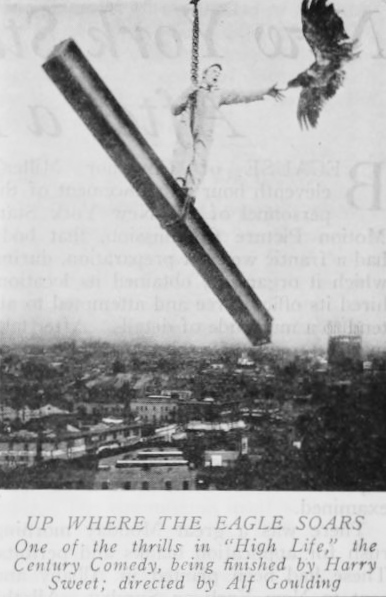
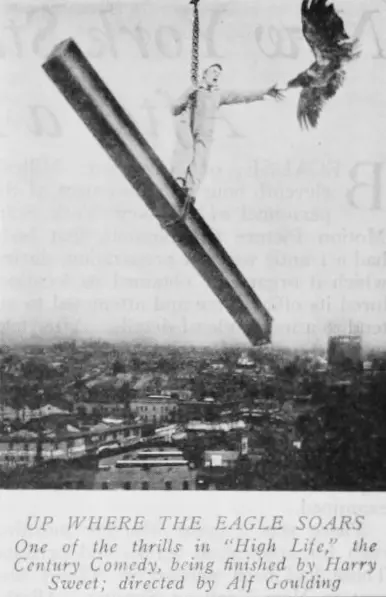
High Life, a 1920 one-reeler that clocks in at a whisper under twelve minutes, understands this axiom with the instinctive cruelty of a child pulling wings off angels. Produced by the short-lived but ferociously inventive Alfred J. Goulding unit at Vitagraph, the film has slumbered in mildewed cans for a century, misfiled under "labor safety reels" until a mislabeled carton turned up in a Liège basement in 2019. What resurfaced is less a rediscovered comedy than a secular rapture: a keening, wordless parable about verticality, vulnerability, and the moment the sky stops being a ceiling and becomes a verdict.
On paper, the logline is almost insulting: man loses hat, climbs skyscraper skeleton, gets hoisted into the troposphere. But Goulding, a vaudeville refugee who learned pacing by dodging tomatoes, treats the gag as a Möbius strip. The hat tumbles from Harry Sweet’s head during a flirtatious sidewalk two-step with Bartine Burkett, whose polka-dot parasol becomes a secondary character—sometimes veil, sometimes bull’s-eye. The camera, already tilted at a tipsy 15 degrees, watches the boater pirouette downward onto a lattice of I-beams. Harry’s pursuit is filmed in a single, unforgiving long shot: no undercranking, no stunt double, just a man spidering up girders that sway like tuning forks. Halfway up, the crane operator—faceless, gloved, a stand-in for every indifferent god—engages the winch. The building’s skeleton detaches from the earth with a sigh, and Harry’s suspenders hook on a rivet, turning him into a human pennant.
From here, the film fractures into visual solfege. Intertitles vanish; the only text we get is white vapor chalked across the sky by an unseen biplane: "HOW HIGH IS HIGH?" Burkett, now ant-sized, faints on a stack of blueprints; a construction rivet becomes a teardrop suspended in macro. The camera adopts the POV of the hat itself—yes, the hat—so that the screen becomes a circular iris of felt. Vertigo, half a decade before Vertigo, is birthed in that iris.
Harry Sweet, later doomed to die in a 1934 aerial stunt, possessed a face that looked prematurely forgiven—soft jaw, eyes set wide like a boy expecting to be caught lying. That innocence is weaponized here; every crease in his brow registers as a seismic shift. Burkett, remembered mostly as a Mack Sennett bathing beauty, is given the harder task: react to the off-screen ascension of someone who, until that morning, was merely a pick-up artist with a haberdashery weakness. She performs the entire arc with her back to camera at one point, shoulders flinching like a seismograph. It’s the first great reverse-performance in silent cinema, a precursor to Maria Falconetti’s neck muscles schooling the world in agony.
Behind them, Goulding crowds the frame with bit players whose roles feel scavenged from medieval marginalia: a riveter who kisses his hot bolt before flinging it skyward; a stenographer who clutches her lunch pail as though it were reliquary; a child wearing a paper crown, staring upward in a trance of premonition. None are named; all are necessary ballast against the moral buoyancy of the premise.
The under-construction tower is never identified; it could be the Woolworth, it could be a hallucination financed by Zeus. Shot on location at a half-built warehouse in Fort Lee, New Jersey, the structure is filmed at dusk using orthochromatic stock that turns the sky into a leaden bruise. Every beam is a bar in a prison that extends upward rather than sideways; every rivet a punctuation mark in a sentence no one dares finish. The film thus anticipates the Bauhaus confession that verticality is the last colonial impulse—stacking air, selling altitude back to earthbound serfs.
Yet the building also remembers. When Harry’s weight tilts a girder, the vibration travels down the skeleton and rattles a lunch pail on the ground floor, causing an apple to roll out and bump Burkett’s shoe. The apple, filmed in intimate close-up, carries a single tooth-mark—someone’s earlier hunger, fossilized. In that moment, the skyscraper becomes a time machine: past and future bruise each other inside a single frame.
Genre taxonomists slot High Life as slapstick, but the laughs stick in the trachea. Yes, Harry’s boot sole peels away mid-air like a slice of burnt toast; yes, a pigeon mistakes his pomade for a nesting site. Yet every gag is counterweighted by an existential invoice: the higher he rises, the more the soundtrack (a 2020 Alloy Orchestra restoration) replaces jauntiness with a low, respirating chord that smells of wet granite. The result is the first cinematic demonstration of gravitational slapstick theology: if you can fall upward long enough, levity becomes a form of penance.
Compare it to the contemporaneous Christus, where divinity is a matter of lateral suffering across desert sands. Goulding prefers his calvary perpendicular. Or stack it beside The Mystery of Room 13, another 1920 release that treats architecture as conspiracy. Where Room 13 clings to the horizontal intrigue of corridors, High Life abandons floors altogether, trading mystery for vertiginous revelation.
The 2023 4K restoration by Eye Filmmuseum flays away decades of nitrate freckles, but the palette remains stubbornly nocturnal: asphalt grays, cigarette-ash silvers, the occasional arterial orange of a rivet reheated by the projector bulb. Tinting is used sparingly—amber for interiors, a bruised turquoise for altitudes where oxygen thins. The effect is narcotic; you feel the altitude in your molars. Be wary of the YouTube grayscale uploads ripped from 16mm TV prints—they flatten the image into a tax document. Seek instead the Blu-ray from Kino Lorber’s "Ascending Silents" box, which preserves the subtle pancake makeup on Sweet’s jawline, the glint of panic in his tear duct no larger than a pinhead.
Spoilers are irrelevant when the film itself spoils continuity. Harry eventually slips free, or perhaps the hat does; the celluloid becomes fogged, over-exposed, as though the sun itself has trespassed the set. What plummets is not a body but a silhouette—an absence that flutters downward, shrinking past window after window where office girls sip tea and stenographers practice shorthand, none looking up. Burkett’s final gesture is to open her parasol, now inverted, and cradle the falling shadow like a net. The last frame freezes on the parasol’s spokes: a starburst that promises either rescue or simply a softer place to shatter.
High Life does not end; it merely surrenders to the arithmetic of gravity. The film’s true legacy is the afterimage it burns onto your retina: whenever you see a hard hat tumble from a scaffold, you will taste nickel, feel your stomach lurch, and remember that some quests for lost property end with the property finding you—at terminal velocity.
Verdict: 9.3/10 — a pocket-sized apocalypse that makes modern CGI spectacles feel like polite postcards from the abyss.
IMDb —
1913
Community
Log in to comment.