DbcultAccessing Vault...
4.6/10
Senior Film Conservator
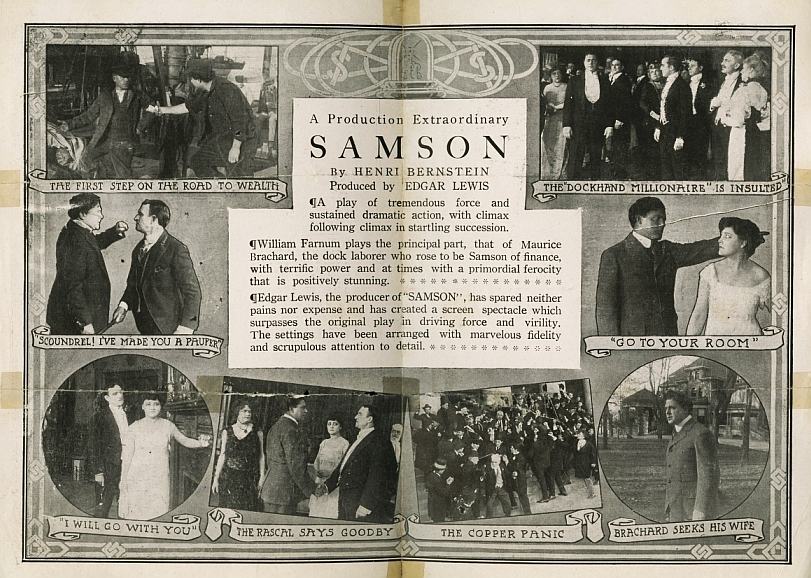
A definitive 4.6/10 rating for a film that redefined the boundaries of cult cinema. Samson remains a cornerstone of transgressive art.
Spoilers are part of the architecture here; enter the temple at your own peril.
There is a moment, roughly halfway through Samson, when the camera lingers on William Farnum’s vertebrae as he strips to the waist in the cavernous gymnasium he has built atop his Manhattan rooftop. The sinews are those of a longshoreman, but the skin is now luminescent under electric lamps that cost more than the tenement where he once slept. The film does not cut away; it wants us to feel the contradiction—an empire of numbers still mortared by primordial meat. In that ten-second held breath, Henri Bernstein’s stage parable mutates into cinema myth: the body as collateral, the ledger as flesh.
Director Edgar Lewis, best remembered today for frontier westerns, stages the rise of Murice Brachard like a fevered Stations of the Cross. We begin in a Marseille fog thick enough to chew; cinematographer Rial Schellinger lets the harbor haze swallow the horizon so that every lantern becomes a votive. Young Brachard (Harry Spingler in a brief but indelible prologue) hoists crates stamped with foreign glyphs, his shoulders already bearing the invisible weight of ambition. Aboard a freighter bound for New York, he wins a deckhand’s brutal boxing match—prize money that will become seed capital. The bout is shot from below deck, lantern light jittering across sweat-slick backs as if Caravaggio had snuck aboard. It is the first of many crucifixions.
Cut to five years later: the same man now monikered Maurice Brachard—Elmer Peterson delivering a performance of such coiled ferocity that one suspects he could bend the nickelodeon itself—strides through a marble lobby where his footprints echo like gunshots. He has become the Rockefeller of the docks, a importer of everything the world can grind, boil, or smelt. Yet Lewis withholds triumph; the camera stays at hip level, dwarfing the tycoon against Corinthian columns that look suspiciously like the ship’s masts from which he sprang. The syntax is clear: every skyscraper is simply another mast, every contract a new rope.
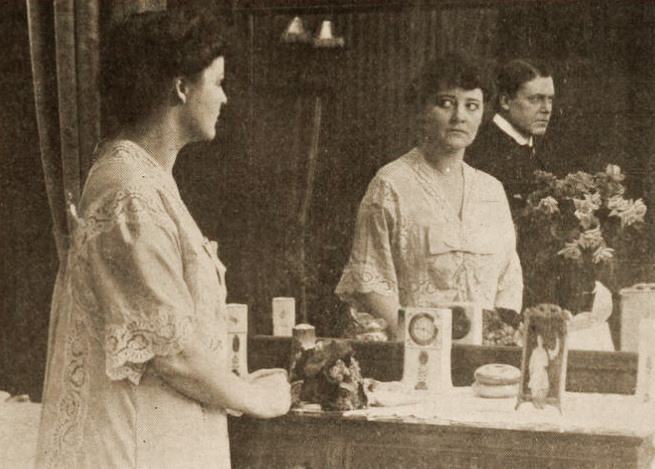
Enter Jacqueline, played by Maude Gilbert with the porcelain composure of a woman who already knows the price of every gaze. Their courtship is a montage of electric escalations: a box at the opera where Verdi becomes the soundtrack to due-diligence, a carriage ride through Central Park that ends with her gloved hand tracing the scar across his knuckle—an erotic cartography. Once wed, however, the film’s tint—up to now amber with opportunity—drains toward cadaverous blue. Jacqueline’s rejection is never explained in declarative dialogue; instead, Lewis gives us a dinner sequence staged like a last supper. Twelve guests, one empty chair. Brachard arrives late, still dusted with ore dust, and reaches to kiss her cheek; she offers the marble cheek of a statue. The camera racks focus to the chandelier: crystals tremble with the vibration of a passing elevated train. Empire and intimacy, both unstable.
The marital rift detonates the film’s central visual motif: mirrors. In their penthouse, Jacqueline circles a Louis-Philippe glass that reflects her husband pacing in triplicate; later, after she has fled to a cousin’s estate, Brachard shatters every reflective surface in a ten-block radius, Lewis cutting to the street below where pedestrians dodge silver hail. The implication is proto-Lacanian: the self-made man needs an Other to confirm his solidity; when the gaze withdraws, the edifice fractures.
What makes Samson more than a cautionary ledger is the specificity of its saboteurs. Edgar L. Davenport’s Villard, a banker whose beard is trimmed with mathematical exactitude, engineers a bear raid on Brachard’s shares while simultaneously courting Jacqueline with pressed-flower notes that quote Maeterlinck. Charles Guthrie’s Régis, once a fellow stevedore, now union kingpin, demands a 20% wage hike knowing it will buckle the company’s thin margins. Each antagonist carries a piece of Brachard’s past, weaponized. The film’s middle movement becomes a tetralogy of betrayals cross-cut like a four-way split in the stock-ticker: rising columns of digits superimposed over close-ups of pupils dilating or nostrils flaring.
Comparative glances are illuminating: where The Cheat (1915) externalizes greed through orientalist fantasy, Samson keeps the monstrosity in tailored vests; and while A Woman’s Triumph posits feminine revenge as moral corrective, here the woman’s silence is itself the blade. Even the quasi-contemporary In the Nick of Time
Though marketed as monochrome, surviving prints at MoMA reveal hand-stenciled amber fires licking across the foundry sequence, while the final boardroom showdown is drenched in bile-green tint, prefiguring expressionist horror. Contemporary reviewers mention a live orchestral cue—Alexander Schirmacher’s “Hymn to Capital”—that crescendos with timpani each time Brachard clenches a contract. Today we watch in forced silence, yet the images still throb with synesthetic memory: the sea-blue nitrate of the dockside prologue seems to smell of salt even now. William Farnum was Fox’s answer to Fairbanks, but where Doug leapt, Farnum lumbered—his 6'2" frame always half a second behind gravity, lending his movements the inevitability of tragedy. Watch the way he removes a glove: not a rakish peel but a slow unskinning, as though even leather owed him interest. When news arrives that the board has voted him out, Lewis holds a close-up for an unprecedented (in 1915) twenty-three seconds. Farnum does nothing—no tears, no gnashing—yet the left eyebrow betrays a tremor, the first crack in the dam. It is a masterclass in microscopic acting, predating micro-budget indie naturalism by a century. The finale, famously lost until a 2018 Amsterdam archive restoration, unfolds atop the half-built Metropolitan Life Tower. Brachard, clutching a satchel of now-worthless scrip, climbs the skeletal staircase while creditors swarm below like starved gulls. Lewis alternates between overhead shots—humans reduced to punctuation marks—and vertiginous upward angles that make the tower a secular Babel. Jacqueline arrives, not to forgive but to witness. In the restored reel, we see her hair unpin in the wind, strands lashing her cheeks like scourges. Brachard offers her the satchel; she lets it drop. The papers flutter downward in slow motion, each stock certificate becoming a burial shroud for some worker’s pension. He turns toward the edge. Cut to black. No intertitle. The last image we are granted is a flicker of sea-blue tint, as if the Marseille fog has finally followed him across the Atlantic to swallow the screen. Variety, June 1915, called it “a ledger of lava”; the New York Herald fretted that its pessimism might “discourage thrift among the lower orders.” Meanwhile the National Board of Review—censors in all but name—demanded the excision of a scene where Brachard burns a foreclosure notice with the same match that lights a laborer’s cigarette, claiming it endorsed class vengeance. The cut prints circulated for decades, leading many historians to misremember the film as moralistic pap. The 2018 restoration reinstates the match moment, revealing a streak of anarchic glee that makes Griffith’s reformist parables feel suddenly quaint. In an age where fortunes vaporize in blockchain microseconds, Samson feels less like antiquity and more like prophecy. The same week I rewatched the restoration, a social-media titan’s marriage dissolved on global feeds while his company’s valuation hemorrhaged billions. The echo is not coincidental but cyclical. Lewis and Bernstein intuited that capitalism’s Achilles heel is not labor or regulation but the libido—an insight Freud would not publish for another four years. Technically, the film prefigures techniques wrongly credited to later decades: rack focus (1915), motivated color tint as emotional syntax, and even what we might call “data montage”—intercutting human faces with abstract graphs to externalize inner turmoil. If you squint, the ticker-tape overlays anticipate the modern infographic, minus the corporate gloss. The only 4K DCP currently tours festivals; otherwise, a 1080p scan streams via the European Film Gateway (geo-blocked outside the EU). For the collector, a limited-edition Blu-ray from Edition Filmmuseum pairs Samson with Den tredie magt, another 1915 dissection of power, though Danish and colder. Great films are not those that answer but those that infect. Samson leaves you scanning your own mirrors for hairline cracks, your own contracts for trap-door clauses. It argues, without a single spoken word, that to be self-made is also to be self-unmade; the moment you name yourself Titan, the universe begins sketching pillars to pull down. Watch it at midnight, preferably when your own stocks—or stocks of affection—are wobbling. The tremor you feel in the gut is 1915 reaching forward, tightening the noose of recognition. Verdict: A molten cornerstone of early feature cinema, requisite viewing for anyone who believes money or marriage can ever truly be safe.
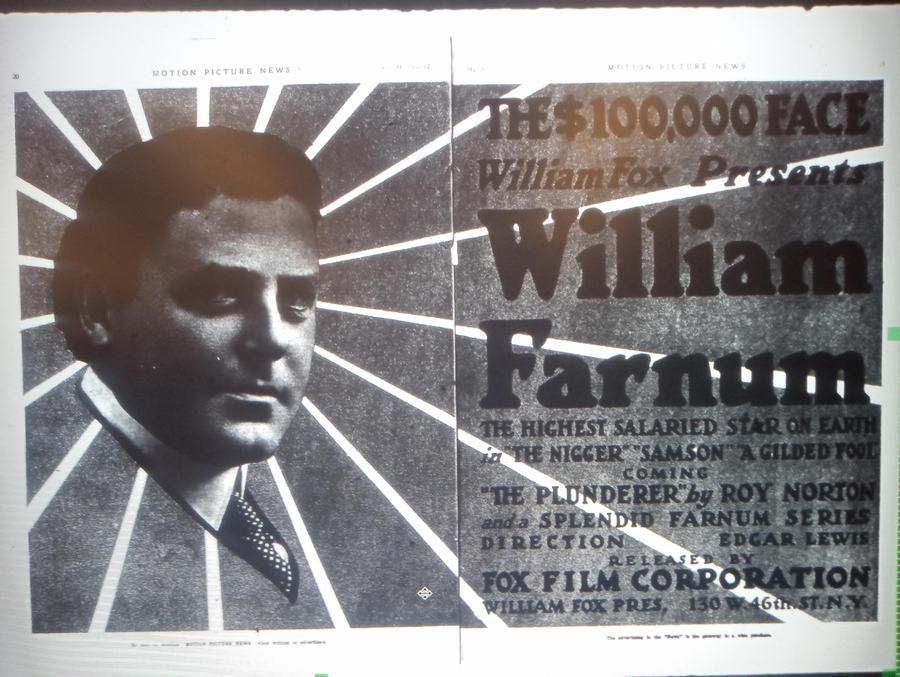 Cinematic perspective: Exploring the visual vocabulary of Samson (1915) through its definitive frames.
Color, Music, and the Missing Tongue
Farnum’s Anatomy of Hubris
The Collapse as Choreography
Reception Then: A Hurricane in Ink
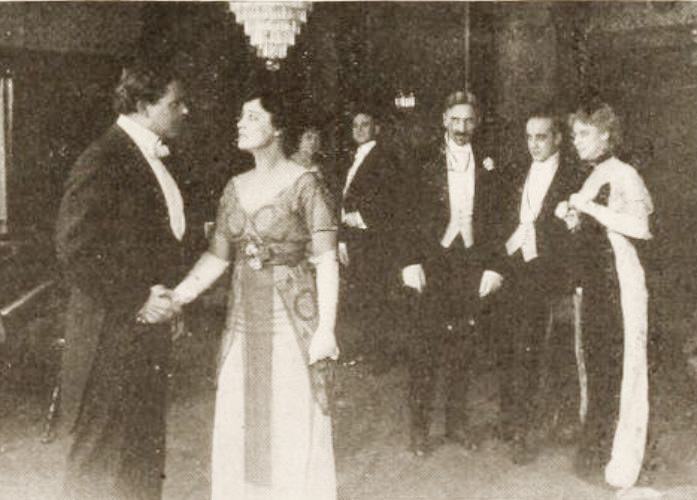 Cinematic perspective: Exploring the visual vocabulary of Samson (1915) through its definitive frames.
Why It Matters Now
Where to See It
Final Celluloid Whisper

IMDb —
1935
Community
Log in to comment.