DbcultAccessing Vault...
5.8/10
Senior Film Conservator
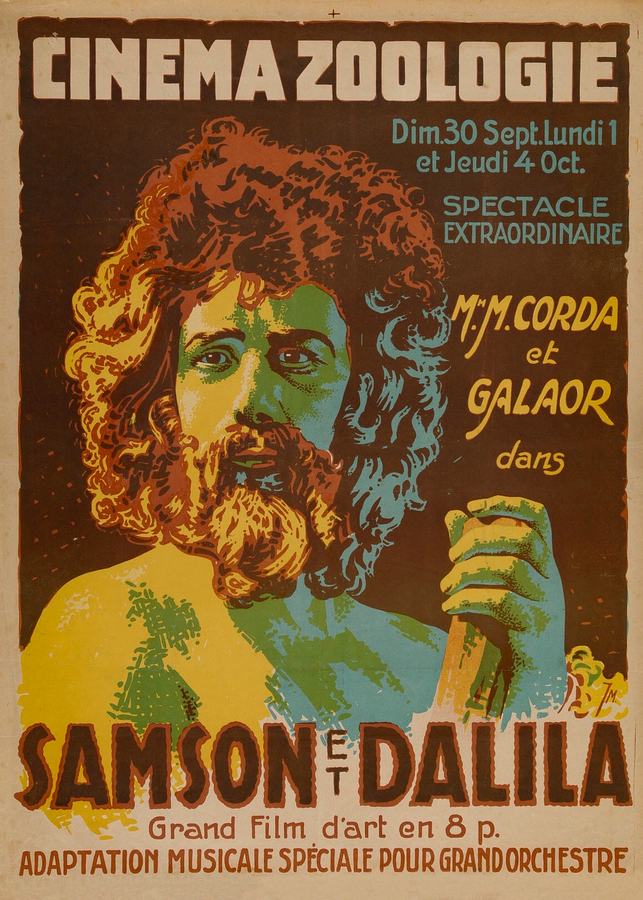
A definitive 5.8/10 rating for a film that redefined the boundaries of cult cinema. Samson und Delila remains a cornerstone of transgressive art.
The moment the curtains parted in Vienna’s Burgkino during the winter of 1922, audiences inhaled a hallucination: a Nazirite strongman whose hair spilled like molten bronze, a seductress whose cigarette embers punctured the gloom, and collapsing marble that felt less like Sunday-school spectacle than like the very psyche of a defeated empire imploding. Alexander Korda’s Samson und Delila is not so much a biblical pageant as it is a brittle fin-de-siècle fever dream wearing scripture like borrowed robes.
Forget the sand-swept California backlots that Cecil B. DeMille would soon trademark; here the Negev is conjured inside a chilled Vienna studio where every papier-mâché boulder exhales expressionist panic. Smoke machines belch ochre clouds until the horizon line dissolves; arc lights bleach the faces of Hebrew extras until they resemble woodcut saints gouged from a cathedral triptych. The camera glides, stutters, then lunges—an impertinent waltz that anticipates both surrealist disorientation and the kinetic swagger of 1930s swashbucklers.
Plotwise, the bones remain familiar: Samson’s uncanny virility, the jawbone massacre, the lion carcass riddled with honey, the final eyeless grind in Gaza’s prison mill. But Korda and screenwriter Ernest Vajda lace every scene with a cocktail of jazz-age cynicism and post-Habsburg malaise. When Delila first appears, she is less oriental temptress than Viennese salon panther, draped in a backless gown that whispers Weimar decadence. Her betrayal feels less motivated by Philistine gold than by sheer ennui—the desire to watch a man unravel simply to confirm her own omnipotence in a world where empires have already crumbled.
As Samson, Franz Hauenstein radiates a carnal sanctity—his eyes flicker between beatific trance and the predatory glower of a dockyard brawler. Watch the sequence where he hoists the city gates: veins engorge like cartographer’s ink across his biceps, yet his face registers shock, as if hearing Yahweh’s voice crack mid-sentence. Opposite him, María Corda (billed in gothic type that dwarfs even the title card) delivers a Delilah who could devour any ingénue for breakfast and still order Sacher torte. She purrs her lines through a half-smile that suggests she has already read Freud and found him naïve.
Supporting players orbit like planets trapped between two suns. Paul Lukas—decades before Hollywood polished his consonants—lends the Saran of Gaza a silk-sheathed menace. His every gesture is a ledger calculation: how much tribute, how many concubines, how to weaponize desire itself. Meanwhile, Ernst Arndt’s high priest of Dagon slinks through incense fumes, clutching an idol that looks suspiciously like a grotesque cartoon—an early wink that paganism, too, traffics in hollow spectacle.
Though filmed in grayscale, the picture secretes chromatic ghosts. Hands were tinted umber during Samson’s first lion brawl; Delila’s veil fluttered through hand-painted crimson reels distributed in rural provinces; the final temple collapse was sepia-washed so that falling rubble resembled clots of dried blood. These fragments survive only in cryptic censorship cards and one corroded vintage print unearthed in a Linz cellar—yet their afterimage stains the surviving footage, persuading your retina to hallucinate hues that were never there.
Cinematographer Franz Planer (future collaborator of Max Ophüls) bends perspective until Gaza becomes a cubist fever: oblique angles tilt city walls into trapezoids, while chiaroscuro trenches carve the protagonist’s face into a topographical map of doubt. Compare this to the rectilinear moral absolutes of The Heart of Lincoln and you realize Korda’s Austria is already negotiating modernity’s vertigo.
The film debuted during the hyper-inflationary twilight of the First Republic; ticket prices quadrupled overnight, yet queues snaked around frost-bitten blocks. Vienna, stripped of its imperial hinterlands, hungered for narratives that mythologized decline. Thus Samson’s blindness mirrors a continent that has gazed too long into its own catastrophic reflection; his grinding at the mill rhymes with reparations that daily crushed the defeated.
Musical accompaniment varied by venue: some house orchestras blasted Wagnerian marches until plaster snowed from baroque ceilings; others opted for Jewish folk motifs that braided exile into the narrative spine. A surviving cue sheet recommends tam-tam strikes synchronized to each lock of hair severed—an aural circumcision that must have rattled ribcages in the auditorium.
Do not mistake Delila’s vamp for mere misogynist figuration; Corda plays her as an anti-patriarchal saboteur who weaponizes the very erotic economy designed to ensnare her. She collects male trophies the way Samson piles Philistine foreskins—an unsettling equivalence that the film neither moralizes nor resolves. Meanwhile, the Philistines’ orientalized regalia—part Bedouin bazaar, part Ringstrasse operetta—exposes Vienna’s colonial nostalgia for a Levant it never ruled.
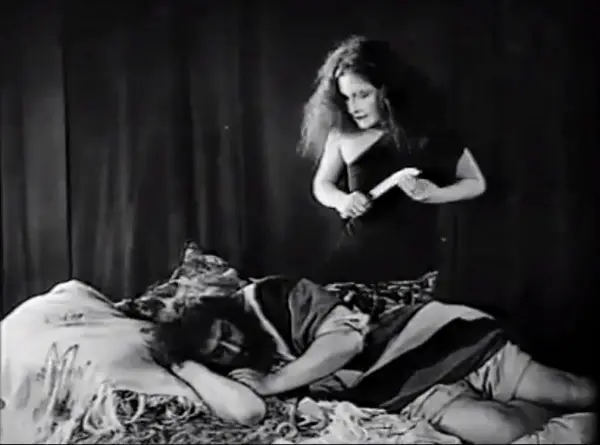
Yet the Hebrews fare little better: sidelocked supplicants wring hands inside candleless ghettos that recall contemporary anxieties about Jewish visibility in post-war Central Europe. Samson’s superhuman strength becomes both pride and peril—the eternal double bind of the diaspora subject who must either assimilate into invisibility or stand accused of subversive potency.
Skip across the ocean and you’ll find Little Lord Fauntleroy peddling bourgeois virtue, or A Sammy in Siberia extracting slapstick from geopolitical chaos. None grapple with the sacred wound as ferociously as Korda. Even DeMille’s 1949 Technicolor rehash feels prudish beside this Austrian bacchanal where the bedroom is a parliament of knives and every prayer sounds like a death rattle.
Within Austria’s domestic output, contrast Shibukawa Bangorô’s intimate kabuki minimalism or Luffar-Petter’s trampish social satire. Samson und Delila alone dares to fuse gigantism with psychoanalytic squalor, forecasting the opulent neuroses of late-silent prestige pictures yet predating their polished sentimentality.
Authorities in Salzburg trimmed 42 meters of “lustful contortions” (read: Delila’s bare shoulder blades). A Bavarian print lost the jawbone massacre, deemed encouragement to proletarian violence. Consequently, no two screenings ran the same length; audiences embarked on a textual Exquisite Corpse. Current restorations splice shards from nine archives, yielding a Frankenstein runtime of 118 minutes—yet even that feels provisional, haunted by phantom frames that evaporate like Samson’s evaporated strength.
Stream this resurrection on 4K and you’ll detect hairline cracks in every prop: papier-mâché pillars flake like old ideological certainties, cardboard temples buckle under the scrutiny of high-definition honesty. The illusion’s brittleness becomes the message—power is always plywood, desire always painted gauze. In an era when influencers monetize their locks and politicians weaponize scripture, Korda’s antique parable feels oddly viral.
Consider Samson the original toxic celebrity—his brand collapses the instant his grooming routine is betrayed. Delila presages the dark PR strategist who trades secrets for clout. Their pas de deux plays out like a scandalous DM leak, only the platform is destiny and the unfollow button costs 3,000 Philistine lives.
Rating: 9/10
Yes, the pacing lurches—intertitles bloated with Teutic theology stall the narrative thrust. Yes, the orientalist caricatures grate even while they critique imperial fantasy. Yet the film’s audacity to wed biblical archetype with Weimar decadence, to sculpt a blockbuster from the traumatized clay of a crumbled empire, grants it wormhole-like magnetism. Every frame vibrates with the gamble of a medium still inventing its own grammar, a continent still counting its amputations.
So seek it out—be it in a rep cinema smelling of varnish and cinephile sweat, or on a pristine Blu-ray where digital scrubbing cannot erase the tremor of history. Let Samson’s demolished temple remind you that every colossus—cinematic, political, personal—rests on pillars that can, and perhaps should, come tumbling down at the tug of a single illicit strand.
—Reviewed by a ghost in the aisles, still dodging falling marble.
IMDb —
1918
Community
Log in to comment.